Whoever Owns the Schema Wins the AI Era
AI agents are learning to shop, book, and act on our behalf. The quiet fight in 2026 is not over which model is smartest, but over who controls the structured data those agents read from.

For the last two years, the AI story has been a horse race between models. Whose chatbot is smarter, whose benchmark is higher, whose demo is flashier. But look at what actually shipped in June 2026 and a different, quieter contest comes into focus. The real prize is not the model. It is the schema: the clean, structured data an AI agent reads before it acts, and the control surface it acts through.
Two announcements make this concrete. Both are worth understanding even if you never write a line of code, because they hint at how buying, booking, and browsing are about to change.
Shopify built the supply side of agentic commerce
On June 17, Shopify shipped its Spring '26 Edition, a release with more than 150 updates. Three of them matter more than the rest, and they all point the same direction.
- The Universal Commerce Protocol (UCP), an open standard for how AI agents transact with merchants. Shopify co-developed it with Google, and it is backed by a who's-who list: Amazon, Meta, Microsoft, Salesforce, Stripe, Etsy, Target, and Wayfair.
- The Catalog API, which turns Shopify's global product catalog into structured, queryable data an agent can actually read instead of guessing at.
- Public MCP servers, and here is the kicker: the old approval requirement is gone. Building on the agent layer is now self-serve for any developer.
Think of it like the difference between a librarian and a treasure hunter. Today, when an AI shopping assistant wants to know about a product, it often scrapes a web page, the digital equivalent of squinting at a photo of a shelf and trying to read the labels. Catalog hands the agent a clean index card instead: title, attributes, variants, price, all in machine-readable form.
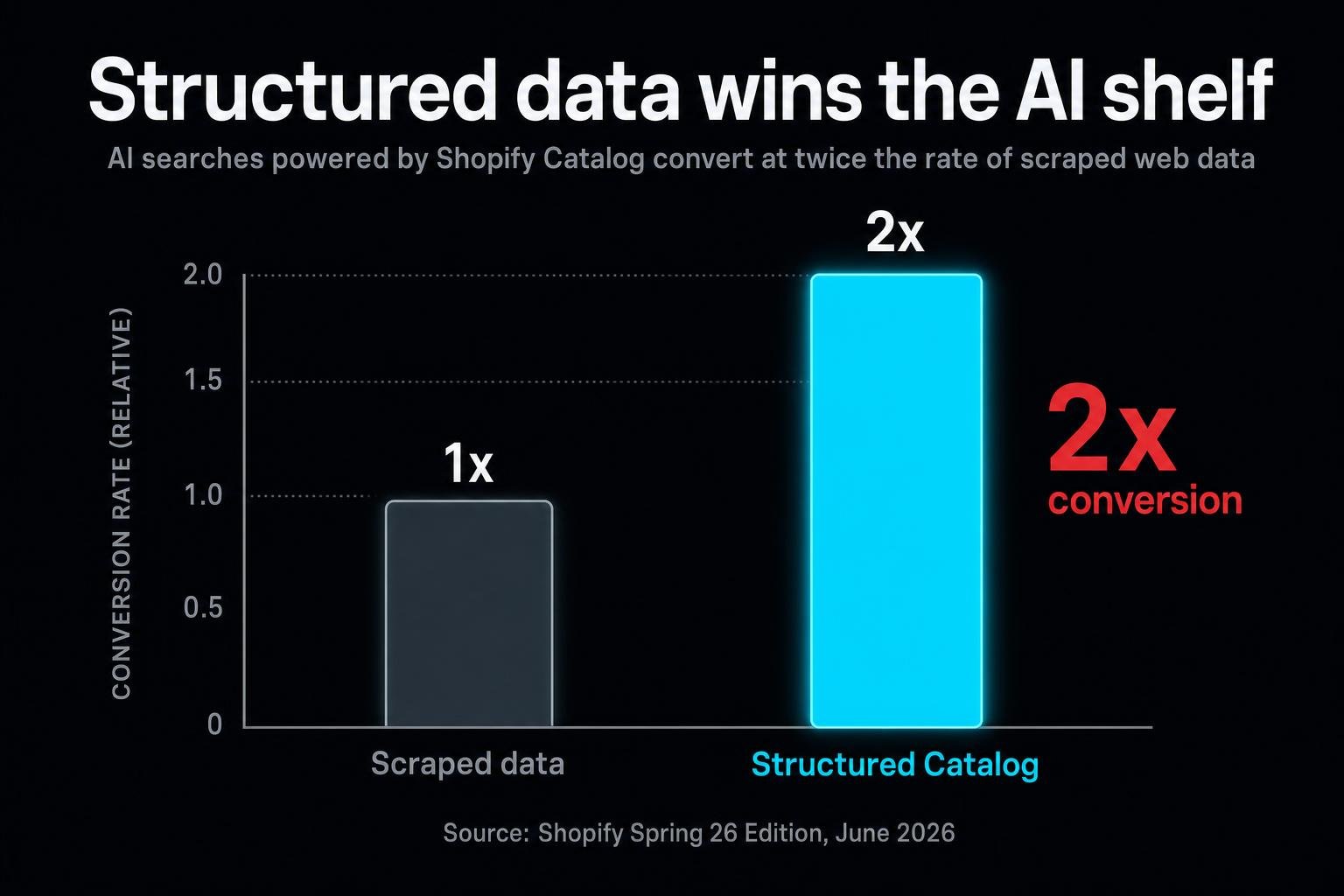
Shopify says the difference is not cosmetic. AI searches powered by structured Catalog data convert at twice the rate of searches built on scraped data. That single number is the whole argument. When an agent understands a product clearly, people buy. When it has to guess, they do not.
The moat used to be "approved access." Now that access is self-serve, the moat is data quality and structure. Clean your schema or get skipped.
MCP stopped being a plumbing detail and became a place
The second shift is about the pipe all of this flows through. The Model Context Protocol, or MCP, started life as a boring but important standard: a common way for AI assistants to call external tools. In 2026 it grew up fast.
The numbers tell the story. MCP now reports roughly 97 million monthly SDK downloads, governance under the Linux Foundation, more than 10,000 servers indexed, and native support inside Claude, ChatGPT, Gemini, Copilot, and Cursor. When a protocol lands in every major assistant and moves under neutral, foundation-level governance, it has stopped being one company's idea and become infrastructure.
But the more interesting change is what MCP can now do. A new extension called MCP Apps pulls interactive UI directly into the chat window. Instead of an assistant answering your question and then telling you to go click a link somewhere else, it can render the thing itself: a preview from Figma, an element from Slack, a booking card, an approval button. Claude now ships a directory of more than 75 official connectors on top of this.
The analogy here is the browser. For years, apps lived behind their own front doors and you traveled to each one. MCP Apps is the assistant becoming a place where those apps come to you and render in line. The chat is no longer a messenger that hands you off. It is starting to be the storefront, the calendar, and the checkout counter all at once.
Why this matters if you sell, build, or just buy things
Put the two together and the pattern is obvious. On the demand side, agents are learning to shop and act. On the supply side, standards like UCP and Catalog are defining how businesses expose themselves to those agents. And MCP is becoming the surface where the whole interaction happens.
For anyone with something to sell, the lesson is uncomfortable but clear. Being findable by humans on a search results page is no longer the finish line. Being legible to machines, with structured, accurate, well-labeled data, is the new baseline. The 2x conversion gap is not a rounding error you can ignore. It is the difference between being recommended by an AI agent and being invisible to it.
For everyone else, this is a preview of how ordinary tasks will feel. Fewer tabs, fewer hand-offs, more "just ask and confirm." The winners in that world will not necessarily be the flashiest models. They will be whoever controls the schema the agents trust.
The takeaway
The AI standards war moved up a layer this year. It is no longer only about who trains the best model. It is about who owns the structured catalog agents read from, the protocol they transact over, and the surface they render on. That is a less glamorous fight than the model benchmarks, and a far more important one.
FAQ
What is agentic commerce? It is buying and selling where an AI agent, not a human clicking around a website, discovers products and completes transactions on a person's behalf.
What is UCP? The Universal Commerce Protocol, an open standard co-developed by Shopify and Google for how AI agents transact with merchants, backed by Amazon, Meta, Microsoft, Salesforce, Stripe, Etsy, Target, and Wayfair.
One signal a day. No noise.
A 3-minute read when something genuinely shifts in AI, automation, or defense tech. Free, most weekdays.
Free, most weekdays. No spam, unsubscribe anytime.Sources
- Shopify - Spring '26 Edition (Developer news) - https://www.shopify.com/news/spring-26-edition-dev
- Windows Forum - Shopify Spring '26 and agentic commerce infrastructure - https://windowsforum.com/threads/shopify-spring-26-shop-pay-for-non-shopify-stores-and-agentic-commerce-infrastructure.427832/
- Let's Data Science - Shopify launches Spring 2026 agentic commerce features - https://letsdatascience.com/news/shopify-launches-spring-2026-agentic-commerce-features-069c5b74
- The New Stack - Model Context Protocol roadmap 2026 - https://thenewstack.io/model-context-protocol-roadmap-2026/
- ChatForest - MCP ecosystem 2026: state of the standard - https://chatforest.com/guides/mcp-ecosystem-2026-state-of-the-standard/
- Model Context Protocol - 2026 MCP roadmap - https://blog.modelcontextprotocol.io/posts/2026-mcp-roadmap/
Quick answers
What is agentic commerce?
Buying and selling where an AI agent, rather than a human clicking through a website, discovers products and completes purchases on a person's behalf.
What is the Universal Commerce Protocol (UCP)?
An open standard co-developed by Shopify and Google for how AI agents transact with merchants, backed by Amazon, Meta, Microsoft, Salesforce, Stripe, Etsy, Target, and Wayfair.
How much better is structured data for AI search?
Shopify reports that AI searches powered by its structured Catalog data convert at twice the rate of searches built on scraped web data.
What is MCP and why does it matter?
The Model Context Protocol is an open standard, now governed by the Linux Foundation, for how AI assistants connect to tools and data. It reports about 97 million monthly SDK downloads and native support in Claude, ChatGPT, Gemini, Copilot, and Cursor.