Your Next Customer Starts in ChatGPT
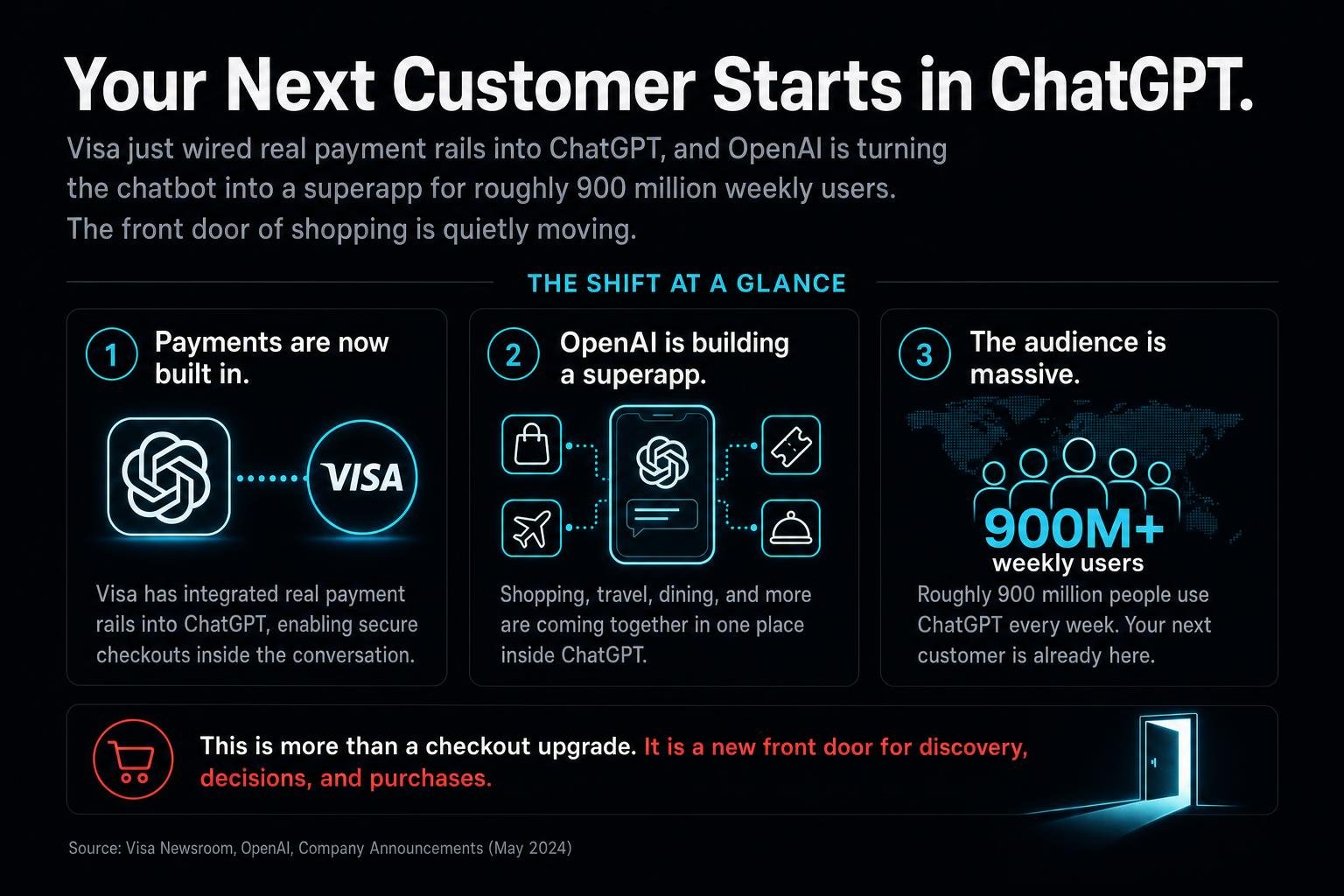
Visa just wired real payment rails into ChatGPT, and OpenAI is turning the chatbot into a superapp for roughly 900 million weekly users. The front door of shopping is quietly moving.

For the last twenty years, buying something online had a familiar shape. You searched on Google, you saw an ad on Meta, you clicked through to a store, and somewhere along the way you handed over a card number. Two moves this month quietly rearranged that whole sequence, and most people have not noticed yet.
First, on June 10, Visa embedded its payment network directly inside ChatGPT. You link a card, set spending limits, and the assistant can shop and check out on your behalf. For now every purchase still needs your approval, but the plumbing is real money over real rails, not a demo. Second, OpenAI is rebuilding ChatGPT into a "superapp", where third-party services like Booking.com and Canva run inside the chat itself, reaching roughly 900 million weekly users.
Put those together and the picture is hard to miss. The place where a buying decision starts is sliding away from the search bar and the social feed, and toward a conversation.
The shopping mall that talks back
Think of the old web as a giant shopping mall. Google was the directory map by the entrance. Meta was the loud window display that pulled you in. You still had to walk to each individual store to actually buy anything.
The superapp version is more like a personal concierge who already knows the mall. You describe what you want, the concierge walks the floor for you, and the shops set up little booths right next to where you are standing. You never wander the corridors. That concierge runs on something called MCP servers, a shared standard that lets outside apps plug into the chat and offer their actions on the spot.
The agent is becoming the new top of the funnel. The store is still where the sale closes, but the conversation is where the journey now begins.
OpenAI tried to own checkout, then backed off
Here is the part I find genuinely instructive, because it is a story about a giant getting humble. OpenAI originally built its own "Instant Checkout," an attempt to own the entire transaction end to end. In March 2026 it retired that feature. The reasons were unglamorous and honest: it was error-prone, it carried a roughly 4% fee, and not enough merchants adopted it.
So OpenAI pivoted. Now products surface inside the chat, but the buyer completes the purchase on the merchant's own storefront, opened in an in-app browser. The assistant is the introduction. The store still closes the deal.
That retreat matters more than the launches, because it tells you where the real estate is. If the most powerful AI company on earth could not convince merchants to hand over checkout, then the storefront is not going away. It is still where trust, speed, and the final "yes" live.
Why this is bigger than a feature update
Two structural shifts are worth holding onto.
- Discovery is leaving the ad auction. For decades, getting found meant paying to rank or paying to interrupt. A conversational front door does not run on the same auction logic. That is a genuinely new surface for being discovered, and it does not behave like Google or Meta.
- Checkout is now contested ground. Visa is in the chat. Stripe is in the mix. The fight over who carries the payment is just beginning, and whoever wins shapes the fees and friction for everyone downstream.
The honest caveat: today this is opt-in, supervised, one purchase at a time. The assistant is a very capable shopping buddy, not an unsupervised spender. The real inflection comes if per-purchase approval ever shifts to standing limits, where the agent can buy within a budget without checking in each time. That would turn a helpful concierge into an actual autonomous buyer. We are not there. But the rails are now laid for it, and rails tend to get used.
What it means if you sell anything
If you run a store, the takeaway is not panic, it is preparation. The moment of discovery is moving into a chat window you do not control, while the moment of purchase stays on a storefront you do. Both ends matter. A fast, trustworthy, low-friction store is not a relic of the old web, it is the thing the new front door hands customers off to.
And if you are simply a person who buys things, the change is subtler and more personal. The choice of what to consider is increasingly being shaped by a model's suggestions before you ever see a list. That is convenient. It is also worth staying awake to, because the concierge who walks the mall for you also decides which booths you walk past.
The front door of commerce does not move often. It moved this month. Worth watching where it opens next.
One signal a day. No noise.
A 3-minute read when something genuinely shifts in AI, automation, or defense tech. Free, most weekdays.
Free, most weekdays. No spam, unsubscribe anytime.Sources
- Axios - Visa embeds payments in ChatGPT agents - https://www.axios.com/2026/06/10/visa-chatgpt-agents-commerce
- TechTimes - OpenAI's ChatGPT superapp bid for agentic commerce - https://www.techtimes.com/articles/318025/20260608/openais-chatgpt-superapp-bid-own-agentic-commerce-apps-run-mcp-checkout-stripe.htm
- Modern Retail - Purchases coming inside ChatGPT as OpenAI retreats on Instant Checkout - https://www.modernretail.co/technology/shopify-says-purchases-are-coming-inside-chatgpt-through-agentic-storefronts-as-openai-retreats-on-instant-checkout/
Quick answers
Can ChatGPT actually buy things for me now?
Partly. As of June 10, 2026, Visa's payment network is embedded in ChatGPT, so you can link a card, set limits, and let the assistant shop and check out. For now each purchase still requires your approval.
What is the ChatGPT superapp?
OpenAI is rebuilding ChatGPT so third-party apps like Booking.com and Canva run inside the chat via MCP servers, reaching roughly 900 million weekly users. The chat becomes a hub for services, not just answers.
Why did OpenAI retire Instant Checkout?
OpenAI shut down its own Instant Checkout in March 2026 because it was error-prone, carried about a 4% fee, and saw low merchant adoption. Buyers now complete purchases on the merchant's own storefront instead.
Does my online store still matter if shopping moves into chat?
Yes. The conversation becomes the new top of the funnel, but the actual purchase still happens on the merchant's storefront, so speed, trust, and low friction at checkout remain essential.