The Assistant Moved Into the Storefront
Google just wired its Gemini app directly into small-business profiles, and ad creation became a tool any AI agent can call. The quiet story underneath: a $200B market for the wiring nobody talks about.

For the last two years, AI assistants lived in a chat box. You typed a question, they typed an answer, and then you went back to your actual tools to do the actual work. This week, the wall between those two worlds started coming down. The assistant stopped being a place you visit and became a thing that reaches into your business and touches the controls.
Three developments landed close together, and they tell one story.
Gemini now runs the front counter
Google launched a set of Gemini app features aimed at small businesses, anchored by a one-tap connection to a Google Business Profile. Once connected, Gemini can read a business's customer reviews, questions, search impressions, call activity, direction requests, and engagement metrics. It can also act: drafting replies to reviews, creating posts, summarizing customer feedback, and pulling performance metrics and the search keywords people used to find you.
It ships with something called Business notebooks, persistent workspaces that hold your chats, your website, and your profile data so the assistant keeps context about your specific business across conversations. In plain terms, the assistant remembers who you are between visits.
Think of your Google Business Profile as the front window of a shop, the thing the whole neighborhood sees before they walk in. Until now, keeping that window clean was manual work: someone logged in, read the reviews, wrote the replies, updated the hours. Google just handed the shop owner an assistant who stands at that window and does the routine part on request.
One detail matters for timing. The features are rolling out globally this month, but not yet in the EEA or UK. Europe is on a different clock, which is becoming a familiar pattern for how these launches stagger across regulatory borders.
Making the ad became a phone call to a robot
The same week, Omneky launched a public API and an MCP server, exposing its autonomous ad-creative engine to any developer, commerce platform, or AI agent. If you are not steeped in the jargon, MCP (the Model Context Protocol) is basically a universal wall socket that lets AI assistants plug into outside tools. An agent that speaks it, Claude included, can be told "make launch ads for our new product page" and receive finished creative in multiple formats back.
The specific company matters less than the shape. An entire marketing capability, making the ad, became a single callable tool. And this is not happening in isolation. There are now more than 10,000 published MCP servers, with native support built into ChatGPT, Gemini, Copilot, and Cursor. The plumbing is standardizing fast.
The pattern to notice is not any one product. It is that whole business capabilities are turning into tools an AI agent can call, the way your phone calls a number without you knowing how the network routes it.
The $200B nobody is selling
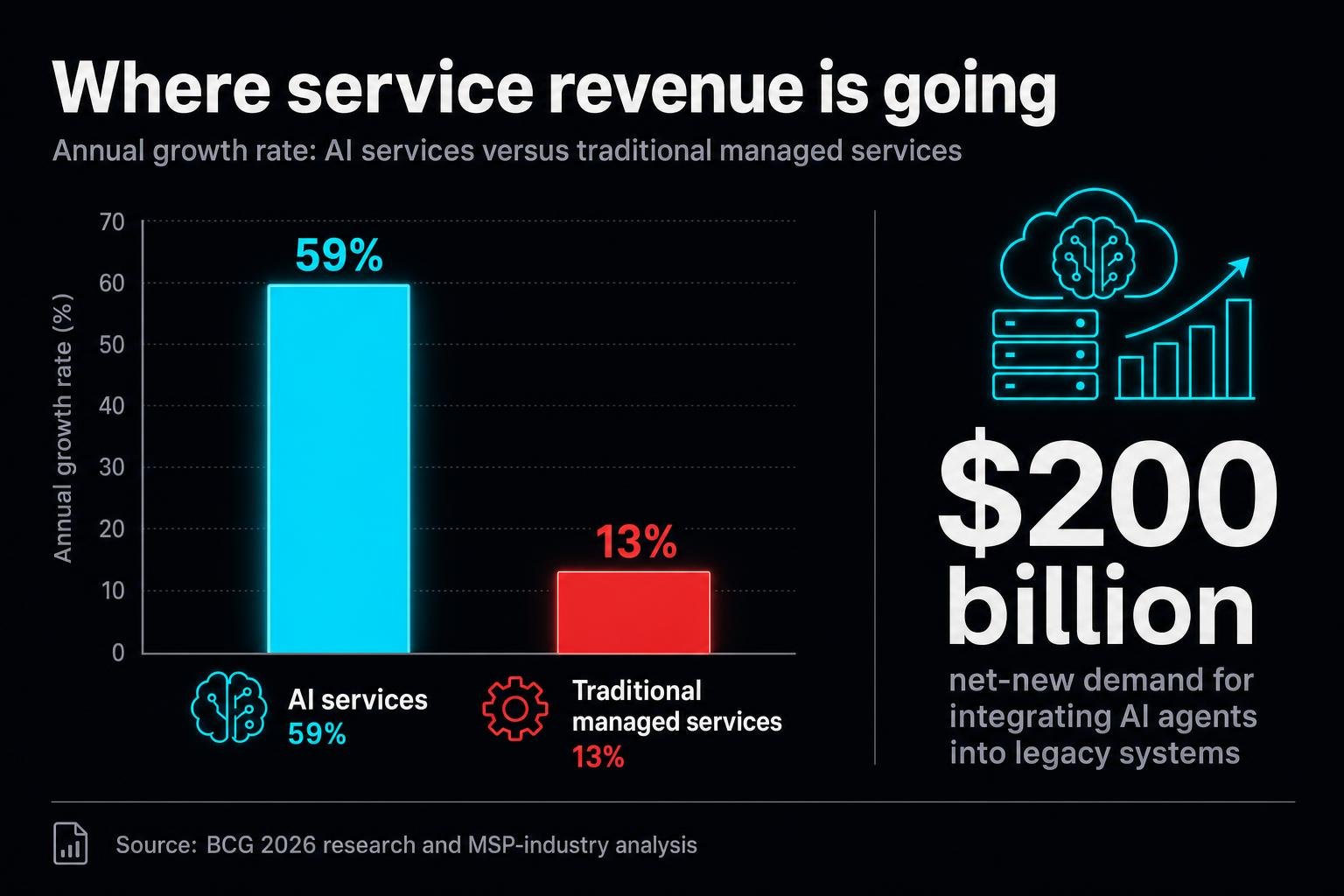
Here is where it gets interesting, and where the money actually is. Boston Consulting Group's 2026 research puts a number on a gap almost nobody names: roughly $200 billion in net-new demand for services that integrate AI agents into the legacy systems businesses already run, the ERP, CRM, financial, HR, and SaaS tools that keep the lights on.
The point BCG makes is sharp. Companies like OpenAI, Anthropic, and Google sell the agent's raw capability. None of them show up to do the unglamorous work of connecting that capability to the messy systems a real business depends on. The model is the engine. Somebody still has to build the car around it.
A parallel read of the managed-services industry sharpens the picture further. AI services inside managed services are growing at 59% a year, against 13% for traditional managed services. That spread is the cleanest single piece of evidence that service revenue is migrating toward integration work. Analysts covering vertical AI add scale to it: they expect 30 to 40% of the roughly $450 billion vertical software market to be reshaped between 2026 and 2028.
Why it matters if you are not a developer
Put the three together and the direction is obvious. The capability, drafting the review reply, generating the ad, reading the metrics, is becoming cheap and available to everyone. What stays scarce, and what BCG just priced at $200 billion, is the wiring: getting these assistants to work safely inside the specific, regulated, half-broken systems a real business runs on.
That is the useful lesson for anyone watching this space. The flashy demo, the assistant that writes your post, is the commodity now. The durable value is one layer up: judgment about what should be automated, guardrails for where an assistant should not act on its own, and the integration that connects a smart tool to the boring system of record. Gemini can edit your business hours. It cannot yet be trusted to run the systems those hours feed into.
FAQ
- What did Google actually launch? Gemini app features for small businesses, led by a one-tap Google Business Profile connection that lets the assistant read reviews, questions, and performance data, and draft replies, posts, and summaries. Persistent Business notebooks keep context across chats.
- Is it available everywhere? It is rolling out globally this month, but not yet in the EEA or the UK.
- What is MCP and why does it matter? The Model Context Protocol is a standard that lets AI assistants plug into outside tools. With 10,000+ servers and native support in ChatGPT, Gemini, Copilot, and Cursor, capabilities like ad creation are becoming callable tools inside agent workflows.
- Where is the money in all this? BCG identifies about $200B in demand for integrating AI agents into legacy systems, work the model vendors do not do. AI services are growing 59% a year versus 13% for traditional managed services.
One signal a day. No noise.
A 3-minute read when something genuinely shifts in AI, automation, or defense tech. Free, most weekdays.
Free, most weekdays. No spam, unsubscribe anytime.Sources
- Google - Gemini features for businesses - https://blog.google/innovation-and-ai/products/gemini-app/gemini-features-for-businesses/
- 9to5Google - Gemini and Google Business Profile - https://9to5google.com/2026/06/10/gemini-google-business-profile/
- Search Engine Journal - Business Profile tools in the Gemini app - https://www.searchenginejournal.com/google-is-adding-business-profile-tools-to-the-gemini-app/578824/
- PYMNTS - Google debuts Gemini features for small businesses - https://www.pymnts.com/google/2026/google-debuts-gemini-features-geared-to-small-businesses/
- PR Newswire - Omneky launches public API and MCP server - https://www.prnewswire.com/news-releases/omneky-launches-public-api-and-mcp-server-bringing-autonomous-ad-creative-generation-to-any-platform-or-ai-agent-302822766.html
- WorkOS - Everything your team needs to know about MCP in 2026 - https://workos.com/blog/everything-your-team-needs-to-know-about-mcp-in-2026
- Swift Headway - The $200B agentic AI services gap (BCG) - https://swiftheadway.ai/blog/200-billion-agentic-ai-services-gap-bcg
- DeskDay - The AI gap for SMBs: the next MSP opportunity - https://deskday.com/the-ai-gap-for-smbs-the-next-msp-opportunity/
Quick answers
What did Google actually launch?
Gemini app features for small businesses, led by a one-tap Google Business Profile connection that lets the assistant read reviews, questions, and performance data, and draft replies, posts, and summaries. Persistent Business notebooks keep context across chats.
Is it available everywhere?
It is rolling out globally this month, but not yet in the EEA or the UK.
What is MCP and why does it matter?
The Model Context Protocol is a standard that lets AI assistants plug into outside tools. With more than 10,000 published servers and native support in ChatGPT, Gemini, Copilot, and Cursor, capabilities like ad creation are becoming callable tools inside agent workflows.
Where is the money in all this?
BCG identifies about $200B in demand for integrating AI agents into legacy systems, work the model vendors do not do. AI services are growing 59% a year versus 13% for traditional managed services.