Claude Sonnet 5 and the Tokenizer Catch
Anthropic's new mid-tier model runs agents that used to need the big guns, at a headline price of $2 in and $10 out. The fine print: a new tokenizer can turn the same English text into up to 42% more billable tokens.

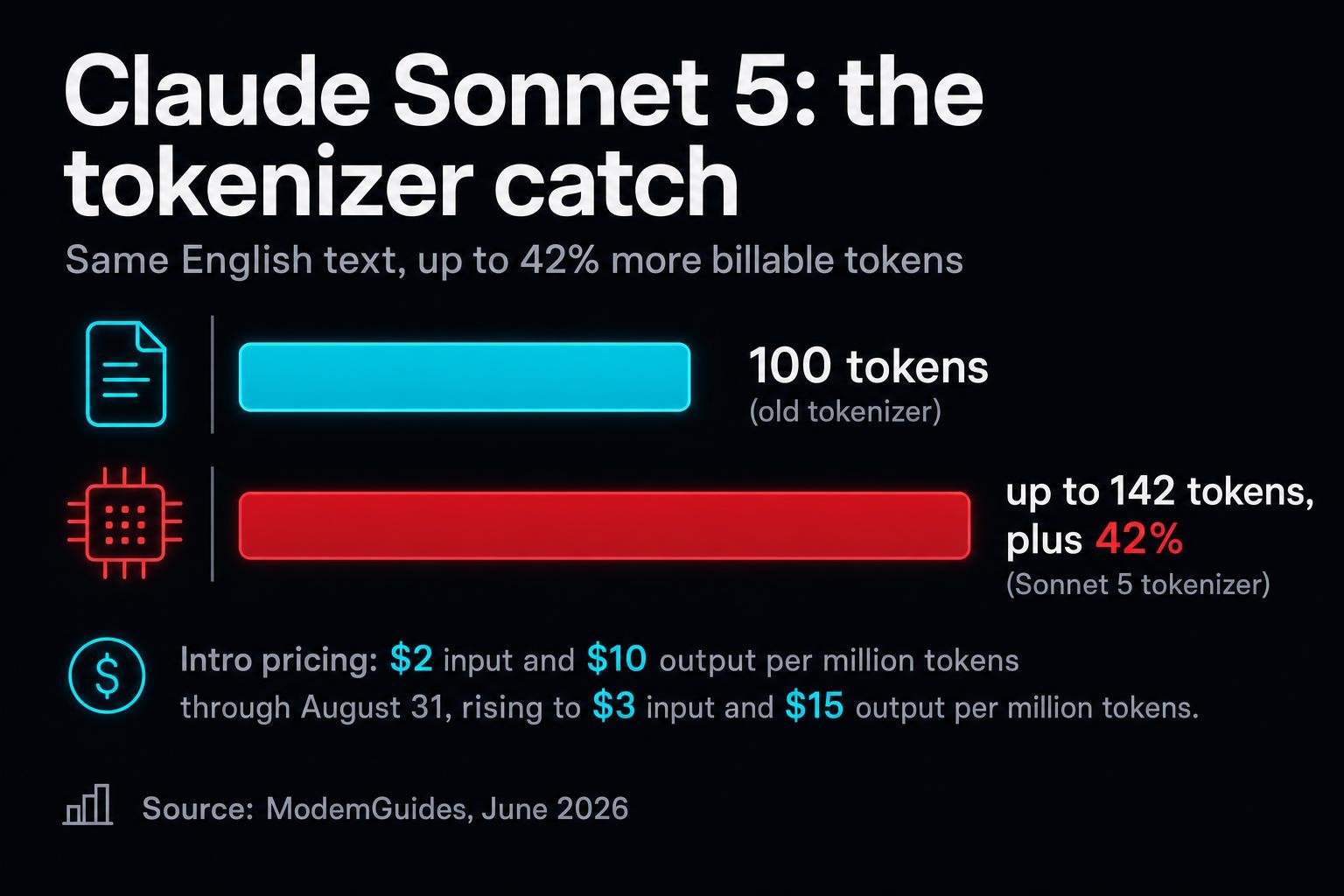
On June 30, Anthropic shipped Claude Sonnet 5, and the pitch is simple: this is a mid-size model that can do the work that recently required the expensive, top-tier ones. It plans, it drives a browser and a terminal, and it runs on its own long enough to be genuinely useful. Anthropic made it the new default on Free and Pro plans, gave it a 1 million token context window with 128K output, and set intro pricing at $2 per million input tokens and $10 per million output tokens through August 31 (rising to $3/$15 after that).
On benchmarks it lands just under Anthropic's flagship Opus 4.8, and in a couple of places it actually wins. On Terminal-Bench 2.1, a test of getting real work done in a command line, Sonnet 5 scores 80.4 versus Opus 4.8's 74.6. So you have a cheaper model beating the flagship at exactly the kind of hands-on, do-the-task work that agents are built for. That is a big deal, and it is the headline everyone read.
But there is a catch buried in the specs, and it is the kind of thing that quietly changes your bill.
The pitch: agent-grade work at mid-tier prices
Think of AI models like rental cars. For a while, if you wanted the car that could actually handle a long, complicated road trip without you babysitting it, you had to rent the luxury model at the luxury rate. Sonnet 5 is the mid-size sedan that suddenly handles the same trip. Same destination, a fraction of the sticker price. For anyone building software that runs on autopilot, that is the whole game, because these systems make thousands of calls and the per-call cost compounds fast.
And the floor keeps dropping underneath it. In the same window, an open model called Unisound U2 posted a 72.2% score on SWE-bench Verified (a test of fixing real software bugs) at just $0.15 in and $0.30 out. So the market now has a cheap, stable, agent-capable middle tier, with even cheaper options nipping at its heels for bulk work. The economics of building with AI genuinely got better this month.
The catch: the ruler changed length
Here is the part that does not fit in a headline. AI models do not charge by the word. They charge by the token, which is a chunk of text roughly the size of a syllable or a short word. A tokenizer is the tool that chops your text into those chunks, and Sonnet 5 ships with a new one.
According to early analysis, that new tokenizer produces up to about 42% more tokens for the same English text. So the price per token can stay flat while the number of tokens you are billed for goes up. It is like a store keeping the price per liter the same but quietly switching to a smaller liter. The label says the same number. Your receipt does not.
If you priced your project by counting words, your cost math is now wrong by as much as 42%, and nothing on the price page will warn you.
Why "same price" can be a raise
This matters because of how most people estimate AI costs. You look at your text, guess roughly how many words go in and out, and multiply by the advertised rate. That shortcut used to be close enough. With a tokenizer that inflates the count, the shortcut now systematically underestimates the bill, and it does it invisibly, because you never see the tokens, only the finished text.
The honest way to read Sonnet 5's launch is two truths at once. First, the capability-per-dollar really did jump, especially for autonomous, tool-using work. Second, the true price is only visible on a metered token bill, not in a word count, and that gap can run up to 42%. Both things are real. A launch can be a genuine bargain and still cost more than the sticker implies, depending on how you measure.
What this means if you build with AI
The takeaway is not "Sonnet 5 is a trap." It is a strong model at a real discount during the intro window. The takeaway is a discipline: measure cost in actual metered tokens, not in words or characters, and re-run those numbers whenever a model changes its tokenizer. Two dates are worth circling. The intro pricing holds through August 31, then steps up to $3/$15 on September 1. If your project's margins depend on model cost, that is the moment to re-check whether the math still works.
More broadly, this is a small lesson in reading AI announcements like an adult. The benchmark numbers and the headline prices are real, and they are also marketing. The interesting information is usually in the footnote about how something is measured. This time the footnote was a tokenizer.
FAQ
- When did Claude Sonnet 5 launch and what does it cost? It launched June 30, 2026. Intro pricing is $2 per million input tokens and $10 per million output tokens through August 31, then $3/$15 after.
- What is the tokenizer catch? Sonnet 5 uses a new tokenizer that early analysis says can produce up to about 42% more tokens for the same English text, so "same price per token" can mean a higher effective bill.
- Is Sonnet 5 better than Opus 4.8? It scores just under Opus 4.8 overall but beats it on Terminal-Bench 2.1 (80.4 vs 74.6), which measures getting real work done in a command line.
- What is a token? A token is a small chunk of text, roughly a syllable or short word, that AI models use to bill and process language instead of counting whole words.
One signal a day. No noise.
A 3-minute read when something genuinely shifts in AI, automation, or defense tech. Free, most weekdays.
Free, most weekdays. No spam, unsubscribe anytime.Sources
- TechCrunch - Anthropic launches Claude Sonnet 5 as a cheaper way to run agents - https://techcrunch.com/2026/06/30/anthropic-launches-claude-sonnet-5-as-a-cheaper-way-to-run-agents/
- Anthropic - Claude Sonnet 5 - https://www.anthropic.com/news/claude-sonnet-5
- Codersera - Claude Sonnet 5 launch guide 2026 - https://codersera.com/blog/claude-sonnet-5-launch-guide-2026/
- ModemGuides - Claude Sonnet 5 price, benchmarks, specs - https://www.modemguides.com/blogs/ai-news/claude-sonnet-5-price-benchmarks-specs
- llm-stats - LLM updates - https://llm-stats.com/llm-updates
Quick answers
When did Claude Sonnet 5 launch and what does it cost?
It launched June 30, 2026. Intro pricing is $2 per million input tokens and $10 per million output tokens through August 31, then rises to $3/$15.
What is the tokenizer catch?
Sonnet 5 uses a new tokenizer that early analysis says can produce up to about 42% more tokens for the same English text, so a flat price per token can still mean a higher effective bill.
Is Sonnet 5 better than Opus 4.8?
It scores just under Opus 4.8 overall but beats it on Terminal-Bench 2.1 (80.4 vs 74.6), a test of getting real work done in a command line.
What is a token?
A token is a small chunk of text, roughly a syllable or short word, that AI models use to bill and process language instead of counting whole words.