The AI Frontier Now Runs Through Washington
In one 72-hour stretch, the US moved to formalize how frontier AI models get released, OpenAI floated handing the government a 5% stake, and Anthropic quietly took the revenue lead. The rules of the industry just shifted under everyone's feet.
For most of the last three years, shipping a new AI model looked a lot like shipping any other software: the lab finished training, ran its evaluations, and pushed the thing out on a Tuesday. That era appears to be ending. In a single 72-hour window, three linked events made it clear that the AI frontier is no longer a purely private product decision. It is becoming a public one, negotiated in rooms in Washington.
Here is the short version. First, the US government entered advanced talks with OpenAI, Google, and Anthropic on voluntary standards for releasing new models, with an announcement possible as soon as next week. This follows a June executive order directing agencies to test advanced models before release. Second, OpenAI reportedly proposed giving the US government a 5% equity stake in the company, an idea Sam Altman pitched using the Alaska Permanent Fund as a model, and one that reportedly calls for other US AI giants to do the same. Third, the Commerce Department lifted export controls on Anthropic's Fable and Mythos models less than three weeks after ordering their suspension, with Fable 5 returning globally on July 1.
Why this feels different
Imagine a software company that has always released whenever it wanted, and then one morning discovers it needs something like FDA approval before a launch. That is roughly the shift happening here. The ad-hoc interventions of the past month, a model suspended, a preview gated, a control lifted, are converging into a standing regime. Release timing starts to look less like a product decision and more like a policy output.
The analogy is imperfect but useful. Drug approvals exist because the thing being shipped can hurt people, and the state claims an interest in that. The move to pre-release testing of frontier models rests on a similar logic: these systems are now considered strategically important enough that the government wants a checkpoint before they reach the world. Whether that is wise or worrying probably depends on where you sit, but the direction is hard to miss.
When release timing becomes a policy output instead of a product decision, the entire cadence of the AI industry changes shape.
The stranger part: offering equity to the referee
The 5% stake proposal is the detail that makes people do a double take. A company that wants favorable treatment from a regulator offering that regulator an ownership slice is, at minimum, an unusual arrangement. It blurs the line between the party being overseen and the party doing the oversight.
To understand why a leading lab would even float this, it helps to look at the money, because the competitive picture is not what a casual observer might assume.
The revenue crown quietly changed hands
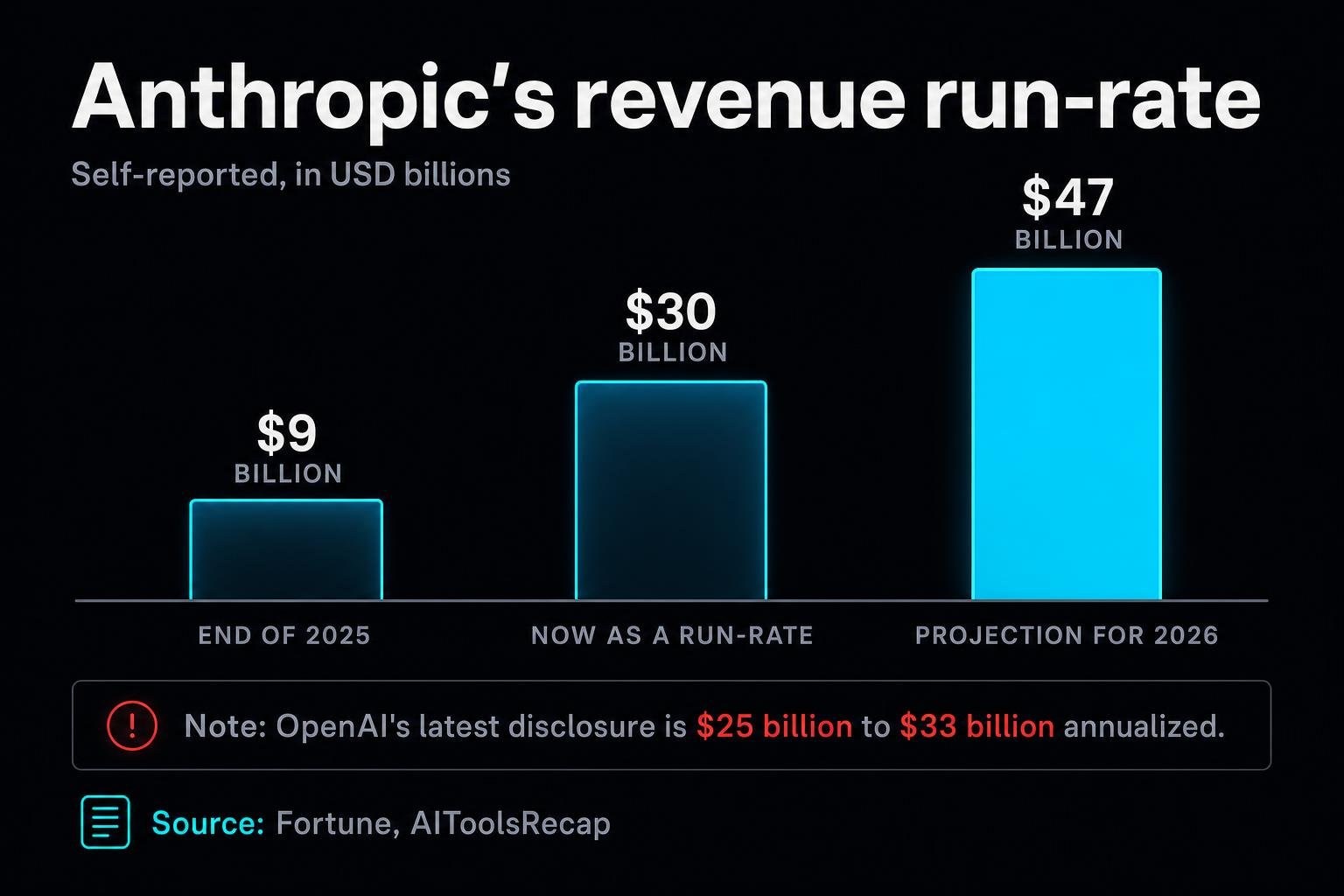
While everyone watched the model launches, the market share story flipped. Anthropic has overtaken OpenAI on self-reported revenue, with a run-rate now past $30 billion, up from roughly $9 billion at the end of 2025. Anthropic reportedly projected $47 billion for the year and expects profitability in 2029, a year ahead of OpenAI. OpenAI's latest disclosure puts it in the $25 to $33 billion annualized range.
Fortune framed Altman's push for a new arrangement, the government stake and the release standards, as a response to OpenAI slowly losing ground to Google and Anthropic. Read that way, item one and item three of this story connect: the company that is arguably behind on revenue is the one offering equity to the referee and helping shape the rules everyone will play by. That is not a scandal, necessarily. But it is a very human move, and worth naming plainly.
What it means if you are not building frontier models
Most of us are not training billion-dollar models. So why care? Because the plumbing of the entire AI economy sits downstream of these decisions.
If frontier releases now pass through a government checkpoint, then availability becomes less predictable. A model can be suspended and then un-suspended within weeks, as Fable just was. For anyone whose product or workflow depends on a specific model being live, that unpredictability is the real story. The practical takeaway is not panic, it is resilience: assume that no single model is permanently guaranteed, and value the parts of the ecosystem that ship without geopolitical ceremony.
The revenue flip matters too, because it is concentrated in enterprise and agentic workloads, the boring but lucrative business of software that actually does things. When the commercial center of gravity in AI moves, the tools, integrations, and platforms that everyone builds on tend to follow.
The honest uncertainty
None of this is settled. The voluntary standards have not been published. The equity proposal is, as reported, a proposal. And self-reported revenue figures deserve the usual skepticism. What we can say with confidence is that the frontier is no longer a private garden. It is becoming shared, contested ground between a handful of companies and the state. The week of July 6 to 10, when the standards framework may drop, is the next thing worth reading the day it lands.
One signal a day. No noise.
A 3-minute read when something genuinely shifts in AI, automation, or defense tech. Free, most weekdays.
Free, most weekdays. No spam, unsubscribe anytime.Sources
- Yahoo Finance / Reuters - US in talks with AI companies on voluntary release standards - https://finance.yahoo.com/technology/ai/articles/us-talks-ai-companies-voluntary-001646707.html
- Forbes - OpenAI reportedly pitches granting US government 5% stake - https://www.forbes.com/sites/siladityaray/2026/07/02/openai-reportedly-pitches-granting-us-government-5-stake/
- Business Standard - OpenAI proposes handing Trump administration 5% stake, say reports - https://www.business-standard.com/world-news/openai-proposes-handing-trump-administration-5-stake-say-reports-126070201101_1.html
- Cybersecurity Dive - OpenAI model government limit request - https://www.cybersecuritydive.com/news/openai-model-government-limit-request/823966/
- Fortune - Sam Altman's new world order push amid OpenAI, Google, Anthropic race - https://fortune.com/2026/07/02/sam-altman-new-world-order-ai-openai-google-anthropic/
- AIToolsRecap - AI news, July 3, 2026 - https://aitoolsrecap.com/Blog/ai-news-july-3-2026
Quick answers
What are the White House AI release standards?
The US government is reportedly in advanced talks with OpenAI, Google, and Anthropic on voluntary standards for releasing new models, following a June executive order directing agencies to test advanced models before release. An announcement could come as soon as the week of July 6 to 10, 2026.
Did OpenAI really offer the government a 5% stake?
According to reports, OpenAI proposed giving the US government a 5% equity stake, with Sam Altman pitching the idea on an Alaska Permanent Fund model. The proposal reportedly calls for other US AI companies to do the same. As reported, it is a proposal, not a finalized deal.
Has Anthropic passed OpenAI in revenue?
By self-reported figures, yes. Anthropic's run-rate is reported past $30 billion, up from about $9 billion at the end of 2025, with a $47 billion projection for the year. OpenAI's latest disclosure puts it at $25 to $33 billion annualized. These are self-reported numbers and should be read with that caveat.
Why does this matter if I don't build AI models?
Because model availability may become less predictable when releases pass through a government checkpoint. A model can be suspended and reinstated within weeks, as Anthropic's Fable was. Anyone whose product depends on a specific model being live has a reason to value resilience and avoid single points of failure.