AI Agents Just Grew Up - and Got a Meter
In a single week, AI agents stopped being a party trick and quietly became infrastructure. Then the free buffet closed. Here's what that one-two punch means for anyone building with AI.

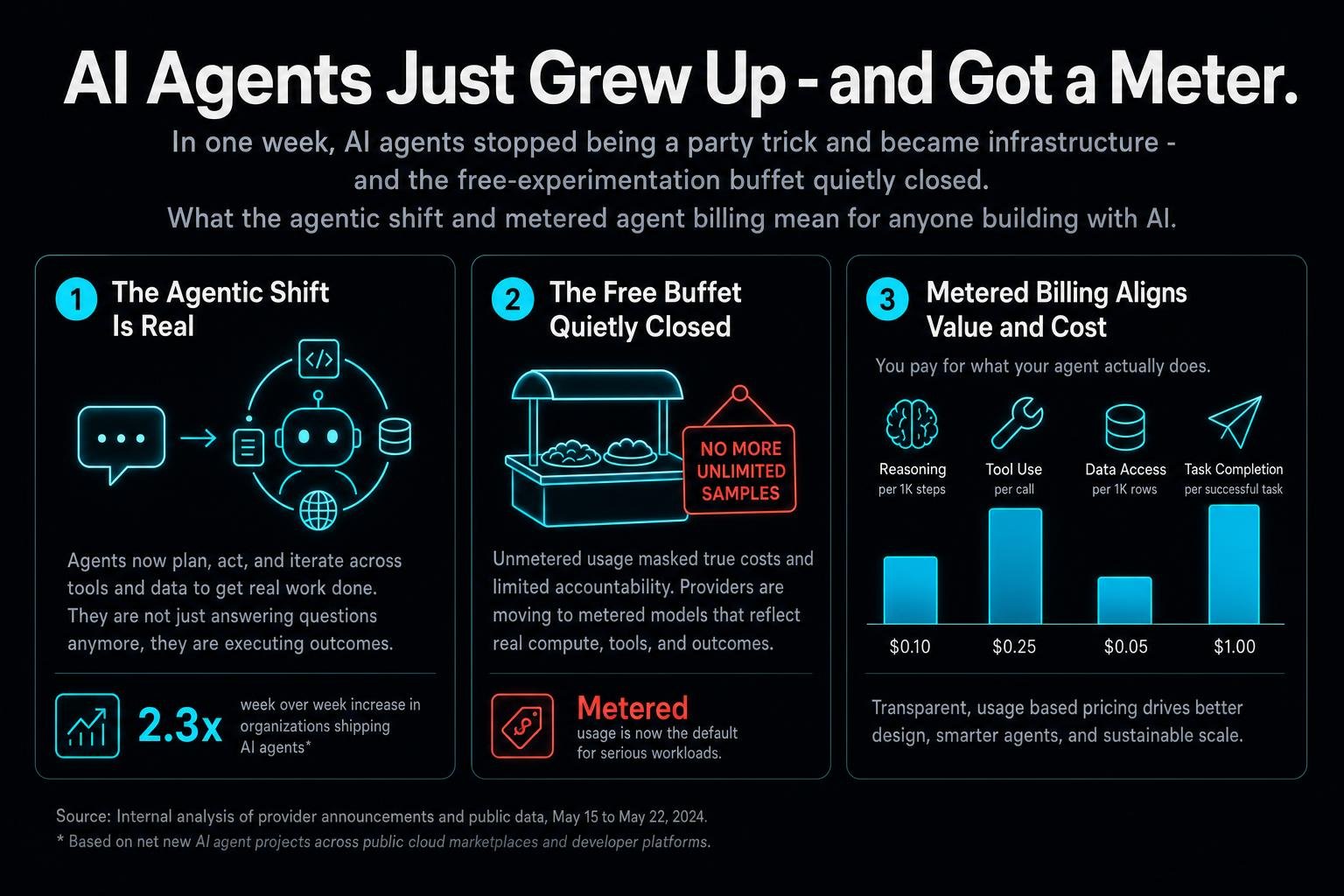
For two years, "AI agents" mostly meant a slick demo. Something on a stage that booked a fake dinner reservation while the audience clapped. Useful the way a concept car is useful - gorgeous, suggestive, not something you'd actually drive to work.
This week, two things happened almost on top of each other, and together they mark the moment the concept car turned into a delivery truck. The first: agents became plumbing - boring, load-bearing, everywhere. The second: someone walked over and bolted a meter onto the pipe.
Part one: the boring revolution
The clearest sign a technology has truly arrived isn't excitement. It's boredom. Electricity stopped being magic the day we stopped noticing light switches. Agents just hit that threshold - and the receipts are in the adoption curve of an unglamorous standard called MCP (the Model Context Protocol - basically the USB-C of AI tools, a common plug that lets any model talk to any app).
Those aren't vanity numbers. 78% of enterprise AI teams now run at least one MCP-backed agent in production, and Gartner expects 75% of API-gateway vendors to ship MCP features this year. When the gateway vendors - the most conservative, least hype-driven layer of the stack - start building for something, the argument is over.
And the platforms people already live in are swallowing agents whole. GoHighLevel, the CRM that runs tens of thousands of small businesses, just shipped agents that can call external tools inside its automation workflows, plus a voice assistant with memory. The June MCP spec went further and added "server-as-agent" - tools that can call other tools, recursively. That's the difference between a power strip and an electrical grid.
The tell that a technology has arrived isn't applause. It's a procurement form.
Money agrees. The AI-agent market is projected to clear $10.9 billion in 2026, up 45% year over year, and the winners are increasingly vertical - agents that do one industry's job extremely well. Avoca just raised $125M to be the voice on the phone for plumbers and HVAC techs. Not a chatbot for everyone; the front desk for someone specific.
Part two: the meter arrives
Here's the part that didn't trend, but should have. The same week agents became infrastructure, the economics of running them changed overnight.
As of June 15, 2026, Anthropic split programmatic Claude usage - the kind that powers automated agents, scheduled jobs, and headless scripts - out of the flat-rate subscription. It now draws from a separate metered credit (roughly $20 / $100 / $200 a month by tier), billed at full API rates, no rollover. When the credit runs dry, the automation simply stops unless you've opted into overflow billing.
For two years, builders ate at an all-you-can-eat buffet. You could leave an agent running in a loop overnight and the worst case was a stern email. That era just ended - and not just for one company. When a leader reprices a category, the rest tend to follow.
This sounds like bad news. It isn't. It's the most bullish signal in the whole story.
Why a price tag is good news
Nobody puts a meter on something nobody uses. You don't meter a fad - you meter water, power, bandwidth. The bill is the graduation certificate. It says agents crossed from "interesting" to "load-bearing enough that the cost has to be real."
But it does rewrite the rules for anyone building. Three shifts matter:
- Every automation now has a unit cost. "It just runs in the background" is no longer free. Each looping agent has a cost-per-run, and it can hard-stop mid-task if the budget drains - which means a runaway loop is now a runaway bill.
- Model-tiering becomes a discipline, not a nicety. The smart pattern is to route cheap, high-volume steps to small fast models and reserve the expensive frontier models for the few steps that actually need the horsepower. Same output, a fraction of the cost.
- A spending cap is now a feature you can sell. "AI automation with a hard cost ceiling" is exactly what every owner spooked by a runaway-bill horror story wants to hear. The constraint became a selling point.
Think of it like the shift from a flat gym membership to a personal trainer who charges per session. The flat membership rewards showing up. Pay-per-session rewards showing up with a plan. The hobbyists drift away; the people building something real get sharper, because now every rep counts.
The takeaway
Two truths landed in the same week. Agents are real now - boring-real, plumbing-real, in-your-CRM-real. And running them costs real money that can shut off at zero. Those aren't contradictions; they're the two halves of any technology growing up. The toy becomes a tool, and the tool comes with an invoice.
The builders who win the next year won't be the ones who can make an agent do a clever trick. They'll be the ones who can make an agent do a useful trick, reliably, under a budget - and who designed for the meter before the meter arrived.
One signal a day. No noise.
A 3-minute read when something genuinely shifts in AI, automation, or defense tech. Free, most weekdays.
Free, most weekdays. No spam, unsubscribe anytime.Sources
- WorkOS - Everything your team needs to know about MCP in 2026
- ChatForest - MCP ecosystem 2026: state of the standard
- Toloka - The future of MCP enterprise adoption
- 8Seneca - Vertical AI agents in the enterprise, 2026
- GeekWire - The rise of vertical AI agents
- The New Stack - Anthropic Agent SDK credits
Quick answers
What is MCP (Model Context Protocol)?
MCP is an open standard that lets AI models connect to external tools and data sources through a common interface - often described as "USB-C for AI." Its June 2026 spec added "server-as-agent" capabilities, letting tools call other tools recursively.
What changed with Anthropic's billing on June 15, 2026?
Programmatic Claude usage - the Agent SDK, headless runs, and CI integrations - was moved out of the flat subscription onto a separate metered monthly credit billed at full API rates with no rollover. When the credit is exhausted, automated requests stop unless overflow billing is enabled.
Why is metered agent billing considered a good sign?
Because providers only meter things that are genuinely used at scale. The shift to real per-use cost signals that AI agents have moved from experimental demos to load-bearing infrastructure - and it pushes builders toward efficient, budget-aware design.
How should builders adapt to per-use agent costs?
Give every automation a unit cost and a hard cap, route cheap high-volume steps to small fast models while reserving frontier models for the few steps that need them, and treat a spending ceiling as a sellable feature rather than a limitation.