The Price Hike That Wasn't
Anthropic cancelled a scheduled 50% price increase on Claude Sonnet 5, and leaked OpenAI numbers show why. Nobody at the model layer can raise prices yet.

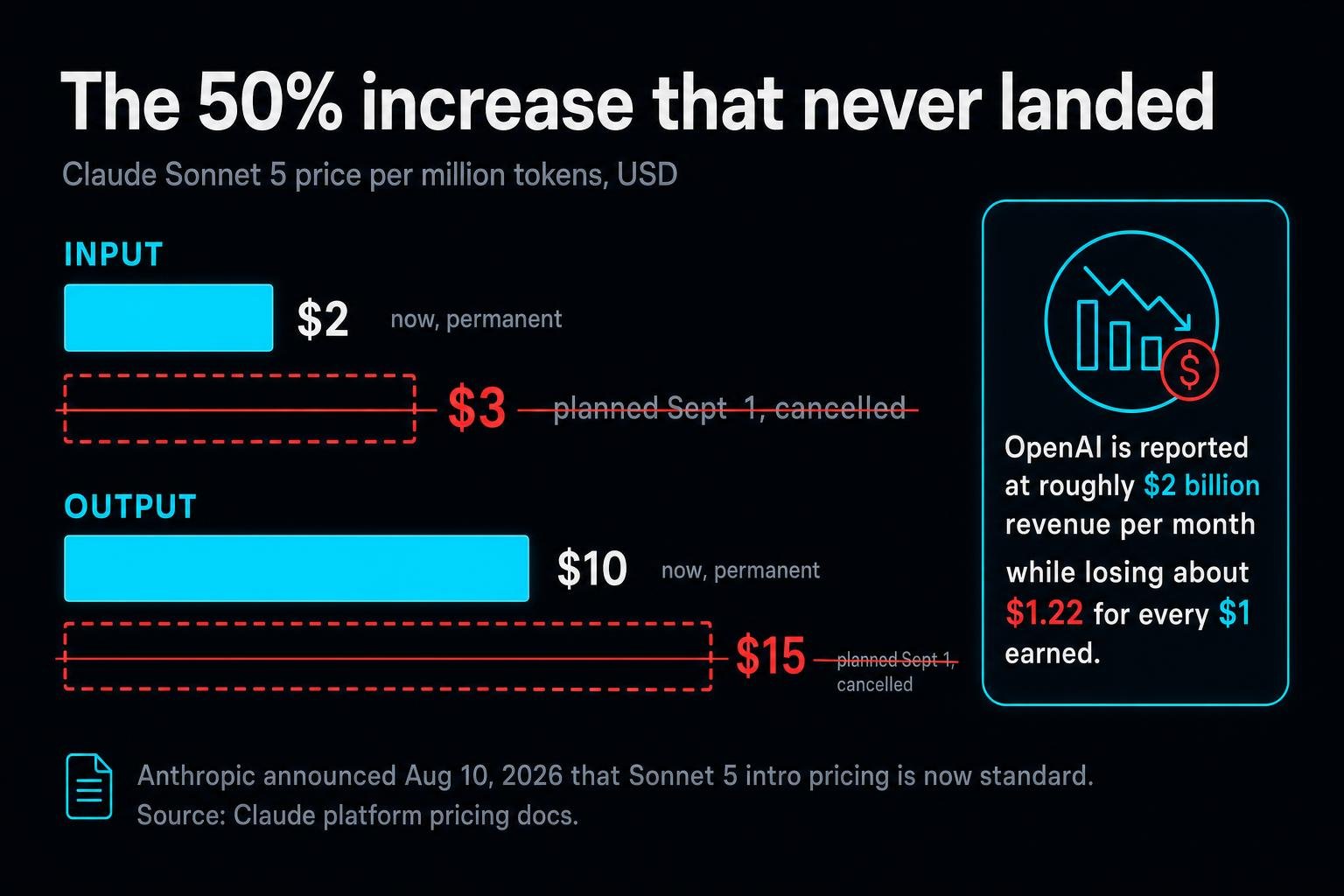
On August 10, Anthropic did something that almost never happens in a market this hot. It cancelled a price increase it had already announced.
The deadline that dissolved
Claude Sonnet 5 launched with introductory pricing of $2 per million input tokens and $10 per million output tokens. On September 1, that was scheduled to become $3 and $15, a 50% step up on the workhorse tier that a lot of production software quietly runs on.
Teams had been planning around that date for weeks. Cost models, fallback providers, migration spreadsheets, an entire small cottage industry of here is how to survive the Sonnet 5 repricing analysis. Then Anthropic announced the introductory price is now simply the standard price. The increase is not happening. The deadline everyone was routing around stopped existing.
Relief, obviously. But the more useful thing is what it tells you about who actually has power in this market.
Pricing power, and the conspicuous lack of it
Picture a landlord who tapes a rent increase notice to every door. Over the next three weeks, tenants start touring other buildings, comparing floor plans, getting quotes on movers. Then the notice comes down and rent stays where it was.
You saved some money. But you learned something worth more than the money: your landlord is not in a position to raise the rent.
That is roughly what happened here. The competitive backdrop is brutal for anyone trying to charge more. DeepSeek's V4 arrived under an MIT license, free to use and modify. GPT-5.6 Luna took an 80% price cut in July. Announcing a 50% increase into that environment mostly invites your customers to go find out how good the cheap option is, and a lot of them will discover it is good enough.
The subsidy era does not end when a lab announces it. It ends when a lab raises prices and the increase sticks. The first one to try just blinked.
That is the honest read on this news. Not Anthropic is generous and not Anthropic is desperate, but something structural: frontier models are converging in capability faster than they are differentiating in ways buyers will pay a premium for. When your product is close enough to a competitor's that switching is a config change, you do not get to set the price. The market does.
The number underneath the cheap tokens
Now put a second fact beside the first. OpenAI's S-1 has still not appeared on SEC EDGAR, with the expected window running through mid to late August and a September or Q4 listing targeted (2027 is reportedly still under consideration). But pre-IPO reporting now pegs the company at roughly $2 billion in revenue per month, losing approximately $1.22 for every $1 earned.
Sit with that second number. Around $24 billion a year coming in, and about $2.22 going out for every dollar that comes back.
Imagine a restaurant packed every single night, three-week waiting list, glowing reviews, and every $20 plate costs $44 to cook. That is not automatically a doomed restaurant. It is a bet that the ovens get dramatically cheaper, or that once you are the only place in town people stop flinching at $50 a plate.
Which is exactly where the two stories collide. The model layer is selling below cost, and it just demonstrated that it cannot raise prices without hemorrhaging customers. One of those two things has to give, and until it does, what we are all using is subsidized.
If you build on top of this stuff
None of that is a reason to panic, but it does change how you plan.
- Price your work against today's published rates, not against promised future ones. A publicly scheduled 50% increase just got publicly reversed. Vendor pricing announcements are marketing, not contracts, and that cuts in both directions: the cut you are counting on can vanish just as easily.
- If your contracts embed model costs, say what happens when those costs move. A one-line pass-through-with-notice clause means neither a future increase nor a future cut strands the agreement.
- Keep a fallback map anyway. Knowing which workloads run on which model, and what the second choice would be, took real effort to figure out this month. That work does not expire because the deadline did. It is cheap insurance, and it is also the only leverage a buyer has.
- Build above the model layer, not as the model layer. Tokens are becoming a commodity with no pricing power and negative margins. What you assemble out of them is not.
What would actually signal the turn
The genuine end-of-subsidy moment will not be an announcement. It will be the first lab that raises prices and holds, with no rollback three weeks later. Watch for that. Watch also for whether price stability itself becomes a marketing promise, and whether the next generation of models still launches with introductory pricing now that the precedent is introductory quietly becomes permanent.
Until then, the deal on the table is remarkable and slightly unreal: frontier-class intelligence at $2 per million tokens in, $10 out, sold to you by companies that are, on the best available numbers, losing money on the transaction.
Use it. Enjoy it. Just do not build something that only works if it stays this cheap forever.
One signal a day. No noise.
A 3-minute read when something genuinely shifts in AI, automation, or defense tech. Free, most weekdays.
Free, most weekdays. No spam, unsubscribe anytime.Sources
- Anthropic - Claude platform pricing docs - https://platform.claude.com/docs/en/about-claude/pricing
- TechJournal - Claude Sonnet 5 pricing now permanent - https://techjournal.org/claude-sonnet-5-pricing-now-permanent
- explainx - Anthropic Sonnet 5 permanent pricing, August 2026 - https://explainx.ai/blog/anthropic-sonnet-5-permanent-pricing-august-2026
- FinOps LLM - Sonnet 5 intro pricing deadline - https://finopsllm.com/research/sonnet-5-intro-pricing-deadline
- Enterprise DNA - Claude Sonnet 5 pricing deadline and cost impact - https://enterprisedna.co/resources/news/anthropic-claude-sonnet-5-pricing-deadline-cost-impact-2026/
- TechJournal - OpenAI IPO: what to expect from the public S-1 - https://techjournal.org/openai-ipo-public-s1-what-to-expect
- SmartAsset - OpenAI stock IPO - https://smartasset.com/investing/openai-stock-ipo
- BuildMVPFast - OpenAI IPO filing and valuation - https://www.buildmvpfast.com/blog/openai-ipo-filing-valuation-s1-2026
- StartupHub - OpenAI stock IPO watch - https://www.startuphub.ai/ai-news/ipo-watch/2026/openai-stock-ipo
Quick answers
Did Anthropic raise the price of Claude Sonnet 5?
No. Anthropic announced on August 10, 2026 that Sonnet 5's introductory pricing is now the standard price. The increase scheduled for September 1, which would have taken it from $2/$10 to $3/$15 per million input/output tokens, will not happen.
What does Claude Sonnet 5 cost now?
$2 per million input tokens and $10 per million output tokens, per Anthropic's platform pricing documentation. That rate is now permanent rather than introductory.
Why would a lab cancel a price increase?
Anthropic did not publish a reason, so this is inference from the market context: DeepSeek's V4 shipped under a permissive MIT license and GPT-5.6 Luna took an 80% price cut in July. A 50% increase on a widely used mid-tier model is hard to make stick when competitors are getting cheaper or free.
Is OpenAI profitable?
Not according to pre-IPO reporting, which puts revenue at roughly $2 billion per month against losses of about $1.22 for every $1 earned. These are leaked, unaudited figures. OpenAI's S-1 has not yet appeared on SEC EDGAR, so no audited numbers are public.