Agents Are Live. Governance Isn't.
The hard numbers on AI agents in production just landed, and they arrived the same week a company openly blamed AI for cutting 15% of its staff. The gap between the two is the whole story.

For a couple of years, "AI agents" lived mostly in demos and hype threads. This week the boring, load-bearing numbers finally showed up, and they tell a clearer story than any keynote.
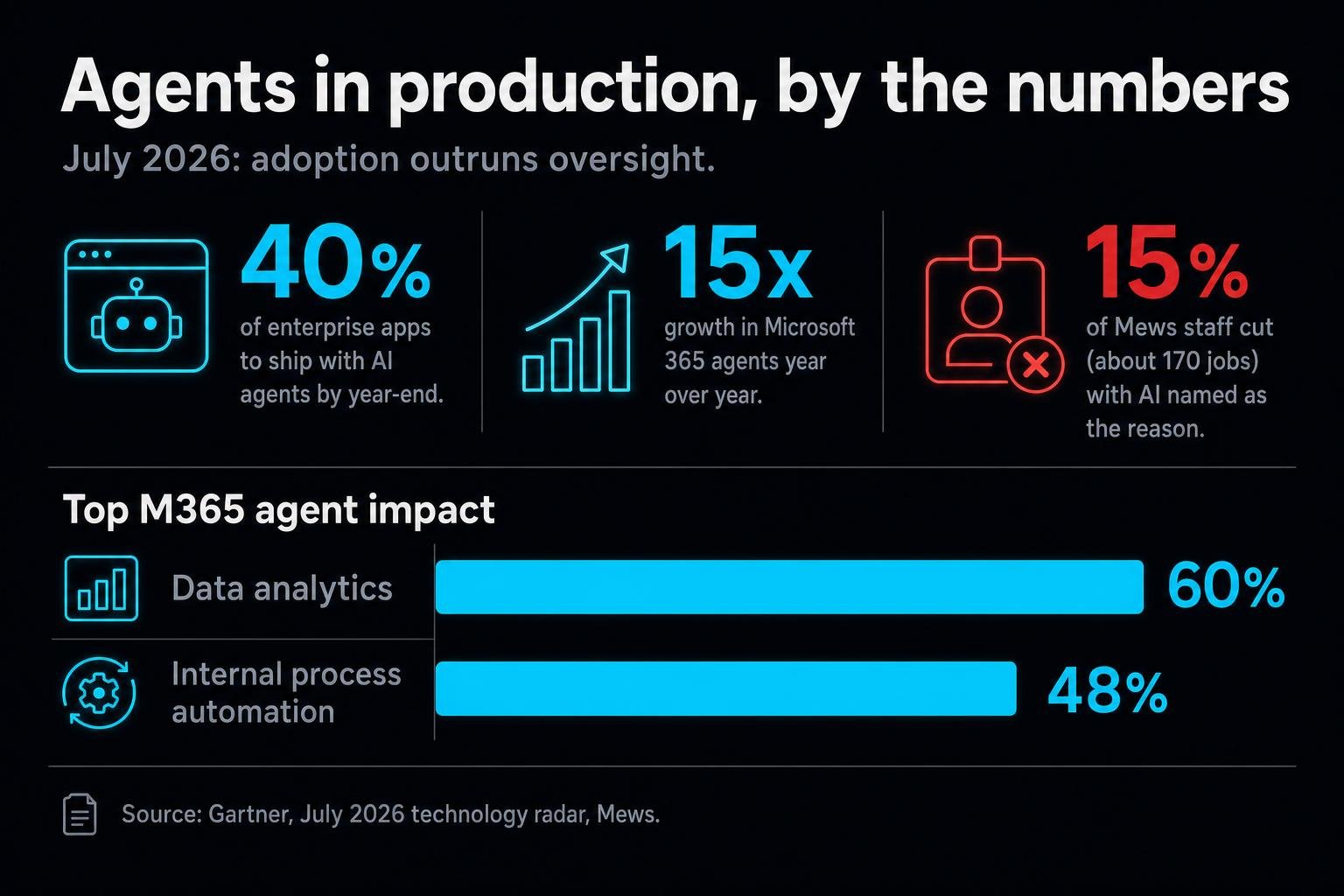
Gartner forecasts that 40% of enterprise applications will ship with AI agents by the end of the year. In the Microsoft 365 ecosystem alone, the number of agents grew 15x year over year, with the biggest impact landing in data analytics (60%) and internal process automation (48%). And the headline of July's technology radar was blunt: agents are entering production while governance fails to keep pace.
A highway built faster than the traffic laws
Here is the shift underneath the stats. We are moving from single-task assistants ("summarize this email") to multi-agent workflows that read, route, draft, update records, and trigger the next step across a business without a human clicking each button. That is genuinely useful. It is also happening faster than anyone has written the rules for it.
Think of it like a new highway that opened before the speed limits, lane markings, and traffic cameras were installed. The road works. Cars are already on it, moving fast. Nobody is quite sure who is responsible when two of them collide.
The part most people miss: if 40% of the software a business already uses will ship with embedded agents, then the decision to "run agents" has mostly been made for you. The same dynamic that quietly enrolls advertisers into automated tools is now happening across ordinary business software. The honest question is no longer "should we use agents?" It is "which agents are already acting on our systems, and who approved them?"
The first honest layoff
The same week the adoption numbers landed, the labor side of the story got its first plainly worded example. Hotel-software company Mews cut about 15% of its staff, roughly 170 jobs, and openly attributed the reduction to AI efficiency, saying individuals can now do work that once required whole teams.
What is notable is not the layoff itself but the honesty. For a while, AI-driven cuts were dressed up as "restructuring." Naming AI out loud breaks a taboo, and once it is broken, more companies say it. That matters for anyone whose job touches repetitive, high-volume work: the conversation is arriving whether you are ready or not.
It is worth separating what agents actually absorb from what they do not. They are good at volume text tasks, routing, and data enrichment. They are bad at judgment, relationships, and compliance calls. The layoff headlines rarely mention the costs that come with the swap: error rates, lost institutional knowledge, and the overhead of actually governing the thing you just deployed. That overhead is the part nobody put a number on until now.
Two very different worlds reached for the same tool
Here is the detail that made me sit up. While enterprise software races ahead of its own governance, the defense world hit the exact same wall and reached for the exact same fix.
The Senate's draft FY27 defense authorization got specific about human control of autonomous systems: personnel must exercise "appropriate levels of human judgment," AI is categorically prohibited from any decision to launch or detonate a nuclear weapon, and, crucially, the bill would mandate an incident repository to track system failures, unintended behavior, and near-miss events. There is even a named standalone bill, the "Ultimate Human Responsibility in Defense Systems Act."
Strip away the stakes and the shape is identical to the civilian problem. Enterprise agents are entering production faster than oversight, and the first governance instrument both worlds grab is the same one: a log of what went wrong, what almost went wrong, and what got changed.
You cannot govern what you do not log. That is the quiet lesson connecting a hotel-software layoff and a nuclear-weapons prohibition in the same week.
Why this matters if you are not in tech
You do not need to build agents to be affected by them. If you run a small business, use a CRM, or manage a team, agents are almost certainly already active inside the tools you pay for, quietly reading and updating things. The useful move is not fear and not blind enthusiasm. It is an inventory: knowing which automated features are switched on, what data they can touch, and who signed off.
The companies that will look smart in a year are not the ones that cut headcount fastest. They are the ones that can answer a simple question when something goes sideways: what was our AI allowed to do, and what did it actually do? Right now, most cannot. That is the gap, and closing it is cheaper than the alternative.
FAQ
How many enterprise apps will have AI agents? Gartner forecasts 40% of enterprise applications will ship with AI agents by the end of the year.
How fast are business agents actually growing? In the Microsoft 365 ecosystem, the agent count grew 15x year over year, with the largest impact in data analytics (60%) and internal process automation (48%).
Are companies really cutting jobs because of AI? Yes, and increasingly say so openly. Mews cut about 15% of staff, roughly 170 jobs, and directly attributed the reduction to AI efficiency.
What is the single most common governance fix? An incident log. Both enterprise technology radars and the U.S. Senate's defense framework converged on tracking failures and near-misses as the baseline control this month.
One signal a day. No noise.
A 3-minute read when something genuinely shifts in AI, automation, or defense tech. Free, most weekdays.
Free, most weekdays. No spam, unsubscribe anytime.Sources
- Technology Radar July 2026 - AI agents go into production and governance doesn't keep up - https://www.hectorpincheira.com/en/news/technological-radar-july-2026-ai-agents-go-into-production-and-governance-doesnt-keep-up/
- AI Agent Store - this week's AI agent news - https://aiagentstore.ai/ai-agent-news/this-week
- Mean.ceo - AI automation trends July 2026 - https://blog.mean.ceo/ai-automation-trends-july-2026/
- unrot.co - Top 10 AI news, July 15 2026 - https://unrot.co/blogs/today-top-10-ai-news-july-15-2026
- Arms Control Association - US Senate panel approves AI autonomous weapons rules - https://www.armscontrol.org/act/2026-07/news/us-senate-panel-approves-ai-autonomous-weapons-rules
- The Hill - Congress urged to add AI guardrails to NDAA - https://thehill.com/policy/technology/5908512-congress-add-ai-guardrails-ndaa/
Quick answers
How many enterprise apps will have AI agents?
Gartner forecasts 40% of enterprise applications will ship with AI agents by the end of the year.
How fast are business agents actually growing?
In the Microsoft 365 ecosystem, the agent count grew 15x year over year, with the largest impact in data analytics (60%) and internal process automation (48%).
Are companies really cutting jobs because of AI?
Yes, and increasingly openly. Mews cut about 15% of staff, roughly 170 jobs, and directly attributed the reduction to AI efficiency.
What is the most common governance fix?
An incident log. Enterprise technology radars and the U.S. Senate's defense framework both converged on tracking failures and near-misses this month.