When 'Open' Weighs 1.4 Terabytes
Moonshot's Kimi K3 ships its weights to everyone this week. There's just one catch: fitting them anywhere real takes a datacenter. 'Open weights' and 'usable weights' just became different claims.

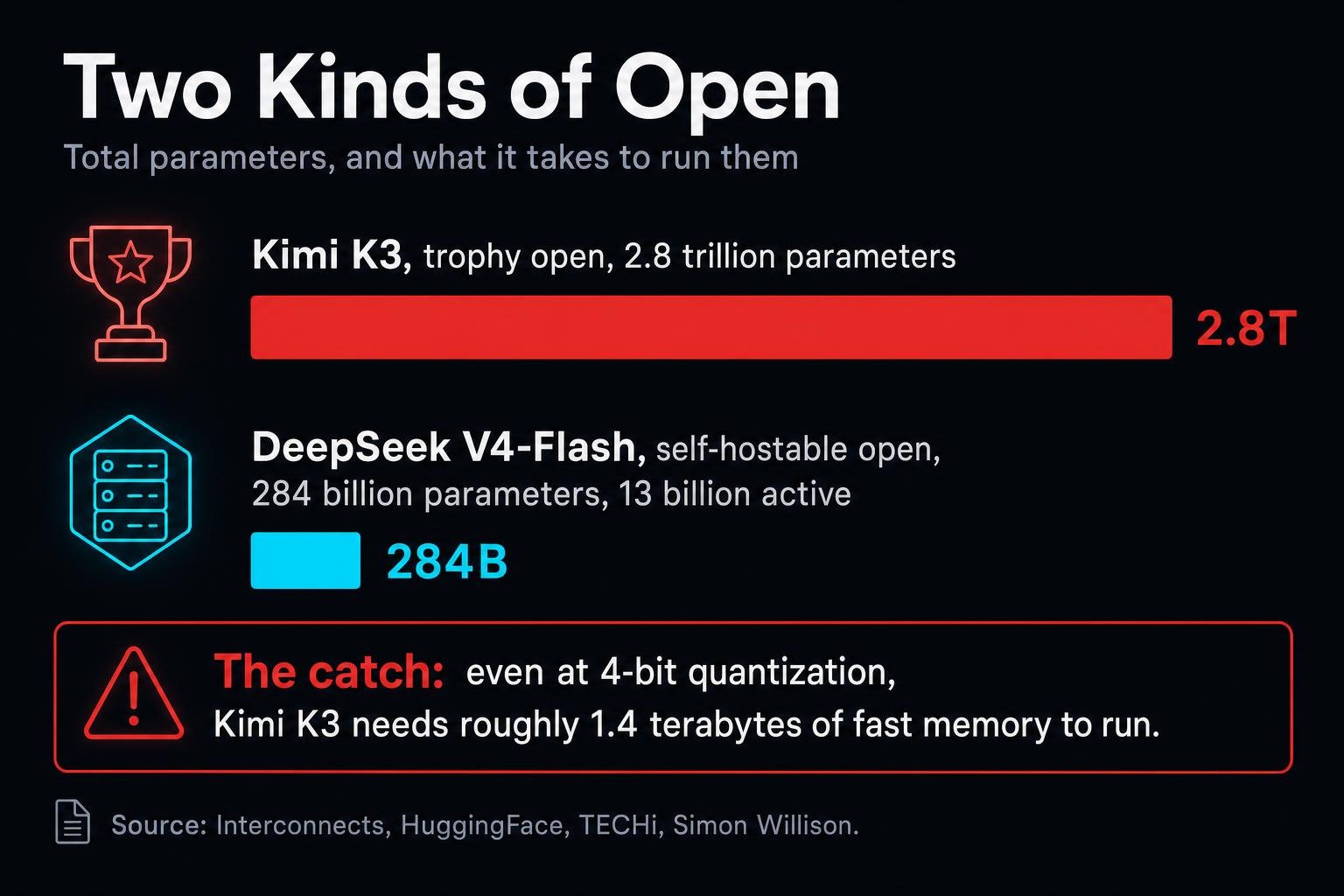
Here is a fun thought experiment. Someone hands you the complete blueprints to a Formula 1 car, free, no strings, do whatever you want with them. Generous, right? Except the car only runs on a fuel that costs more than a house, and the pit crew you'd need fills a hangar. You technically own the plans. You still can't drive to work.
That is roughly the situation with Kimi K3, the new model from the Chinese lab Moonshot, whose open weights ship this week under a Modified MIT license. It is the first open model in the roughly three-trillion-parameter class: a 2.8-trillion-parameter mixture-of-experts design with a one-million-token context window, built for long-horizon coding and agent work. On paper it is the most powerful model anyone has ever handed the public for free.
The catch is in the plumbing. Even squeezed down to 4-bit MXFP4 quantization, K3's weights need roughly 1.4 terabytes of fast memory to run. That is not a laptop. That is not a beefy gaming rig with a couple of graphics cards. That is multi-node datacenter hardware, the kind you rent by the hour from a handful of specialized providers. So in practice, the free, open model gets consumed exactly the way a closed, locked-down model does: through someone else's servers, on someone else's bill.
Open weights, meet usable weights
For years, "open weights" has been shorthand for freedom. You can download it, inspect it, fine-tune it, run it on your own machine, and nobody can take it away or change the terms on you. That promise held because the models were small enough to actually run. A hobbyist with a decent computer could self-host something genuinely capable.
K3 quietly breaks that link. The license is open. The hardware is not. And when the only way to touch a model is to rent industrial infrastructure, the difference between "open" and "closed" stops being about permission and starts being about physics.
Open in license, datacenter-bound in practice. The download is free. The electricity, the memory, and the multi-node cluster are the actual price of admission.
This is why it helps to split "open" into two honest categories. There is self-hostable open, models like DeepSeek's V4-Flash at 284 billion total parameters with only 13 billion active at a time, which runs on hardware a serious individual or small company can realistically own. And there is trophy open, models like K3, which are open in the way a museum is free on Sundays: you can look, you can even benchmark, but you are not taking the exhibit home.
Why the distinction matters more than the hype
The instinct when a frontier-class open model drops is to say "see, the free stuff caught up, why pay for anything?" K3 is the counterexample that should retire that reflex. Free at the license layer does not mean free at the running-it layer, and for a three-trillion-parameter model the running-it layer is where nearly all the cost lives.
There is a subtler consequence too, and it is about trust. A lot of the open-model conversation this year has been about provenance: where did the training data come from, can you verify it, who is accountable if something in the model misbehaves. The intuition was that open weights meant you could answer those questions yourself. But if almost nobody can actually run K3 on their own metal, then the provenance question does not land on the weights. It lands on whoever hosts them. The host becomes the accountable party, the same way it is for any closed API. Openness, in other words, does not automatically distribute responsibility. It can quietly concentrate it.
The bigger pattern
Zoom out and K3 rhymes with something happening across the whole AI stack. The protocol layer is open, the standards are public, and yet the money and the accountability keep collecting around whoever operates the deployment. The capability gets democratized. The infrastructure to wield it does not. "Free" describes the artifact, never the operation.
None of this makes K3 a bad thing. A powerful model with an open license is genuinely useful: it sets a public benchmark, it pressures the closed labs, and clever people will inevitably distill and prune it down toward something a smaller shop can host. That community response is the real story to watch. But the headline "most powerful open model ever" deserves an asterisk, and the asterisk is 1.4 terabytes tall.
The honest way to read this week: the frontier of open models kept climbing, and the ladder to reach it got a lot more expensive. When you next hear "but it's open, it's free," ask the only question that actually decides anything. Free to download, sure. But what does it cost to run?
One signal a day. No noise.
A 3-minute read when something genuinely shifts in AI, automation, or defense tech. Free, most weekdays.
Free, most weekdays. No spam, unsubscribe anytime.Sources
- Interconnects - Kimi K3: the open-weights escalation - https://www.interconnects.ai/p/kimi-k3-the-open-weights-escalation
- HuggingFace - Kimi K3 model overview (MXFP4 quantization, open weights) - https://huggingface.co/blog/ResterChed/kimi-k3-model-overview-mxfp4-quantization-open-wei
- TECHi - Kimi K3 open weights inference economics - https://www.techi.com/kimi-k3-open-weights-inference-economics/
- Simon Willison - Kimi K3 - https://simonwillison.net/2026/Jul/16/kimi-k3/
Quick answers
What is Kimi K3?
An open-weights AI model from the lab Moonshot, shipping this week under a Modified MIT license. It is a 2.8-trillion-parameter mixture-of-experts model with a one-million-token context window, built for long-horizon coding and agent workflows, and it is the first open model in the roughly three-trillion-parameter class.
If Kimi K3 is open and free, why can't I just run it myself?
Because of memory. Even compressed to 4-bit MXFP4 quantization, K3's weights need roughly 1.4 terabytes of fast memory. That requires multi-node datacenter hardware, so in practice most people will use K3 through the same hosting providers as any closed model.
What's the difference between 'self-hostable open' and 'trophy open'?
Self-hostable open models, like DeepSeek V4-Flash at 284 billion total parameters with 13 billion active, run on hardware a serious individual or small company can realistically own. Trophy open models like K3 are open in license but datacenter-bound in practice, so you can benchmark them but not easily self-host.
Does an open license mean you can verify the model's provenance yourself?
Not necessarily. If almost nobody can run the model on their own hardware, the accountability for the model's data and behavior shifts to whoever hosts it, much like a closed API. Openness does not automatically distribute responsibility; it can concentrate it on the host.