The 17-Day Outage Nobody Priced In
A frontier model went dark for every customer on earth days after launch, and on August 1 the mechanism that did it got a standing process. Model access is no longer just a commercial relationship.
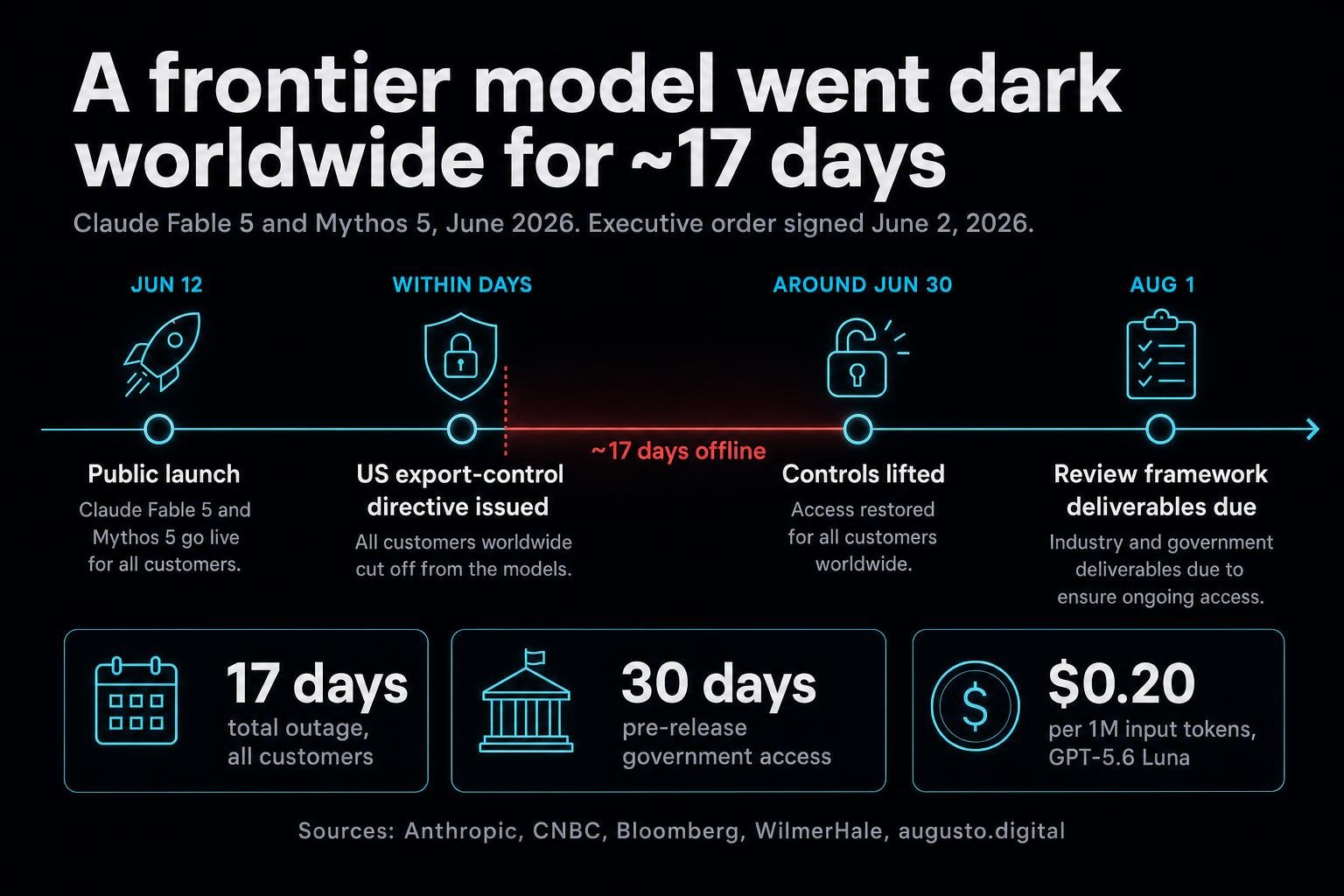
Here is something that happened this summer and mostly got filed under "weird news." Anthropic launched two frontier models, Claude Fable 5 and Mythos 5, on June 12, 2026. Within days, the US Commerce Department issued an export-control directive suspending access for any foreign national, anywhere: inside the United States, outside it, and explicitly including Anthropic's own foreign-national employees. Segregating users by nationality at that speed was not practical, so Anthropic did the only clearly compliant thing available and switched both models off for every customer, worldwide.
Roughly seventeen days later, on or around June 30, Commerce lifted the controls and the models came back. Launch to blackout to restoration in about two and a half weeks.
In June that read like a one-off. On August 1, the one-off got a process.
What went live on August 1
A June 2, 2026 executive order directed the government to identify and review "covered frontier models" for cyber and national-security risk. Its core deliverables came due August 1. Two things landed:
- A classified benchmarking process that determines which models cross the threshold for review.
- A window of roughly 30 days of pre-release government access to those models, with reviews run by the Commerce Department's Center for AI Standards and Innovation (CAISI) alongside the NSA.
Participation is nominally voluntary, with IP and confidentiality protections attached. Crowell describes the result as a "voluntary regulatory regime." Practitioners reading the same text call it voluntary on paper and mandatory in practice. Wiley and Latham both flag the same structural oddity, and it is the part worth staring at: the capability thresholds are classified. A developer cannot know in advance what triggers a review.
Picture a building code where the inspector arrives before you open, has real authority over whether you open, and the code itself is sealed. You can still build. You just cannot check your work.
Why June is the important half
For about two years, the planning assumption behind essentially every AI product has been that frontier model access is a commercial relationship. You pay, you get tokens, and availability is an engineering problem with engineering answers: rate limits, retries, a status page.
June falsified that. Not partially. Completely.
A frontier model became unavailable to every customer on earth days after launch, not because of capacity, pricing, or a bug, but because of a directive about who the users were.
The reported trigger was a jailbreak that could turn the models into unrestricted cyber tools. Anthropic reviewed the demonstration and characterized the vulnerabilities found as previously known and minor. That disagreement is interesting, but it is not the lesson. The lesson is the escalation path: a reported jailbreak to a worldwide shutoff, in days. And note the shape of the restriction versus the shape of the outcome. The rule was scoped by nationality of user. The effect was total, because selective compliance at that speed was not realistic.
Then August 1 stacked standing process on top of a mechanism that had already been fired once. That is the actual news. What happened by exception in June now has a cadence, a review body, and a pre-release window attached.
The strange economics underneath
Now the part that should make you sit up. While all of this was happening, the price of raw intelligence kept collapsing. GPT-5.6 Luna's input pricing was cut roughly 80%, to $0.20 per million input tokens.
So capability is getting cheaper by the quarter, and the availability of that capability is getting more political by the quarter. Two lines moving in opposite directions. Almost every AI roadmap I have seen is priced off the first line and silent on the second.
It is like a factory that consolidated onto one overseas supplier because the parts got cheap. The parts really did get cheap. The parts were never the risk. The port was.
What to do about it if you build things
Not panic. Plumbing. A few things that generalize:
- Model choice is now partly a jurisdiction choice. Three models from one lab is not redundancy. A different provider in a different jurisdiction is.
- Cheap inference makes redundancy cheaper, not less necessary. At $0.20 per million input tokens, keeping a tested alternative warm is a rounding error on most budgets.
- A fallback you have never switched on is a hypothesis, not a fallback. Turn the primary off on purpose and see what breaks.
- Size the drill to the precedent. Seventeen days is now a measured, real-world number. Long enough to hurt a business, short enough that a working alternative turns it into a non-event.
If you serve users outside the United States, the nationality-scoped shape of the June directive is worth understanding precisely, because it is exactly the shape that lands hardest on a non-US user base and it is the kind of question that starts showing up in procurement.
The open question
None of this is finished. A bipartisan Senate letter dated August 3 to Secretaries Rubio and Bessent is still probing model-access policy, and late-July reporting had the White House converging on the final framework. The details can still move.
The mechanism, though, is real and demonstrated. One invocation is an incident, which is why the market largely shrugged. A second invocation, against another lab or another model family, makes it a pattern. And a pattern means that for anyone building on frontier models, availability stops being an SLA question and becomes a geopolitical one.
The moat was never the model. It turns out the model is not even reliably yours.
One signal a day. No noise.
A 3-minute read when something genuinely shifts in AI, automation, or defense tech. Free, most weekdays.
Free, most weekdays. No spam, unsubscribe anytime.Sources
- WilmerHale - New Executive Order Addressing Early Government Access to Frontier AI Models - https://www.wilmerhale.com/en/insights/client-alerts/20260602-new-executive-order-addressing-early-government-access-to-frontier-ai-models
- Vorp Labs - Frontier Model Review Framework - https://vorplabs.com/ai-regulatory-updates/frontier-model-review-framework
- Crowell - Executive Order Creates Voluntary Regulatory Regime of Frontier AI Models - https://www.crowell.com/en/insights/client-alerts/executive-order-creates-voluntary-regulatory-regime-of-frontier-ai-models
- Wiley - New AI Executive Order Addresses Frontier Models and Cybersecurity Vulnerabilities - https://www.wiley.law/alert-New-AI-Executive-Order-Addresses-Frontier-Models-and-Cybersecurity-Vulnerabilities
- Latham & Watkins - Executive Order Establishing AI Cybersecurity and Frontier Model Framework - https://www.lw.com/en/insights/president-trump-signs-executive-order-establishing-ai-cybersecurity-and-frontier-model-framework
- Anthropic - Statement on Fable 5 and Mythos 5 access - https://www.anthropic.com/news/fable-mythos-access
- Al Jazeera - US orders Anthropic to disable AI models for all foreign nationals - https://www.aljazeera.com/news/2026/6/13/us-orders-anthropic-to-disable-ai-models-for-all-foreign-nationals
- Bloomberg - Anthropic says US limits foreign access to Fable 5, Mythos 5 - https://www.bloomberg.com/news/articles/2026-06-13/anthropic-says-us-limits-foreign-access-to-fable-5-mythos-5
- Forbes - Anthropic disabled Fable 5 and Mythos 5 after a US export control order - https://www.forbes.com/sites/anishasircar/2026/06/16/anthropic-disabled-fable-5-and-mythos-5-after-a-us-export-control-order-heres-what-happened/
- CNBC - Anthropic says Trump admin has lifted export controls on Claude Fable 5 and Mythos 5 - https://www.cnbc.com/2026/06/30/anthropic-says-trump-admin-has-lifted-export-controls-on-claude-fable-5-and-mythos-5.html
- Greenberg Traurig - Anthropic suspends access following US export control directive - https://www.gtlaw.com/en/insights/2026/6/ai-company-anthropic-suspends-access-to-claude-fable-5-claude-mythos-5-following-us-export-control-directive
- US Senate - Bipartisan AI model access letter, August 3, 2026 - https://www.gillibrand.senate.gov/wp-content/uploads/2026/08/Senate-AI-Model-Access-Letter.pdf
- Augusto Digital - Monthly LLM news, August 2026 - https://augusto.digital/insights/blogs/monthly-llm-news-august-2026/
Quick answers
What happened to Claude Fable 5 and Mythos 5 in June 2026?
They launched publicly on June 12, 2026. Within days, the US Commerce Department issued an export-control directive suspending access by any foreign national, inside or outside the United States, including Anthropic's own foreign-national employees. Because segregating access by nationality quickly was impractical, Anthropic shut both models off for all customers worldwide. Commerce lifted the controls around June 30, roughly seventeen days later.
What is the frontier model review framework that started on August 1, 2026?
It comes from a June 2, 2026 executive order directing the government to identify and review "covered frontier models" for cyber and national-security risk. Its core deliverables were due August 1, 2026, and what landed was a classified benchmarking process for deciding which models cross the review threshold, plus roughly a 30-day window of pre-release government access. Reviews are run by the Commerce Department's Center for AI Standards and Innovation (CAISI) alongside the NSA.
Is participation in the review framework mandatory?
It is nominally voluntary, with IP and confidentiality protections attached. Crowell characterizes it as a "voluntary regulatory regime," while practitioners describe it as voluntary on paper and mandatory in practice. Wiley and Latham both note that the capability thresholds are classified, so developers cannot know in advance what triggers a review.
Why does this matter to companies building on AI models?
It reframes model availability from a commercial and engineering question into a policy one. The June episode showed a frontier model can become unavailable to every customer on earth in days, for reasons unrelated to capacity, pricing, or bugs. With input pricing falling sharply, roughly 80% for GPT-5.6 Luna down to $0.20 per million input tokens, maintaining a tested fallback across a different provider and jurisdiction is cheap relative to the demonstrated seventeen-day downside.