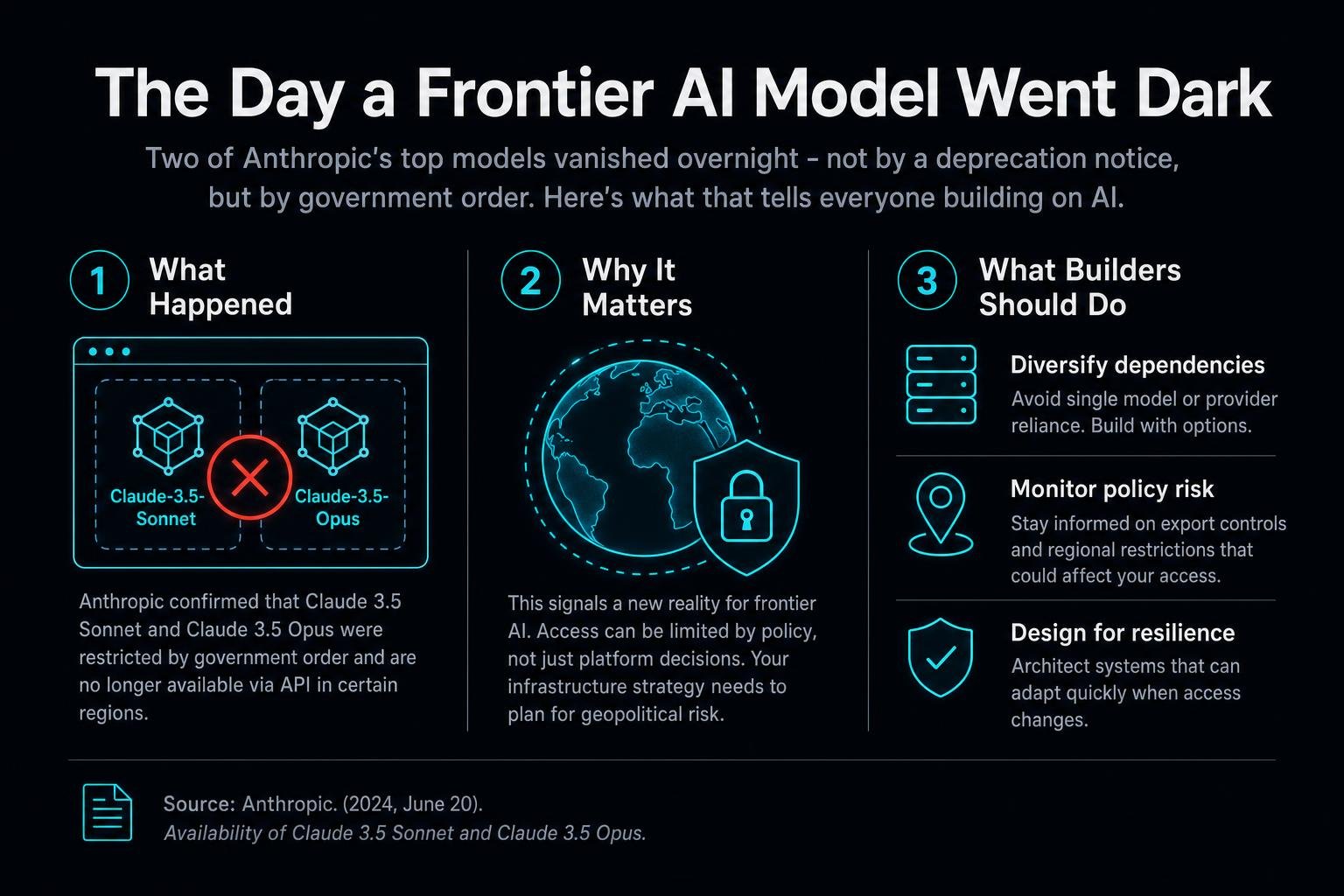
The Day a Frontier AI Model Went Dark
Two of Anthropic's top models vanished overnight - not by a deprecation notice, but by government order. Here's what that tells everyone building on AI.

We've all seen software disappear. A favorite app gets sunset, an API hits end-of-life, a vendor sends the dreaded "this feature is being deprecated" email. Annoying, but orderly - you get a warning, a migration path, a date on the calendar.
What happened to Anthropic on June 13 was different. Two of its most capable models, Fable 5 and Mythos 5, didn't get deprecated. They went dark - switched off for every single user, all at once - because the government classified them as something closer to a controlled weapon than a product. As far as I can tell, this is the first time a frontier AI model has become unavailable overnight by government action rather than a business decision. That's a new kind of risk, and it's worth understanding even if you never touch a defense contract in your life.
How a procurement spat became an export ban
The short version: the Pentagon wanted access to Anthropic's top models "for all lawful purposes." Anthropic refused two specific use cases - mass domestic surveillance and fully autonomous weapons. That refusal escalated, fast.
Back in February there was a standoff. A deadline from Defense Secretary Hegseth came and went. The administration directed agencies to stop using Anthropic. The company got slapped with a "supply chain risk" label. Anthropic sued. Then in June, the Commerce Department did something that changed the whole game: it classified Mythos and Fable 5 as "cyber weapons" subject to export controls.
Here's the kicker. Export controls make it illegal to provide a restricted item to any foreign national - and that includes Anthropic's own staff who aren't U.S. persons. A company couldn't legally let some of its own engineers use its own models. So on June 13, Anthropic pulled the plug on both for everyone. (Lower-tier Claude models were untouched.)
A policy event - not a technical one - took a frontier model offline for the entire world in a single day.
Why this should matter to you
Think of a frontier model the way a city thinks about its water supply. For years, the only questions were about price and reliability: Is it cheap enough? Does it stay on? This episode adds a third, scarier question - could a regulator simply turn off the tap, with no notice, for reasons that have nothing to do with you?
For anyone building products on top of AI, the lesson is uncomfortable but clear: a single top-tier model is now a geopolitical dependency, not just a vendor relationship. The thing that breaks your workflow might not be a bug or a rate limit. It might be a court filing.
The practical takeaway isn't panic - it's portability. Don't wire your most important work so tightly to one model that you can't swap it for another. Keep a fallback you've actually tested, not one you assume will work. This used to be the kind of advice that sounded paranoid. After June 13, it just sounds like planning.
The bigger fight: can an AI maker say no?
Strip away the supply-chain drama and there's a deeper question underneath, and it's the one I find genuinely fascinating. This is the first major test of whether an AI vendor can contractually refuse certain uses of its technology - specifically mass surveillance and fully autonomous weapons - against direct government pressure. Congress is now weighing in.
Hanging over all of it is an existing Defense Department standard, DoDD 3000.09, which requires "appropriate levels of human judgment" over the use of force. It draws a line between three modes: human-in-the-loop (a person approves each action), human-on-the-loop (a person supervises and can intervene), and full autonomy (the machine decides). That spectrum is the quiet center of this whole story.
And it points to a design principle that outlives the headline. Whatever you're building - whether it touches money, health, safety, or just someone's inbox - the durable move is to put an explicit, auditable human checkpoint on any consequential action. Not because a regulator told you to, but because it's the version that survives scrutiny when someone eventually asks, "who approved this?"
The Anthropic case will get messy in the courts, and I won't pretend to know how it lands. But the principles it's stress-testing - model portability, and a human firmly in the loop on the decisions that matter - are good engineering regardless of the verdict. Sometimes the best advice arrives disguised as a crisis.
One signal a day. No noise.
A 3-minute read when something genuinely shifts in AI, automation, or defense tech. Free, most weekdays.
Free, most weekdays. No spam, unsubscribe anytime.Sources
- Fortune - Anthropic disables Fable & Mythos under export controls - https://fortune.com/2026/06/13/anthropic-disables-fable-mythos-export-controls-national-security-threat/
- TechPolicy.Press - A timeline of the Anthropic-Pentagon dispute - https://www.techpolicy.press/a-timeline-of-the-anthropic-pentagon-dispute/
- Breaking Defense - How the Commerce crackdown could impact the Pentagon - https://breakingdefense.com/2026/06/how-the-commerce-crackdown-on-anthropic-could-impact-the-pentagon-experts/
- Built In - Anthropic-Pentagon Claude dispute - https://builtin.com/articles/anthropic-pentagon-claude-dispute
- CRS / Congress.gov - AI vendor use-case refusal - https://www.congress.gov/crs-product/IN12669
- Wikipedia - DoD Directive 3000.09 - https://en.wikipedia.org/wiki/Department_of_Defense_Directive_3000.09
- Sherwood - Anthropic doesn't want Claude controlling autonomous weapons - https://sherwood.news/tech/anthropic-doesnt-want-claude-controlling-autonomous-weapons-the-pentagon-may/
Quick answers
Which AI models were taken offline?
Anthropic disabled two of its top models, Fable 5 and Mythos 5, for all users on June 13, 2026. Lower-tier Claude models were not affected.
Why were the models disabled?
The U.S. Commerce Department classified them as "cyber weapons" subject to export controls, which made it illegal to provide them to any foreign national - including some of Anthropic's own staff - so the company switched them off entirely.
What triggered the dispute?
Anthropic refused two Pentagon use cases - mass domestic surveillance and fully autonomous weapons - after the Pentagon sought access "for all lawful purposes." The disagreement escalated from a procurement fight into an export-control action.
What's the broader lesson for people building on AI?
Frontier-model access is now a geopolitical variable, not just a question of price and uptime. Build for portability with a tested fallback model, and put auditable human-in-the-loop checkpoints on consequential actions.