Your Website Is Only 15% of AI Search
New benchmark data says about 85% of the brand mentions AI engines pull from live on pages you don't own. And plain mentions predict citation roughly three times better than backlinks do.
For twenty years, the deal in search was simple: your website was your storefront. You polished it, you got links pointed at it, and Google sent people through the front door. Everyone in marketing internalized that shape so deeply it stopped feeling like a strategy and started feeling like physics.
A batch of 2026 citation research just put a number on how much that physics has changed, and the number is uncomfortable.
The finding: 85% of it happens somewhere else
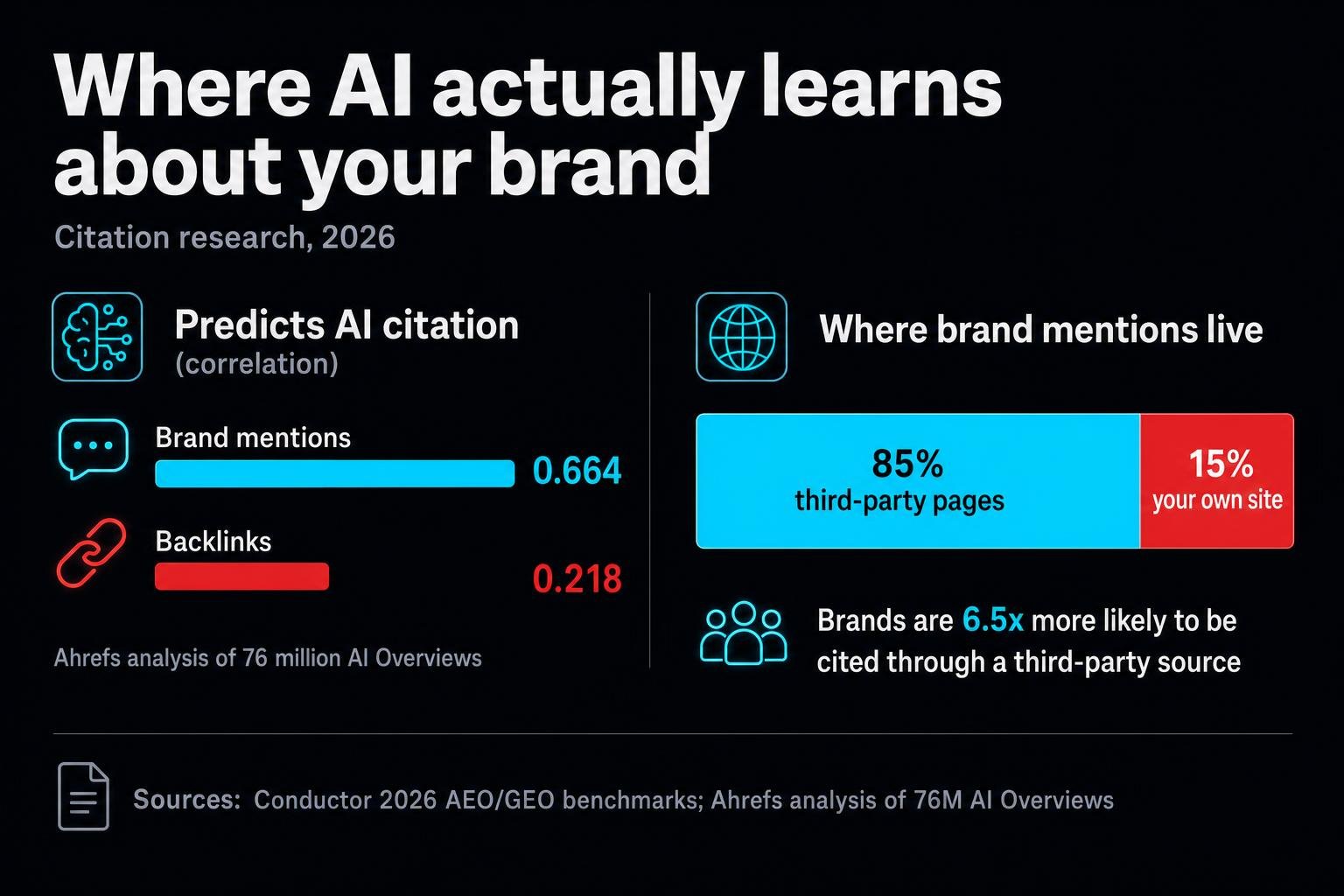
According to Conductor's 2026 AEO/GEO benchmarks, roughly 85% of brand mentions in AI search originate from third-party pages, not brand-owned sites. Put another way: brands are about 6.5x more likely to be cited through a third-party source than through their own website.
Think about how you actually learn whether a restaurant is good. You do not read the restaurant's own menu board and conclude, well, they say the risotto is exceptional, case closed. You read what other people wrote about it. You skim a roundup, you check a forum, you ask a friend who lives nearby. The restaurant's own site is one input, and honestly the least trusted one, because of course it's flattering.
Language models learn about your brand the same way, and for the same reason. They are built from text written across the whole web, and the overwhelming majority of the text about you was not written by you.
Mentions beat backlinks, roughly 3 to 1
The second number is the one that should reorganize budgets. Ahrefs analyzed 76 million AI Overviews and found that brand mentions correlate 0.664 with citation probability, while backlinks correlate 0.218.
That gap has a mechanical explanation, and once you see it you can't unsee it. A backlink is a structure. It's plumbing, an instruction for a crawler to follow a path. A mention is a sentence: "if you need X, most people go with Y." Models are made out of sentences. They read text; they largely don't traverse the plumbing.
A link is a road. A mention is a rumor. Language models don't drive, they listen.
So the entire link-building industrial complex isn't merely dated in this context. It's optimizing the weaker of the two variables, by a factor of three.
What actually moves the needle
The rest of the benchmark data sharpens the picture:
- Topical authority explains about 17% of citation variance. Domain Authority explains under 4%. Being deeply, visibly knowledgeable about one narrow thing beats being a big generic domain.
- Freshness has a cliff. On fast-moving queries, content older than 90 days enters a decay window and loses retrieval priority. Not a gentle slope. A window.
- The platforms behave nothing alike. Perplexity always cites its sources. Google AI Overviews draw 99% of citations from the organic top 10, which means classic SEO still governs that surface almost entirely. ChatGPT pulls about 87% of its citations from web search when it cites at all, but here's the catch: 53.6% of ChatGPT responses return no web sources whatsoever.
That last one deserves a pause. More than half the time, the largest AI assistant in the world answers from what it already absorbed during training, not from a live lookup. You cannot optimize your way into a retrieval that never happens. You can only have already been in the corpus.
Why this matters now and not next year
Scale is what converts an interesting research finding into an urgent one. ChatGPT passed 900 million weekly active users, up from roughly 400 million in 2025. That is not an emerging channel. That is a doubling in a year, on a base that was already enormous.
The industry has noticed, if unevenly: 97% of digital leaders reported positive impact from answer-engine optimization, and 94% planned to increase generative-engine optimization spend in 2026. The demand is there. What's mostly missing is the correct shape of the work.
Because if 85% of your mentions live off your property, then "we'll optimize your pages for AI" is a proposal to work on the remaining 15%. The site still matters, obviously. It's the thing you fully control, it's table stakes, and on Google's AI Overviews it's nearly the whole game. But treating it as the entire program is like a restaurant repainting its own menu board while every review site in town runs a stale description from 2023.
The uncomfortable reframe
The honest read is that AI visibility looks a lot less like technical SEO and a lot more like digital PR plus genuine topical saturation. Roundups. Comparison pages. Communities and forums where your category actually gets discussed. Podcast and interview transcripts. Association and directory listings. Review platforms. The unglamorous, hard-to-automate surfaces where humans write sentences about you.
None of that is new advice, exactly. Publicists have said it forever. What's new is that we now have correlation numbers attached, and they point the same direction: 0.664 versus 0.218, 85% versus 15%, topical depth over domain size.
And there's one number worth watching above all the others, because it decides which game everyone is playing next: that 53.6% no-sources rate. If it falls, and ChatGPT leans harder into live search, then getting cited becomes more valuable and, crucially, more measurable. If it rises, the leverage shifts from retrieval optimization to simply being present in the training corpus, which is a slower, stranger, far less controllable game.
Either way, the storefront metaphor is finished. You're not being read. You're being talked about, and the model is listening to the room, not to you.
One signal a day. No noise.
A 3-minute read when something genuinely shifts in AI, automation, or defense tech. Free, most weekdays.
Free, most weekdays. No spam, unsubscribe anytime.Sources
- Conductor - AEO/GEO Benchmarks Report - https://www.conductor.com/academy/aeo-geo-benchmarks-report/
- Brentonway - AEO Statistics - https://brentonway.com/blog/aeo-statistics
Quick answers
What percentage of AI brand mentions come from a brand's own website?
Only about 15%. Conductor's 2026 AEO/GEO benchmarks found roughly 85% of brand mentions in AI search originate from third-party pages, and that brands are about 6.5x more likely to be cited through a third-party source than through their own site.
Do backlinks still matter for AI search visibility?
Less than mentions do. Ahrefs' analysis of 76 million AI Overviews found brand mentions correlate 0.664 with citation probability, versus 0.218 for backlinks. Links still matter for classic ranking, and Google AI Overviews draw 99% of citations from the organic top 10, but plain text mentions are the stronger predictor.
How often does ChatGPT actually cite web sources?
Less than half the time. About 53.6% of ChatGPT responses return no web sources at all. When it does cite, roughly 87% of those citations come from web search.
How fresh does content need to be for AI engines?
On fast-moving queries, content older than 90 days enters a decay window and loses retrieval priority. Topical authority also matters far more than domain size: it explains about 17% of citation variance, while Domain Authority explains under 4%.