Every AI Just Grew an Approve Button
In the space of a few weeks, an ad network, a marketing automation platform, and a U.S. intelligence agency all landed on the same design pattern. The bottleneck for AI agents was never intelligence. It was trust.

Something quietly remarkable happened over the last few weeks. A marketing automation platform, the world's largest ad network, and a United States intelligence agency all shipped or funded the same idea, apparently without coordinating. The idea is unglamorous, has no demo reel, and will not trend on X. It is also, I think, the most important design pattern in AI right now.
The machine proposes. A human approves.
Three announcements, one shape
Start with GoHighLevel, the marketing automation suite that a large chunk of the agency world runs on. Its August 3 to 7 release week gave its AI assistant the ability to build entire ad campaigns from a prompt. That is the headline. The detail underneath the headline is the interesting part: those campaigns stay in draft until a human explicitly approves publishing. The AI got a promotion and a supervisor in the same release note.
Then Meta. August's Advantage+ changes let the system rewrite headline text baked directly into your ad creative. Not the copy fields, the actual pixels inside the image. Alongside that capability, Meta shipped a new setting called Restricted Words, a denylist you populate with terms the AI must never generate, plus a per-creative opt out. One announcement, two halves: here is a much more aggressive automation, and here is the brake pedal we built because we knew you would need one.
And then, from a completely different universe, the National Geospatial-Intelligence Agency. Enabled Intelligence won a seven year contract worth up to $708.3 million for computer vision work: object detection, tracking, classification, pattern detection. Standard enough. But the scope also explicitly includes natural language and machine learning for business process automation across the intelligence mission. Translation: a large part of that budget is not for the model that spots the thing. It is for the workflow that routes what the model spotted to the right human, with the right context, and records what they decided.
An ad platform, a CRM, and a spy agency walked into 2026 and independently drew the same architecture on the whiteboard.
The number that explains all of it
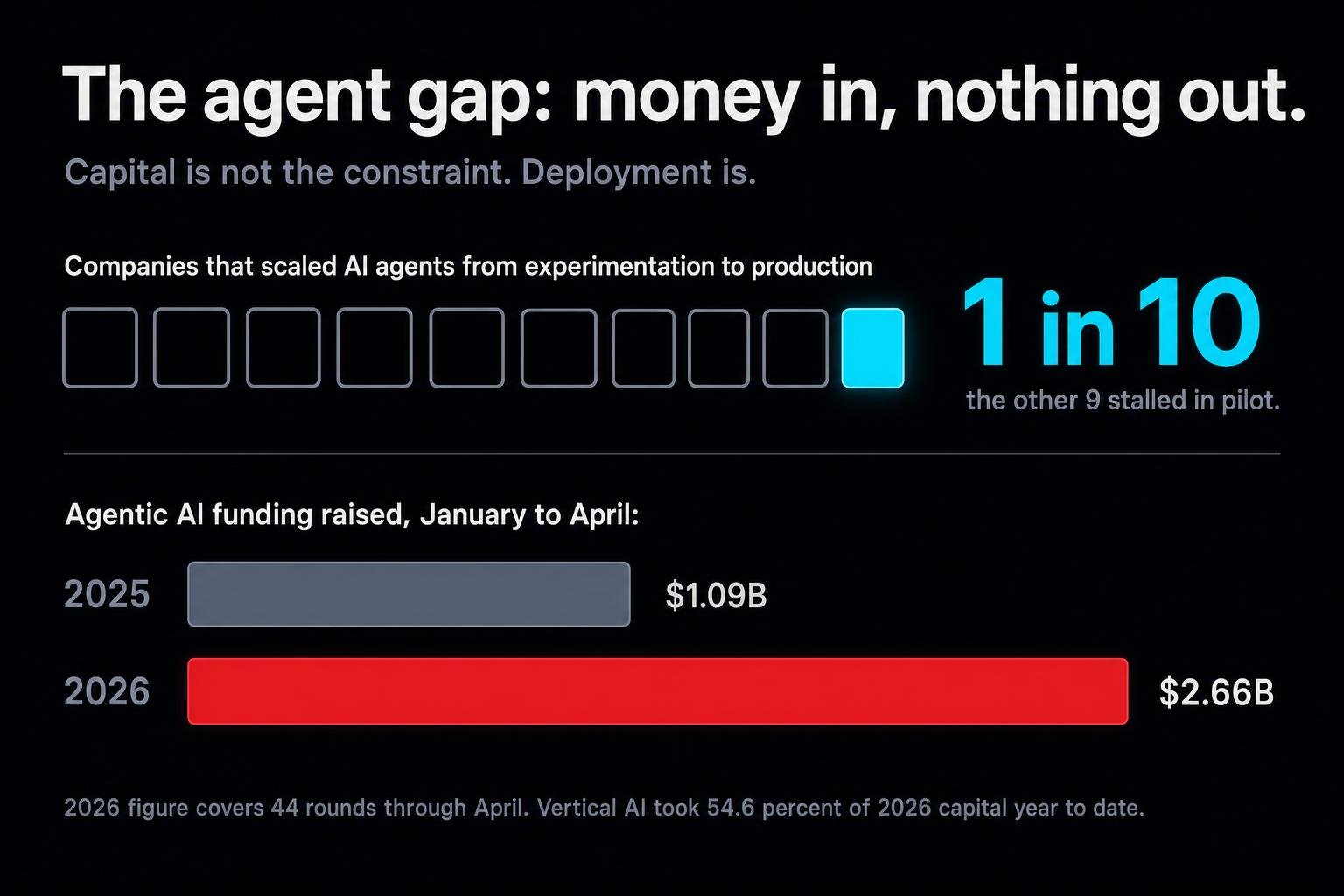
Here is the statistic I cannot stop thinking about. Vertical AI took 48.3% of 2026 deals and 54.6% of all capital year to date. Agentic AI startups raised $2.66 billion across 44 rounds through April 2026, up from $1.09 billion in the same window a year earlier. Money is not the constraint. Enthusiasm is not the constraint.
And yet: only about 1 in 10 companies have scaled an AI agent from experimentation into production.
Nine out of ten AI agents are stuck in the pilot phase. That is not a model problem. The models are fine. It is a permissions, data hygiene, and trust problem, and no amount of GPU spend fixes it.
Think about self-driving cars. The genuinely hard engineering problem was never the highway cruising, which looked solved years ago. It was the handoff: when does the car give control back, how does it tell you, and who is responsible for the two seconds in between. Every company trying to deploy an agent right now is stuck at exactly that handoff.
Or put it in hiring terms. You have just recruited an extraordinarily fast intern who has read everything, works at 3am, and never gets bored. Would you hand them the company credit card and the ad account on day one with no review process? Of course not. That instinct is not conservatism. It is the entire reason 90% of agent projects never leave the sandbox, and the platforms have finally started shipping the thing that resolves it.
Meta's denylist is a quiet transfer of responsibility
The Restricted Words setting deserves more attention than it got. A denylist means the burden of enumerating what the AI must never say has moved onto you. The platform provides the mechanism; you provide the list. If your product sits anywhere near health, finance, or any regulated claim, the difference between a configured denylist and an empty one is the difference between an optimization experiment and a compliance incident.
Most people running these campaigns will never open that setting. Not because they are careless, but because nobody told them the automation now edits the words printed inside their images.
What this actually means if you are shipping AI
Three things follow, and they apply whether you are automating ad copy or triaging satellite imagery.
- Write the guardrails before the agent runs, not after it embarrasses you. Every one of these platforms shipped the constraint in the same release as the capability. That is the tell.
- The audit log is the product. What did the agent do, when, on whose authority, based on what evidence. This is precisely what converts a nervous executive no into a yes with conditions. It is also, not coincidentally, what a $708 million government contract is partly paying for.
- The valuable human skill is shifting from producing to reviewing. If the machine drafts twenty campaigns, the scarce capability is judging twenty campaigns quickly and well. Review throughput is a real discipline, and almost nobody is training for it yet.
The pattern is remarkably consistent across sectors that share no customers, no regulators, and no engineers: machine proposes with a confidence score, work lands in a prioritized queue, a human reviews with full context, they approve or reject or escalate, and every decision is logged immutably.
That is not a hedge or a transitional phase before full autonomy arrives. On the current evidence it is the shape of responsible AI deployment, arrived at simultaneously by an ad network optimizing for spend, a software platform optimizing for churn, and an intelligence agency optimizing for not being catastrophically wrong. When three parties with nothing in common converge on the same answer, it is usually because it is the answer.
The approve button is not a limitation on AI. Right now, it is the thing that lets AI ship at all.
One signal a day. No noise.
A 3-minute read when something genuinely shifts in AI, automation, or defense tech. Free, most weekdays.
Free, most weekdays. No spam, unsubscribe anytime.Sources
- NetPartners - HighLevel updates, week of August 3 to 7, 2026 - https://netpartners.marketing/highlevel-updates-week-august-3-7-2026/
- GoHighLevel.ai - GoHighLevel updates 2026 - https://www.gohighlevel.ai/blog/gohighlevel-updates-2026
- AdMake AI - Meta Ads updates, August 2026 - https://admakeai.com/blog/meta-ads-updates-august-2026
- Benly - Advantage+ updates 2026 - https://benly.ai/learn/meta-ads/advantage-plus-updates-2026
- New Market Pitch - Vertical AI funding analysis - https://newmarketpitch.com/blogs/news/vertical-ai-funding-analysis
- New Market Pitch - Agentic AI funding trends - https://newmarketpitch.com/blogs/news/agentic-ai-funding-trends
- Gravity - AI agent funding tracker, Q3 2026 - https://gravity.fast/blog/ai-agent-funding-tracker-q3-2026/
- Payload Space - Enabled Intelligence bags $708M NGA contract - https://payloadspace.com/enabled-intelligence-bags-708m-nga-contract/
- OrangeSlices AI - NGA announces AI Industry Day - https://orangeslices.ai/nga-announces-ai-industry-day-showcasing-future-contract-opportunities/
Quick answers
What does agent proposes, human approves actually mean?
It is a deployment pattern where an AI system generates work (an ad campaign, a detection, a draft reply) but cannot execute it. The output lands in a queue, a human reviews it with full context, and approves, rejects, or escalates it. Every decision is logged. GoHighLevel, Meta, and the National Geospatial-Intelligence Agency all shipped or funded versions of this pattern in 2026.
Why do so few companies get AI agents into production?
Only about 1 in 10 companies have scaled an AI agent from experimentation to production. The blocker is generally not model capability. It is integration, permissions, data hygiene, change management, and trust. Those are implementation problems, not research problems.
What is Meta's Restricted Words setting?
It is a denylist in Advantage+ campaign setup where advertisers list terms the AI must never generate. It arrived alongside a much more aggressive capability: Advantage+ can now rewrite headline text baked into ad creative images, not just the copy fields. Advertisers can also opt out per creative.
Is AI agent funding still growing in 2026?
Yes, sharply. Agentic AI raised $2.66 billion across 44 rounds through April 2026, compared with $1.09 billion in the same period a year earlier. Vertical AI agents accounted for 48.3 percent of 2026 deals and 54.6 percent of capital year to date.