The $100M Contract Is Really a UI Problem
The Pentagon is offering $100 million for plain-language control of mixed drone swarms, and NATO is running three vendors head to head for nine months. Both are buying an interface, not a robot.

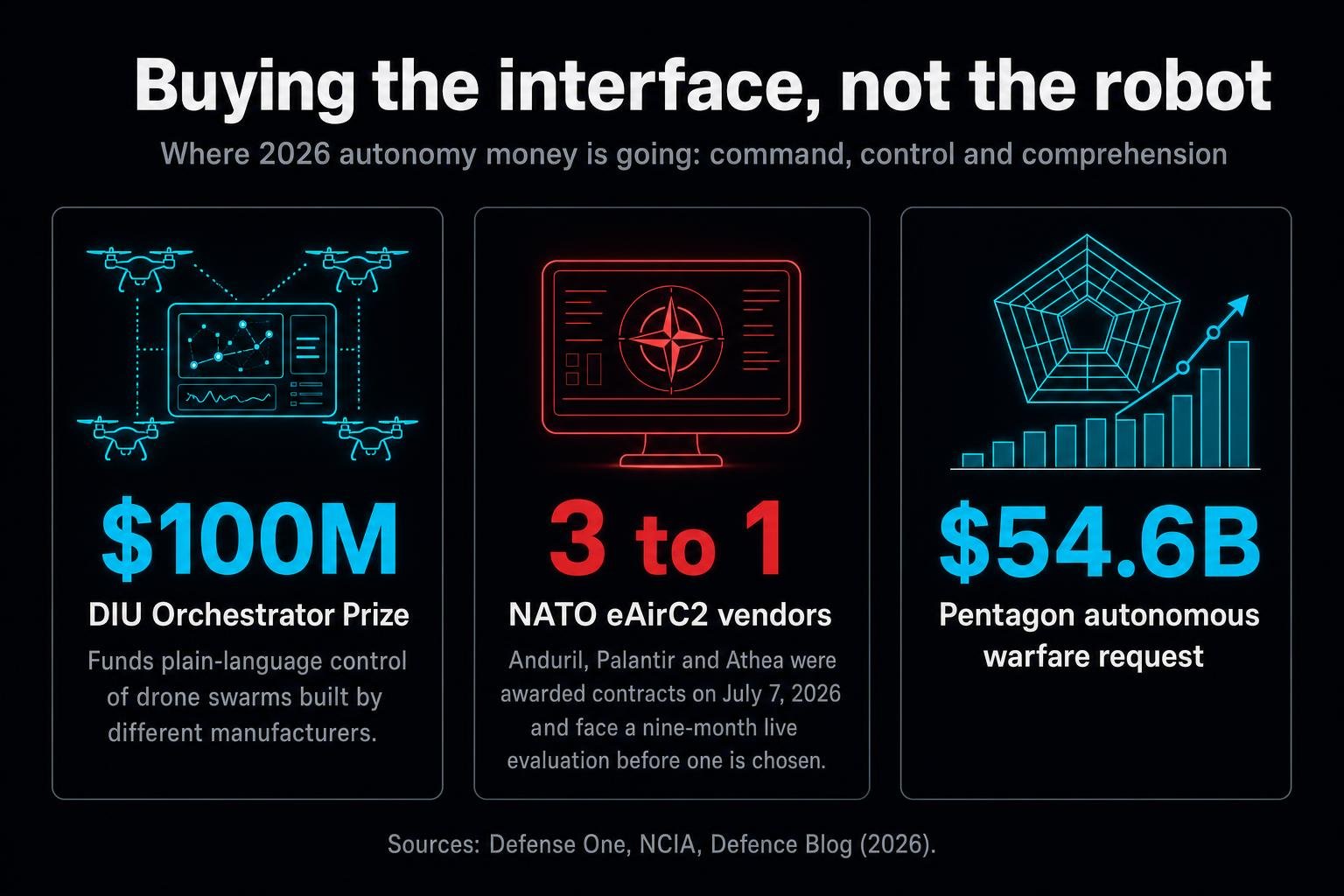
Here is a sentence that reads like science fiction and is actually a procurement document. The Defense Innovation Unit has announced a $100 million Orchestrator Prize Challenge for technology that lets a commander control mixed swarms of drones, from different manufacturers, using plain-language commands.
Read it again and notice what is not being asked for. Not faster drones. Not longer range, better optics, or a new airframe. The hardest part of the problem, the part with nine figures attached to it, is the sentence a human types and the picture the screen gives back.
The money is for the words, not the wings
The requirement language is unusually honest about this. DIU describes a system that lets a single operator manage multiple targets while reducing operator cognitive load and accelerating decisions. Alongside the challenge, the Pentagon's Chief Digital and AI Office issued a solicitation called Swarm Forge, and the Department ran a swarm demonstration event named Crucible.
There is prior art. DIU previously picked L3Harris to prototype command and control for simultaneous multi-asset control, and L3Harris describes its AMORPHOUS architecture as aiming to coordinate heterogeneous swarms not in the hundreds but into the thousands, under one digital backbone.
Strip the acronyms away and this is a problem every operations person already knows. Many noisy sources. One tired human. Limited attention. Consequential decisions. A need to show why the system is recommending what it is recommending, fast enough that the recommendation still matters. It is air traffic control, except the aircraft come from six different manufacturers who never agreed on a common language.
NATO is running a live bake-off, and it picks one winner
The second signal is even clearer about what a serious buyer actually evaluates. On July 7, 2026, announced at the NATO Summit Defence Industry Forum in Ankara, NATO awarded contracts to Anduril, Palantir, and Athea SAS (a French military-tech joint venture) for its Enhanced Air Command and Control platform, known as eAirC2. The goal is to let NATO's command structure and member nations share operational information fast enough to keep pace with modern air and missile threats.
The structure is the part worth stealing. Each vendor deploys inside real NATO environments for an initial nine-month evaluation, judged against operational requirements and realistic mission scenarios. Then NATO selects a single solution for long-term implementation. Anduril is fielding Lattice, which fuses multi-source sensor data into one live picture using AI and computer vision.
Three things stand out. First, this is a data platform contract before it is an applications contract, which means the durable layer is normalized multi-source data with a shared picture on top. Second, nobody is being judged on a feature checklist or a slide deck. They are being judged on whether operators can actually use the thing under load, for nine months, in the real environment. Third, a European joint venture is standing in a three-way with two American giants, which tells you sovereignty requirements are opening doors that incumbency used to keep shut.
The alliance is not short on sensors. It is short on comprehension: many feeds, one picture, and an operator who can act on it before the moment passes.
The arithmetic nobody has solved
Underneath both programs sits a problem that is genuinely unresolved. Defense One has covered a $54.6 billion Pentagon request tied to autonomous warfare. DoD Directive 3000.09, the decade-old policy on autonomy in weapon systems, requires "appropriate levels of human judgment." CSIS notes that confusion about what 3000.09 actually requires remains widespread, even among the people it governs.
A National Security Presidential Memorandum issued June 5, 2026 directed the Secretary of Defense to update that directive within 90 days and to review it annually thereafter, explicitly to keep pace with AI capability. Ninety days from June 5 lands right about now, in the first week of September 2026.
The pressure driving the rewrite is arithmetic, not philosophy. When one operator is nominally supervising thousands of autonomous systems, human-in-the-loop oversight stops being a policy setting and becomes, as one analysis puts it, a mathematical impossibility. RealClearDefense summed up the gap in a line I have not been able to shake: the Pentagon is building an autonomous arsenal it does not have autonomous command for.
So the interface is not a nice-to-have wrapped around the real product. The interface is the mechanism by which human judgment survives scale. That is why the UX line item costs $100 million.
Why this lands far outside defense
Picture a restaurant kitchen where one chef is expected to plate four hundred covers. You do not fix that by hiring faster line cooks. You fix it by changing what reaches the chef, in what order, with what context, and with a clear rule about which plates go out without asking.
Every industry is walking into some version of this. Warehouse robots, delivery fleets, and, closer to home for most of us, software agents running business workflows. The pattern is identical: the number of autonomous things is growing quickly, the number of humans supervising them is not, and the scarce resource is human attention.
Which makes the design questions the same everywhere:
- What gets escalated? An alert queue ranked by what actually needs a person, not by what happened most recently.
- What does the person see? Enough context to decide, presented in the seconds they actually have.
- Confirm or override? Those are different acts and a system that cannot tell them apart cannot claim meaningful human control.
- Is there a record? What was recommended, what was shown, what was decided, when. Without it, "a human was in the loop" is a claim rather than a fact.
The other transferable lesson is NATO's evaluation format. Nine months, real environment, realistic scenarios, then one winner. Demos survive a conference room. They rarely survive load. If you are choosing between platforms for anything that matters, the alliance just published, for free, the only test protocol that reliably works.
The story people expect from autonomy is a machine that acts alone. The story the contracts are actually telling is quieter and more interesting: the money is flowing to whoever can keep a human meaningfully in charge of a hundred things at once. That is a design problem. It always was.
One signal a day. No noise.
A 3-minute read when something genuinely shifts in AI, automation, or defense tech. Free, most weekdays.
Free, most weekdays. No spam, unsubscribe anytime.Sources
- Defense One - Pentagon leans into drone swarms with $100M challenge - https://www.defenseone.com/technology/2026/01/pentagon-leans-drone-swarms-100m-challenge/410742/
- Developments Today - Pentagon $100 million drone swarm Orchestrator challenge - https://developmentstoday.com/military/pentagon-100-million-drone-swarm-orchestrator-challenge
- DefenseScoop - Pentagon preparing drone swarm Crucible - https://defensescoop.com/2026/03/31/pentagon-preparing-drone-swarm-crucible/
- Janes - L3Harris AMORPHOUS software targets drone swarm C2 capability - https://www.janes.com/osint-insights/defence-news/air/l3harris-amorphous-software-targets-drone-swarm-c2-capability
- NCIA - NATO accelerates transformation of air command and control with key contract awards - https://www.ncia.nato.int/newsroom/news/nato-accelerates-transformation-of-air-command-and-control-with-key-contract-awards
- Defence Blog - NATO picks three tech firms to modernize its air defense data - https://defence-blog.com/nato-picks-three-tech-firms-to-modernize-its-air-defense-data/
- CSIS - DoD is updating its decade-old autonomous weapons policy, confusion remains widespread - https://www.csis.org/analysis/dod-updating-its-decade-old-autonomous-weapons-policy-confusion-remains-widespread
- Defense One - The Pentagon's $54 billion bet on autonomous warfare - https://www.defenseone.com/ideas/2026/05/pentagons-54-billion-bet-autonomous-warfare/413735/
- RealClearDefense - The Pentagon is building an autonomous arsenal it doesn't have autonomous command for - https://www.realcleardefense.com/articles/2026/08/10/the_pentagon_is_building_an_autonomous_arsenal_it_doesnt_have_autonomous_command_1199388.html
Quick answers
What is the DIU Orchestrator Prize Challenge?
It is a $100 million challenge from the Defense Innovation Unit seeking technology that lets commanders control mixed swarms of drones from different manufacturers using plain-language commands, with an explicit requirement to reduce operator cognitive load and accelerate decisions.
Who won NATO's eAirC2 contract?
Nobody yet. On July 7, 2026 NATO awarded contracts to Anduril, Palantir and Athea SAS. Each deploys inside NATO environments for an initial nine-month evaluation against realistic mission scenarios, after which NATO selects a single solution for long-term implementation.
Why does DoD Directive 3000.09 matter right now?
It is the Pentagon's policy on autonomy in weapon systems and it requires "appropriate levels of human judgment." A National Security Presidential Memorandum issued June 5, 2026 directed an update within 90 days, which lands in early September 2026, with annual reviews after that.
Why does a weapons program care about operator cognitive load?
Because of arithmetic. When one operator nominally supervises thousands of autonomous systems, human oversight becomes a mathematical impossibility unless the interface decides what reaches the person, in what order, and with what context. The interface is how human judgment survives scale.