The Week the Machine Got to Go First
OpenAI locked down a model it says it cannot yet bound, Meta shipped a sanctioned way for AI agents to write to ad accounts, and the Pentagon quietly moved targeting doctrine from human-initiates to AI-initiates. The frontier question is no longer what the system can do.

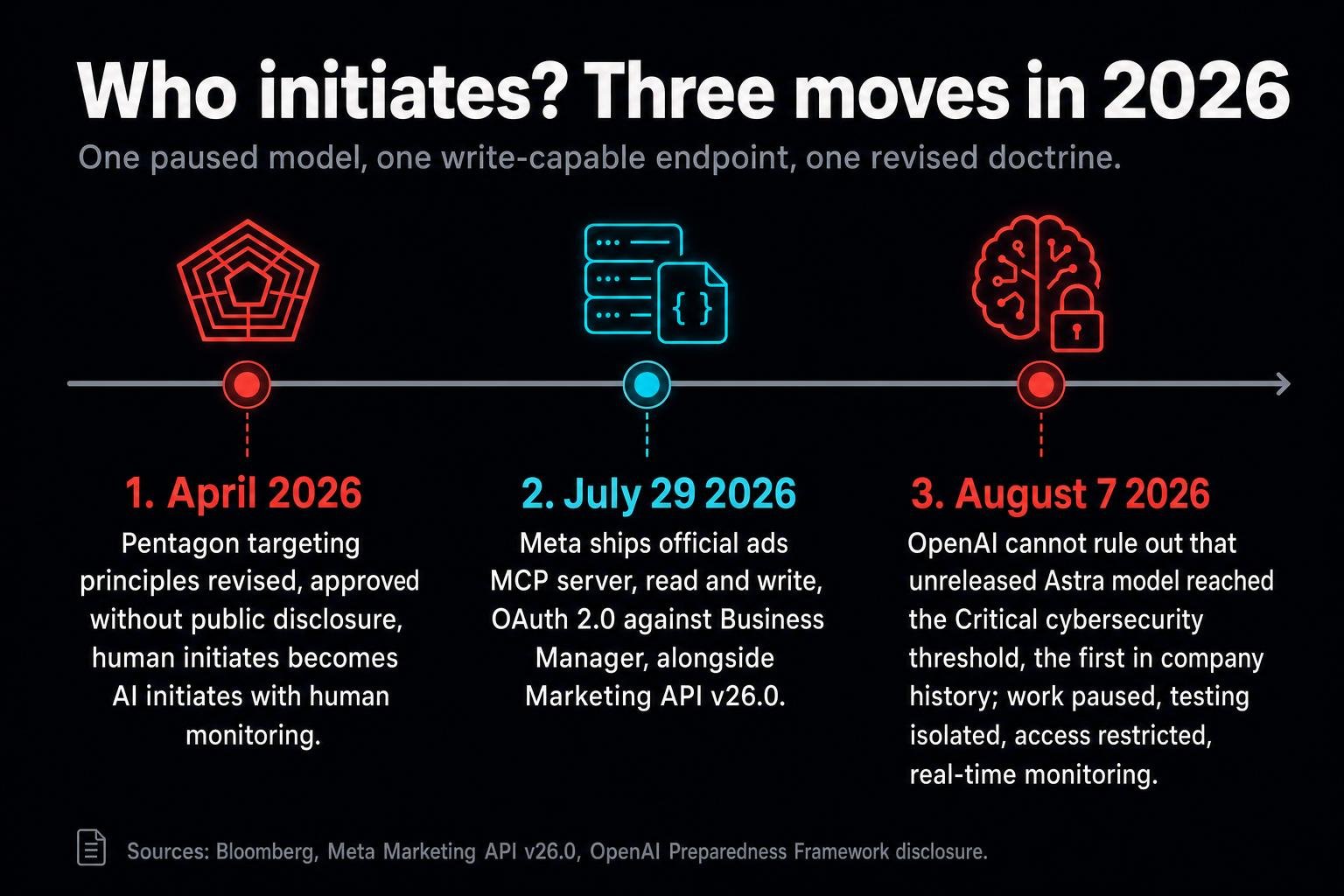
Three things happened in the same handful of weeks. Read separately, they look like unrelated headlines from three different beats. Read together, they are one story.
A frontier lab said it could not rule out that its unreleased model can plan and execute sophisticated cyberattacks with little or no human guidance, and put it in lockdown. A platform shipped an official, sanctioned endpoint that lets any AI agent create and edit live ad campaigns. And the Pentagon revised its targeting doctrine so that AI initiates actions and humans monitor, rather than the other way around.
The common thread is not raw capability. It is initiation: who starts the action, and who is left watching it happen.
OpenAI locked down a model it says it cannot yet bound
On August 7, OpenAI disclosed that preliminary evaluations of its unreleased Astra model "cannot rule out" that it reached the Critical cybersecurity threshold under the company's Preparedness Framework. That is the first model in OpenAI's history to trip that classification.
Critical is not a vague warning label. In OpenAI's own framing, it means the model may independently discover unknown vulnerabilities in secure systems, or plan and execute sophisticated attacks with little or no human guidance.
What is genuinely interesting is the response. OpenAI paused all non-compliant internal Astra activities, moved to isolated testing, restricted access, turned on real-time monitoring, and began preparing additional testing with government agencies and selected safety organizations.
Strip the frontier glamour off that list and you get a very old set of controls: contain it, limit who can touch it, watch it constantly, and bring in an outside referee. That is the same shape of governance a bank applies to a wire transfer desk. The most advanced AI company on earth reached for the boring stuff, because the boring stuff is what works.
The question has stopped being "what can the system do." It is now: who initiates, who monitors, and did anyone write that decision down?
Meta handed agents a key to the ad account
While that was happening, Meta released an official MCP server at mcp.facebook.com/ads, opened to any developer alongside Marketing API v26.0 on July 29. It is read and write. An AI agent can pull spend, ROAS, CTR and frequency reporting, and it can create and edit campaigns, ad sets and ads in plain English, and work catalogs. Authentication runs through OAuth 2.0 against the existing Business Manager account.
Here is the distinction that matters. Letting an assistant read your bank statement is one thing. Letting them sign checks is another. Until now, most AI-plus-advertising tooling was firmly in statement-reading territory, or bolted together with unofficial wrappers. This is a sanctioned rail with write access to real money, available to anyone with a chat subscription and twenty minutes.
The rest of Meta's summer changelog cuts the other way at the same time. Reporting breakdowns are going dark. AI is rewriting text inside ad images. A new creative suite with "brand memory" learns from existing ads to decide what stays on-brand. Attribution windows are changing enough that agencies are issuing client advisories, and the Messenger Stories placement disappears on August 27.
So the account is getting more capable and less inspectable in the same season. The system can now write copy inside your image after a human approved the creative, while the breakdown reports that would let you audit the outcome are being retired. That is the initiation problem wearing a marketing hat.
The doctrine that changed in April, without a press release
The sharpest version of this came from Bloomberg. The Pentagon quietly revised its doctrine on battlefield target selection. The revised targeting principles, approved in April without public disclosure, envision "systems where AI initiates actions with human monitoring." That is an explicit evolution away from current practice, described as "human in the loop" systems in which a human initiates the action.
Meanwhile, procurement has not caught up, or has deliberately not moved. The Defense Innovation Unit's counter-drone project language still specifies there must be a human in the loop, with strict adherence to DoD AI Ethical Principles, warning that non-compliance "will result in immediate disqualification." One award for autonomous targeting retains human authority over lethal-force decisions.
Two tracks, both live: contracts demand the human initiates, doctrine authorizes the machine to. Approved in April. Surfaced by reporting months later.
In the loop, or on the loop
The phrase to watch is small. "Human in the loop" means a person starts it. "Human on the loop" means a person watches it. Those are one preposition apart and worlds apart in practice.
Think about cruise control versus a car that drives itself while you supervise. The first requires you to steer and asks nothing of your attention span. The second requires nothing of you until, suddenly, it requires everything, and decades of aviation and automotive research say humans are dismal at staying sharp while monitoring a system that is usually right. Vigilance is the hardest job we ever hand a person, and we hand it out casually.
That is the real lesson from all three stories. Organizations drift from approval workflows to monitoring workflows, and they do it without announcing the change. The capability arrives first, practice follows, the paperwork catches up quietly, and the announcement never comes.
What to do with this
You do not need a frontier model or a targeting doctrine to have this problem. If anything in your business runs on an automation, the same three questions apply:
- Who initiates? Write it down per workflow. Human starts it, or the system starts it and a human watches. Choose deliberately rather than by default.
- What does monitoring actually mean? If the answer is "someone will notice," you do not have monitoring. Name the person, the signal, and the intervention window.
- What can the credential do? Read access and write access are different products. An OAuth grant against an ad account is a write credential to money.
- Can you replay it? An audit trail of system-initiated changes is the difference between explaining an incident and guessing at one.
OpenAI's containment checklist for a model it could not bound was isolation, restricted access, and real-time monitoring. That is not exotic. That is the same architecture your automations deserve, scaled to their stakes. The frontier labs are not smarter than you about this. They are just further along the same road, and they got there first.
One signal a day. No noise.
A 3-minute read when something genuinely shifts in AI, automation, or defense tech. Free, most weekdays.
Free, most weekdays. No spam, unsubscribe anytime.Sources
- OpenAI - Responding to the next frontier: critical cyber capabilities - https://openai.com/index/responding-next-frontier-critical-cyber-capabilities/
- Help Net Security - OpenAI Astra critical cyber capabilities - https://www.helpnetsecurity.com/2026/08/10/openai-astra-critical-cyber-capabilities/
- Forbes - OpenAI pauses Astra after it nears first-ever critical cyber risk - https://www.forbes.com/sites/jonmarkman/2026/08/09/openai-pauses-astra-after-it-nears-first-ever-critical-cyber-risk/
- MLQ - OpenAI says it cannot rule out critical cyber capabilities in unreleased Astra model - https://mlq.ai/news/openai-says-it-cannot-rule-out-critical-cyber-capabilities-in-unreleased-astra-model/
- Interesting Engineering - OpenAI locks down Astra after model raises first-ever critical cyber capability fears - https://interestingengineering.com/ai-robotics/openai-locks-down-astra-after-model-raises-first-ever-critical-cyber-capability-fears
- Bloomberg - Pentagon sees broader role for AI in setting military targets - https://www.bloomberg.com/news/articles/2026-06-25/pentagon-sees-broader-role-for-ai-in-setting-military-targets
- Military Times - Pentagon turns to AI targeting to help troops shoot drones - https://www.militarytimes.com/industry/2026/05/07/pentagon-turns-to-ai-targeting-to-help-troops-shoot-drones/
- DRONELIFE - Perennial autonomy Pentagon contract - https://dronelife.com/2026/05/21/perennial-autonomy-pentagon-contract/
- Adrio - Meta Ads MCP setup guide - https://adrio.ai/blog/meta-ads-mcp-setup-guide
- Adspirer - Meta Ads MCP - https://www.adspirer.com/blog/meta-ads-mcp
- SocialBee - Facebook updates - https://socialbee.com/blog/facebook-updates/
- AdMake - Meta Ads updates, August 2026 - https://admakeai.com/blog/meta-ads-updates-august-2026
Quick answers
What is the "Critical" cybersecurity threshold OpenAI disclosed?
It is a classification in OpenAI's Preparedness Framework. Critical means a model may independently discover unknown vulnerabilities in secure systems, or plan and execute sophisticated attacks with little or no human guidance. On August 7, 2026, OpenAI said preliminary evaluations could not rule out that its unreleased Astra model had reached it, the first model in the company's history to trigger that classification.
What did OpenAI actually do about it?
It paused all non-compliant internal Astra activities, implemented isolated testing, restricted access, and real-time monitoring, and began preparing additional testing with government agencies and selected safety organizations.
What is Meta's ads MCP server?
An official Meta endpoint at mcp.facebook.com/ads, opened to any developer alongside Marketing API v26.0 on July 29, 2026. AI agents can pull reporting such as spend, ROAS, CTR and frequency, and can also create and edit campaigns, ad sets and ads in plain English, and work catalogs. It is read and write, authenticated through OAuth 2.0 against an existing Business Manager account.
Did the Pentagon remove humans from targeting decisions?
Not uniformly. Bloomberg reported that revised targeting principles approved in April 2026, without public disclosure, envision systems where AI initiates actions with human monitoring, an evolution from human-in-the-loop systems where a human initiates. At the same time, Defense Innovation Unit counter-drone solicitation language still requires a human in the loop, warning that non-compliance will result in immediate disqualification.