The Terms Changed, Not the Technology
On August 31 no major model shipped. Instead two music publishers named a CEO personally in a copyright suit, OpenAI moved to cut off a rival owner's coding tool, and the price of a popular model jumped 50%. The rules of using AI moved more than AI did.

Some days in AI are about capability. A model gets smarter, a demo goes viral, everyone argues about benchmarks for a week. Monday, August 31 was not one of those days. Nothing major shipped.
And yet it may have been the most consequential day of the month, because three separate things moved at once: who can be personally sued for how a model was trained, who is allowed to call a model at all, and what that call costs. None of that is technology. All of it is terms. And terms are what you actually build a business on.
A copyright suit that names people, not just a company
On August 28, Sony Music Publishing and Warner Chappell Music sued Anthropic in the Northern District of California. The allegation is that the company torrented, scraped and downloaded tens of thousands of copyrighted compositions to train Claude. The complaint seeks up to $150,000 per infringed work, which at the alleged scale runs into the billions. Named songs include Eye of the Tiger and Uptown Funk.
That part is almost routine by now. Concord and Universal filed over roughly 500 compositions in January. BMG has its own action. Every frontier lab has copyright exposure priced somewhere into its balance sheet, and the suits arrive on a schedule.
Here is the part that is not routine. The complaint names CEO Dario Amodei and co-founder Benjamin Mann individually, not just the corporate entity. It lands against the backdrop of a reported $2 trillion valuation round.
Think of the difference this way. A speeding ticket issued to a delivery company is a line item. A speeding ticket issued to the person driving is a change in how that person drives. Corporate liability gets absorbed by the finance team. Officer liability gets absorbed by the officer, and it turns "where did our training data come from" from a research question into a board question, asked in a room where nobody wants to be the one who shrugged.
Model access became a competitive weapon
The next day, August 29, OpenAI notified the coding tool Cursor that it will terminate model access on November 12, 2026. The trigger is not technical and it is not abuse of the API by end users. It is ownership: SpaceX completed a roughly $60 billion acquisition of Cursor on August 14. OpenAI cites a history of contract violations and points at xAI having distilled its models without authorization. Cursor-served OpenAI models account for about 5% of user traffic, and OpenAI's new "Astra" model will not be made available there at all.
This is the second time in a year that a lab has revoked a downstream product's access for cap-table reasons. Anthropic previously cut off Windsurf under comparable circumstances, while keeping its own SpaceX compute lease in place.
Sit with that asymmetry for a second. One lab severs a SpaceX-owned product. Another lab keeps a SpaceX compute relationship. These positions are commercial, not principled, which means they will move again when the commercial logic moves.
If a single provider is load-bearing in your product, you have outsourced a shutdown decision to a boardroom you will never sit in, about a cap table you have no stake in.
And the meter went up
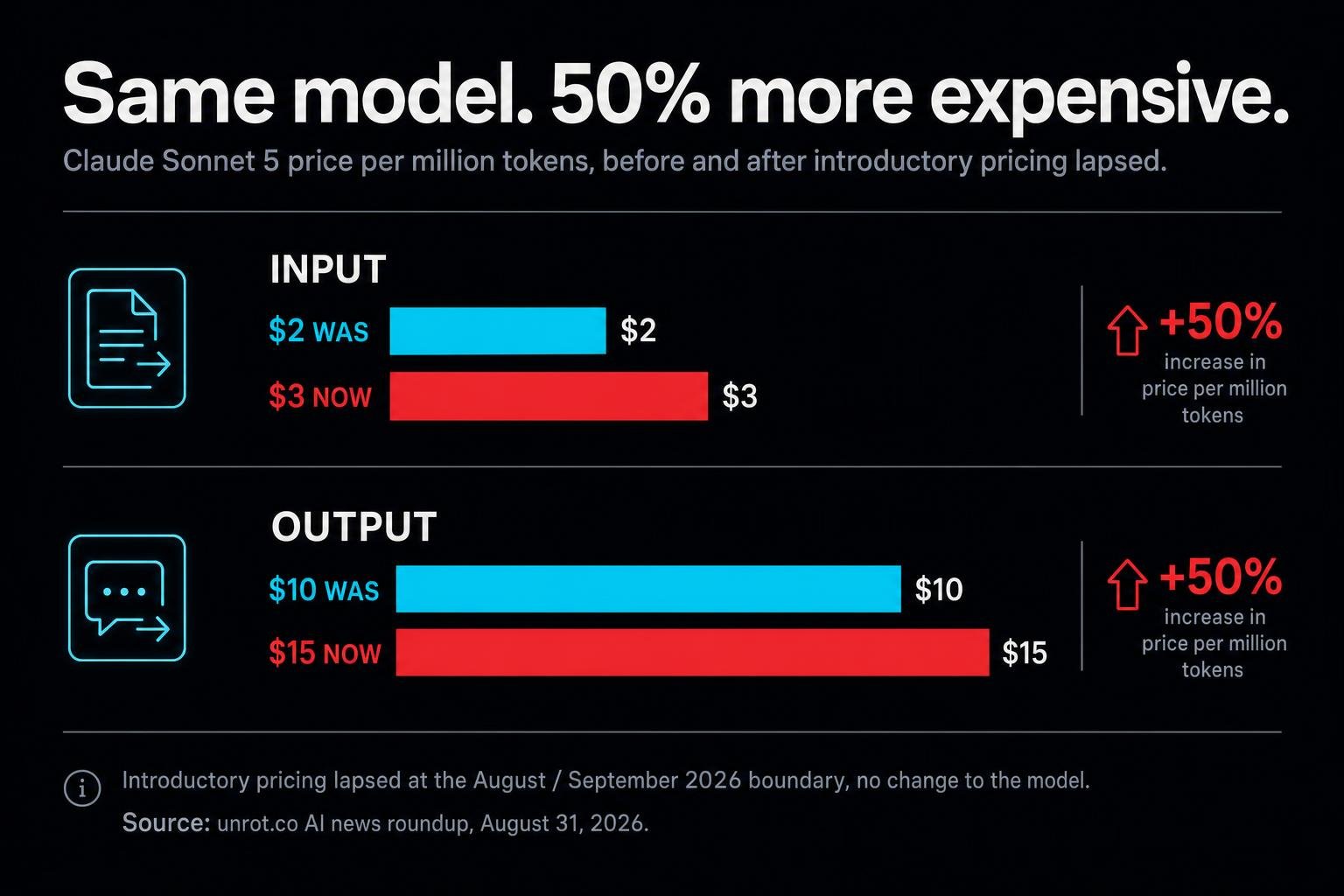
Quietly, at the August/September boundary, Claude Sonnet 5's introductory pricing lapsed. Input went from $2 to $3 per million tokens. Output went from $10 to $15. A 50% step on both legs, for exactly the same model doing exactly the same work.
Introductory pricing expiring is not a scandal. It is a promotion ending, and everyone who has ever seen a streaming service raise its price after year one understands the mechanic. But stack it on the other two stories and a pattern appears. In a single week, the same capability got legally riskier to have trained, politically riskier to depend on, and 50% more expensive to run. The model itself did not change by a single weight.
Regulators are writing terms too
The same day, California's legislature adjourned for the year with roughly 24 AI bills still racing through final votes, most at or near third reading in their second chambers. The topics span chatbot safety, children's use of AI, medical and mental-health disclosure, consumer rights, and frontier-model oversight. California and other states had already passed 85 new AI laws earlier in 2026. One measure that did pass requires that certain public-school employees, including nurses and psychologists, be human beings.
Read that last sentence again. In 2026 a legislature found it necessary to specify that the school nurse must be a person. That is not a joke about lawmakers. It is a marker of how fast the default assumption shifted.
What this actually means if you are building
The instinct in this industry is to track capability. Which model is smartest, which context window is longest, which benchmark moved. That instinct is now roughly one quarter behind where the real risk lives.
- Provider choice is a supply question, not a taste question. The most defensible move available to almost any team is boring: stop calling vendor SDKs directly from your business logic, and make the provider a configuration value. The success criterion is one line long. Can you switch providers by editing one file?
- Provenance is becoming a customer question. When officers are personally named in training-data suits, labs push warranties and indemnities into commercial terms, and the buyers downstream start asking whoever ships them AI-generated work where it came from. Recording which model produced what, and from which sources, costs nothing today.
- Price the trend, not the week. One vendor ending a promotion is a pricing decision. The multi-year data-center build-out points the other way. Do not rebuild your economics around a single step change in either direction.
The exciting version of AI news is the one where something gets smarter. The version that decides whether your product exists in eighteen months is the one where a contract clause changes. Monday was all clause.
One signal a day. No noise.
A 3-minute read when something genuinely shifts in AI, automation, or defense tech. Free, most weekdays.
Free, most weekdays. No spam, unsubscribe anytime.Sources
- unrot.co - Today's Top AI News, August 31, 2026 - https://unrot.co/blogs/today-top-ai-news-august-31-2026
- Pluribus News - The AI bills to watch before California legislators adjourn - https://pluribusnews.com/news-and-events/the-ai-bills-to-watch-before-california-legislators-adjourn/
- AI Laws by State - California - https://www.ailawsbystate.com/state/CA
Quick answers
Why does it matter that the Anthropic lawsuit names executives personally?
Sony Music Publishing and Warner Chappell filed on August 28 in the Northern District of California and named CEO Dario Amodei and co-founder Benjamin Mann individually, not just the company. Corporate copyright exposure is already priced into every lab's balance sheet. Personal officer exposure is not, which pushes training-data provenance from a research-team concern to a board-level one.
Why is OpenAI cutting off Cursor?
OpenAI notified Cursor on August 29 that it will terminate model access on November 12, 2026, after SpaceX completed a roughly $60 billion acquisition of Cursor on August 14. OpenAI cites a history of contract violations and points at xAI having distilled its models without authorization. OpenAI-served models were about 5% of Cursor's user traffic, and OpenAI's new Astra model will not be offered there.
How much did Claude Sonnet 5 pricing change?
Introductory pricing lapsed at the August / September 2026 boundary. Input went from $2 to $3 per million tokens and output went from $10 to $15 per million tokens, a 50% increase on both legs for the same model.
What should a small team actually do about provider risk?
Put every model call behind a single internal interface so the provider is a configuration value rather than an import scattered through your business logic. The test is whether you can switch providers by editing one file. Access has now been revoked twice in a year for ownership reasons that had nothing to do with the downstream product's behavior.