The Pentagon Line Item That Grew 24,000%
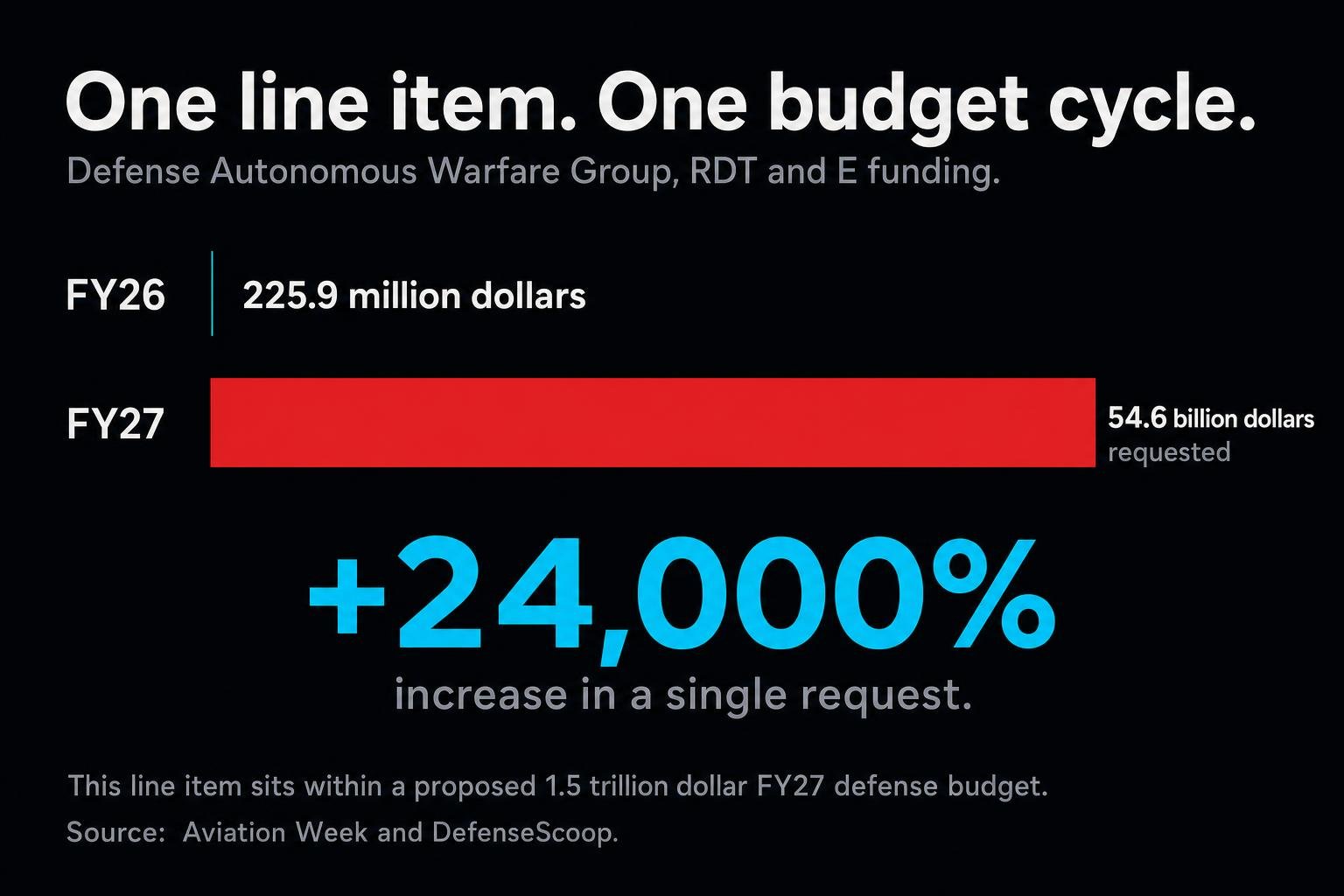
A little-known Pentagon group got about $225.9M in its first year. The FY27 request asks for $54.6B. That is not a budget increase, it is a category change.
Budget documents are boring on purpose. They are written to be skimmed by people who already know the answer. But every so often a single line in one of them tells you more than a year of press releases, keynote demos, and glossy hardware videos.
Here is this week's line. The Defense Autonomous Warfare Group, an organization most people outside the Pentagon have never heard of, received roughly $225.9 million in FY26, its first year of funding. The FY27 research and development request for it is $54.6 billion.
That is a roughly 24,000% increase in one budget cycle. And yes, the acronym is DAWG.
What a jump like that actually means
Percentages that large stop being intuitive, so here is the shape of it. Imagine a company that spent a couple hundred thousand dollars last year testing a new product line, quietly, in one office. This year it proposes spending fifty million on the same line. Nobody does that because the tests went slightly well. You do that when a leadership team has decided the thing being tested is no longer a side project, it is the main event.
The structural moves around the money say the same thing. The Pentagon has been standing up a new autonomous warfare sub-unified command. The Senate pushed for a Robotic and Autonomous Systems Combatant Command in the FY27 policy bill. Southcom created its own Autonomous Warfare Command. Money, command structure, and policy language all moved in the same direction inside a single year, which almost never happens by accident.
Scale matters for honesty here, so hold the number against the whole: Aviation Week frames the overall FY27 defense proposal at about $1.5 trillion. DAWG is not the budget. But it is one named group, one year removed from being a rounding error, now asking for tens of billions.
The constraint stops being money
This is the part I find genuinely interesting, and it is not really about defense at all.
When you increase spending on something by two orders of magnitude in twelve months, you do not get two orders of magnitude more capability. You get a traffic jam. The bottleneck moves. It stops being can we afford this and becomes do we have anyone who can actually absorb it: cleared engineers, accredited test environments, integration labor, and software that survives contact with the real world rather than a demo stage.
A 24,000% increase in one cycle means the constraint stops being money and becomes absorptive capacity. The hard part is no longer buying the thing. It is wiring the thing to the other things.
Anyone who has watched a startup raise a round three times bigger than its last one recognizes this exact failure mode. Capital arrives instantly. Competence arrives on a schedule you cannot compress with a wire transfer. The gap between those two curves is where most of the waste, and most of the opportunity, lives.
The other end of the barbell
Now look at the same sector from the bottom, because it makes a much better story than the big number alone.
On September 1, two small defense-adjacent companies raised rounds:
- Airbility (Korea) closed a Series A of about ₩6.5 billion, roughly $4.7 million, led by Saje Partners with Industrial Bank of Korea joining, bringing its total to about ₩10.5 billion. It builds air-to-air interceptor drones that physically destroy or capture hostile drones. Its 10kg-class AB-U10 won a 2026 Red Dot prize, and it is working with the Army Air Defense School on an AI interceptor network.
- Kepler Aerospace (Bengaluru) raised an $8 million seed led by Blue Ashva with Finvolve, building an autonomous swarming satellite constellation for intelligence, surveillance, and reconnaissance.
Four point seven million dollars. Eight million dollars. Against a $54.6 billion line item. That is a barbell, and the middle is thin.
What it tells you is that the interesting work in this category is not gated on capital anymore. The hardware is cheap enough that small teams in Seoul and Bengaluru can credibly enter, which means the real differentiator is software: detecting an object, classifying it, correlating tracks across a camera and a radar return and a radio signature, and deciding whether the thing in the sky is a threat or a seagull. For context on the demand side, US federal counter-drone spending is projected at at least $1.8 billion in 2026 alone.
Why a civilian should care
Two reasons, and neither requires an opinion about defense policy.
First, this is the clearest signal yet that autonomy has crossed from research budget to procurement budget. Procurement budgets create standards, suppliers, certification regimes, and job categories. Research budgets create papers. When a technology moves from one column to the other, its surrounding economy gets built within about three years.
Second, false positive suppression is about to become a very well funded problem. Birds, kites, and delivery drones are the bane of every counter-drone deployment on earth, and solving that is a computer vision and sensor fusion problem that looks almost identical to problems in agriculture, logistics, and industrial inspection. Money pointed at one of those usually spills into all of them.
What I am watching
Whether the $54.6 billion survives conference intact. A large cut would mean Congress is not sold, and the whole story reads differently. And whether DAWG's first solicitations are hardware-weighted or carve out a real software and integration set-aside, because that single detail decides whether small vendors get a door at all.
Either way, the number is out in the open now. A group nobody could name eighteen months ago is asking for more money than most countries spend on their entire military. That deserves a better acronym.
One signal a day. No noise.
A 3-minute read when something genuinely shifts in AI, automation, or defense tech. Free, most weekdays.
Free, most weekdays. No spam, unsubscribe anytime.Sources
- Aviation Week - The Debrief: Pentagon's little-known DAWG fetches $54.6B spending plan - https://aviationweek.com/defense/budget-policy-operations/debrief-pentagons-little-known-dawg-fetches-546b-spending-plan
- Task & Purpose - Pentagon drones and DAWG - https://taskandpurpose.com/news/pentagon-drones-dawg/
- DefenseScoop - Hegseth autonomous warfare sub-unified command - https://defensescoop.com/2026/04/29/hegseth-autonomous-warfare-sub-unified-command/
- DefenseScoop - Senate pushes DoD to create new combatant command for unmanned systems - https://defensescoop.com/2026/06/11/senate-pushes-dod-to-create-new-combatant-command-for-unmanned-systems/
- DefenseScoop - Southcom's new Autonomous Warfare Command - https://defensescoop.com/2026/04/22/southcom-new-autonomous-warfare-command-drones-gen-donovan/
- Seoul Economic Daily - Airbility raises 6.5 billion won in Series A round - https://en.sedaily.com/finance/2026/09/01/airbility-raises-65-billion-won-in-series-a-round
- Dealroom - Airbility raises $4.7M Series A to build counter-drone aircraft - https://dealroom.co/news/147946-airbility-raises-4-7m-series-a-to-build-counter-drone-aircraft/
- StartupTalky - Kepler Aerospace raises $8M seed for autonomous swarming satellite constellation - https://startuptalky.com/news/kepler-aerospace-raises-8-million-seed-round-led-by-blue-ashva-capital-and-co-led-by-finvolve-to-build-the-worlds-first-autonomous-swarming-satellite-constellation-for-isr/
- Airsight - Anti-drone market 2026 federal funding - https://www.airsight.com/blog/anti-drone-market-2026-federal-funding
Quick answers
What is DAWG?
The Defense Autonomous Warfare Group, a Pentagon organization focused on autonomous and unmanned warfare. FY26 was its first year of funding, at roughly $225.9 million.
How much is being requested for FY27?
$54.6 billion in research, development, test and evaluation funding, which is about a 24,000% increase over its FY26 figure. It sits inside an overall FY27 defense proposal that Aviation Week frames at about $1.5 trillion.
Is this money guaranteed?
No. It is a request. The figure still has to survive congressional conference, and a large cut would be a meaningful signal that lawmakers are not fully sold on the plan.
Are only large defense primes involved in autonomy?
No. On September 1 alone, Airbility in Korea raised a Series A of about $4.7 million for air-to-air interceptor drones and Kepler Aerospace in Bengaluru raised an $8 million seed for an autonomous swarming ISR satellite constellation. US federal counter-drone spending is projected at at least $1.8 billion in 2026.