Your Pitch Deck Lost to a Database Query
A US counter-drone task force now ranks vendors by asking an AI agent to search ten years of standardized test results. The Navy just turned the same idea into a $1B production order. The sales deck is losing its job.
If you have ever sold anything to a large organisation, you know the ritual. You build the deck. You pick the three charts that make you look best. You hope the buyer never asks how the test was run, or who else was tested on the same day under the same conditions.
That ritual just got a lot harder in one corner of the market, and the corner is a telling one.
A general, a database, and a plain-English question
At Falcon Peak 26.2 at Yuma, Brig. Gen. Matt Ross, who directs the US counter-drone task force JIATF-401, described how his team now picks what to buy. Every system demonstrated at these events is tested against codified, Defense Department wide counter-drone test standards published earlier this year. Same rules, same measurements, every time. That means results from one demo can be compared directly against results from another.
All of those results go into a central repository Ross calls the "tech arsenal." And then the interesting part: his team queries that repository using agentic AI, in plain English. His own example was something like asking for an active radar that handles Group 1 and Group 2 drones at one to four kilometres for under $15,000, ranked by measured performance across ten years of tests.
Out comes a ranked list. Purchases coming out of Falcon Peak, he said, happen in "days, not weeks."
Think about what that replaces. The old way was a shoebox full of receipts: every vendor's own test, run their own way, written up their own way, sitting in a different PDF in a different inbox. Nobody could add them up, so the decision drifted toward whoever told the best story in the room. The new way is a spreadsheet you can sort. You do not need a better story. You need a better row.
Ross added the caveat that anyone who has built one of these things would add, and it is the most honest sentence in the whole story:
"It's only as good as the data that goes into it."
That is not a disclaimer, it is the entire design spec. An AI ranked list over inconsistent data is just a confident wrong answer. An AI ranked list over results captured under one published standard is something a procurement officer can actually defend. The standard is doing the heavy lifting here. The agent is the convenient front door.
Pass the test, join the shelf
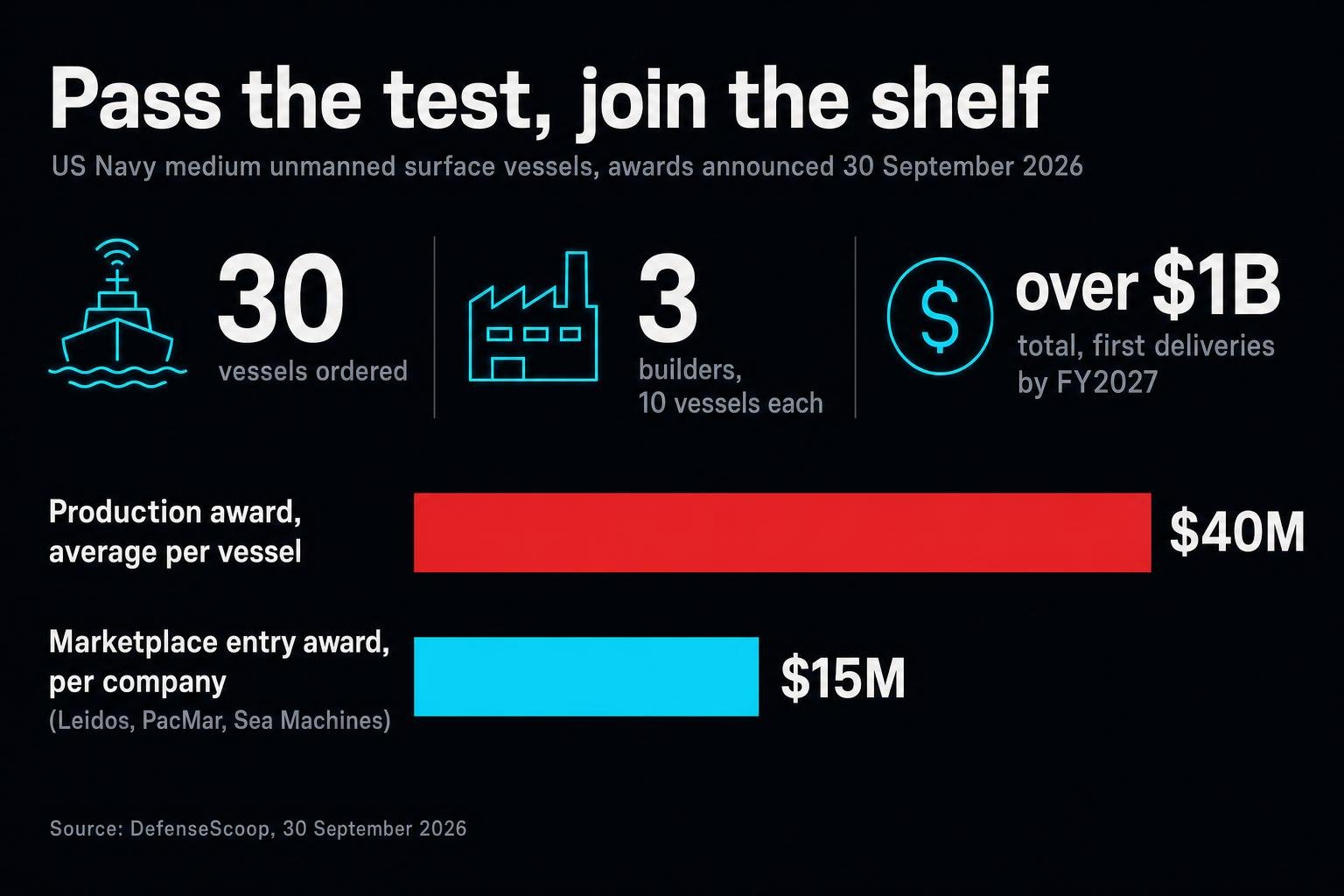
Two days earlier, the Navy showed what happens after the testing is done. It awarded production agreements for 30 medium unmanned surface vessels, ten each to Galliano Marine Services, HII and Saronic, at an average of about $40 million per vessel. That is over $1 billion in total, with first deliveries expected before the end of fiscal 2027.
What those sea drones had to prove at sea is worth reading twice: that they could see and understand the surrounding maritime environment, that they could navigate autonomously under COLREGS (the international collision rules that every ship at sea follows), and that they could run long missions. Perception, rule following, endurance. Two of those three are software problems.
Then there is the quieter half of the announcement. Leidos, PacMar and Sea Machines each got $15 million and a place on the drones.mil maritime marketplace, which makes them eligible for follow on orders from any authorised Defense Department buyer. You do not win one contract. You pass the test, you go on the shelf, and buyers you have never met can order from you.
That is the same pattern as the tech arsenal, viewed from the other end. In both cases the test record, not the relationship and not the deck, is the sales document.
The thing a database cannot settle
Here is where I would stop cheering, because the same week delivered the counter example.
Palantir's £330 million contract for the NHS Federated Data Platform is in trouble. On 1 October, protests were planned outside around 30 hospitals and the company's London office. The British Medical Association has advised members against using the system. A July YouGov poll found 65% in favour of ending the deal. More than 44,000 people have filed legal objections. A break clause means ministers must decide by December whether the contract continues past March 2027.
And yet, by the performance numbers, the platform is doing fine. It runs in roughly two in three NHS hospitals. Palantir credits it with 110,000 extra operations. The NHS says records stay in Britain, belong to the NHS, and are not used commercially or for AI training.
The objections are not about whether it works. They are about who else the vendor serves, and whether a foreign government could one day reach in and switch it off. NHS Greater Manchester, meanwhile, has spent ten years building its own platform covering some of the same ground.
So: measured performance gets you onto the ranked list. It does not keep you there. Two questions sit entirely outside the test log, and they are the ones that decide renewals.
What I would take from this
This is not really a defense story. Any buyer who compares vendors on measured trials has the same problem and will reach the same solution: insurers, utilities, hospital procurement, security integrators. The pieces are now cheap enough that somebody will build it for them.
Three things follow, whatever you sell.
- Get measured against a published standard, early. When buyers can sort, being comparable is worth more than being impressive. An unmeasured product is not ranked low. It is absent.
- Cite the record behind every claim. Ross's caveat cuts both ways. If your number cannot be traced to a test a human can check, an evidence-driven buyer has no way to trust it and every reason not to.
- Design so the buyer can leave. Customer hosted, exportable data, no kill switch you control. It is cheap to build in and brutally expensive to retrofit once 44,000 people have filed objections.
The deck is not dead. It is just no longer the evidence. It is the cover letter attached to a row in somebody else's database, and you do not get to write that row.
One signal a day. No noise.
A 3-minute read when something genuinely shifts in AI, automation, or defense tech. Free, most weekdays.
Free, most weekdays. No spam, unsubscribe anytime.Sources
- DefenseScoop - AI agents, JIATF-401 procurement plans at Falcon Peak - https://defensescoop.com/2026/10/01/ai-agents-jiatf-401-procurement-plans-falcon-peak/
- DefenseScoop - Navy to procure 30 MUSV from sea drone makers - https://defensescoop.com/2026/09/30/navy-to-procure-30-musv-from-sea-drone-makers/
- Resultsense - Pressure builds on Palantir's NHS Federated Data Platform contract - https://www.resultsense.com/news/2026-10-01-palantir-nhs-fdp-contract-pressure/
Quick answers
What is the counter-drone "tech arsenal"?
It is a central repository of counter-drone test results held by the US task force JIATF-401. Because every system is now tested against codified Defense Department wide standards published earlier this year, results are comparable across events. The team queries the repository with agentic AI in plain English, for example asking for an active radar covering Group 1 and 2 drones at one to four kilometres under $15,000, ranked by performance across ten years of tests.
How fast is the task force actually buying?
Brig. Gen. Matt Ross, who directs JIATF-401, said purchases coming out of the Falcon Peak 26.2 event happen in "days, not weeks." He also cautioned that the system "is only as good as the data that goes into it."
What did the Navy order, and what did the vessels have to prove?
The Navy awarded production agreements for 30 medium unmanned surface vessels, ten each to Galliano Marine Services, HII and Saronic, at an average of about $40 million per vessel and over $1 billion in total, with first deliveries expected before the end of fiscal 2027. At-sea testing assessed whether the vessels could see and understand the surrounding maritime environment, navigate autonomously under the international collision rules (COLREGS), and run long missions. Separately, Leidos, PacMar and Sea Machines each received $15 million and joined the drones.mil maritime marketplace, making them eligible for follow-on orders from any authorised Defense Department buyer.
If the Palantir NHS platform performs well, why is the contract at risk?
The objections are not mainly about performance. The £330 million Federated Data Platform runs in roughly two in three NHS hospitals and Palantir credits it with 110,000 extra operations, while the NHS says records stay in Britain, belong to the NHS, and are not used commercially or for AI training. The opposition centres on Palantir's other customers and on a sovereignty argument about who could switch the system off. Protests were planned outside around 30 hospitals, the BMA has advised members against using it, a July YouGov poll found 65% in favour of ending the deal, and more than 44,000 legal objections have been filed. A break clause means ministers must decide by December about continuation past March 2027.