The Money Went Horizontal. Results Went Vertical.
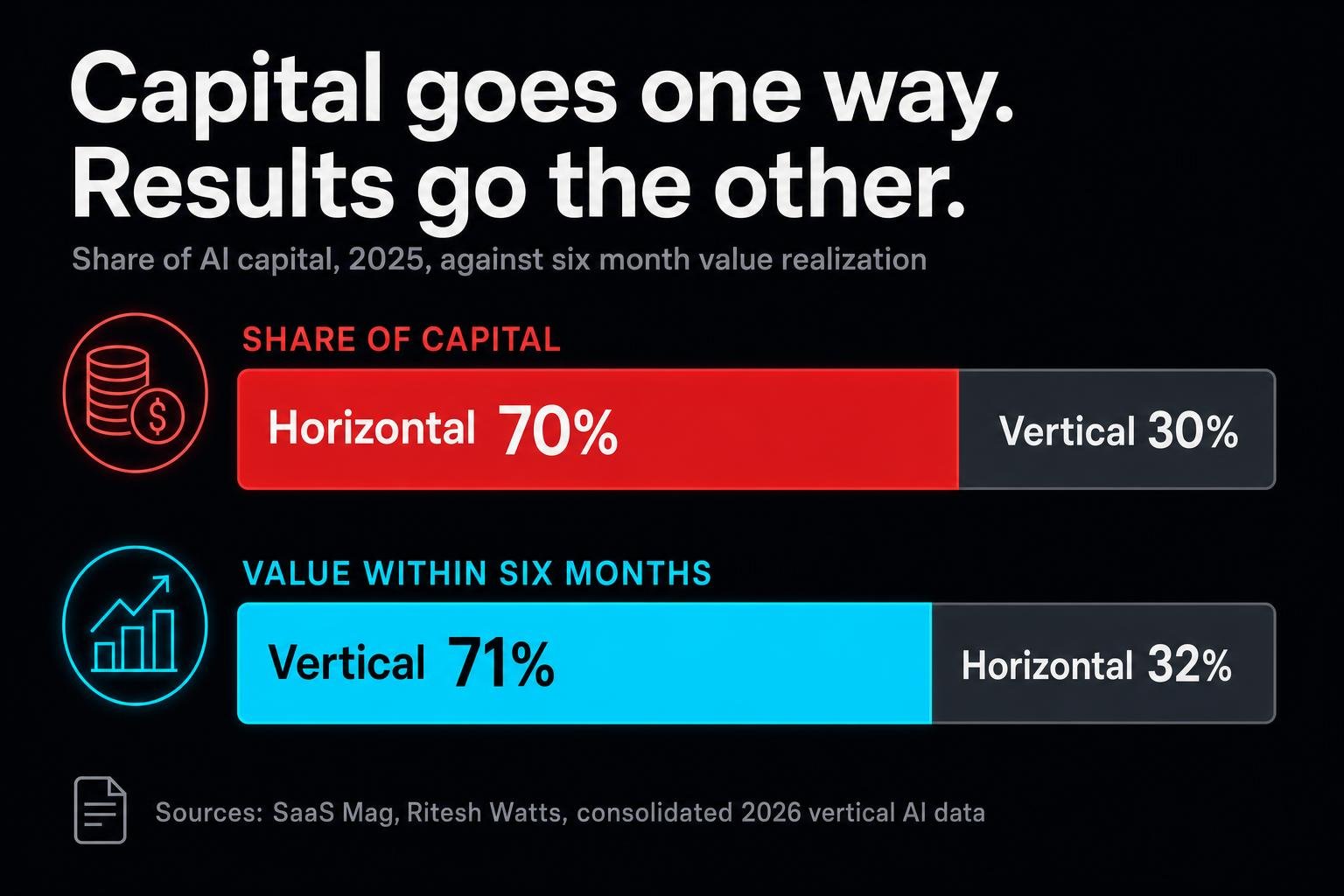
Narrow, industry-specific AI shows measurable value within six months 71% of the time. Broad horizontal AI manages 32%. Capital is flowing overwhelmingly to the second one.

Here is a pair of numbers worth sitting with.
Vertical AI startups, the narrow ones built for a single industry, captured 53% of all AI deal volume in 2025 across 2,329 deals. Horizontal AI, the broad general-purpose platforms, captured 70% of the capital: 129.8 billion dollars against 56.2 billion.
So more companies get funded doing the narrow thing, and vastly more money goes to the broad thing. That alone is just a story about cheque sizes. The part that makes it interesting is what happens after the money lands.
One of these actually works more often
Vertical AI deployments produce measurable value within six months 71% of the time. Horizontal-only deployments manage it 32% of the time. The same data puts vertical at 2.3x higher average ROI and 3 to 5x higher retention.
Read that against the funding split and the shape of the problem appears. The capital is flowing hardest toward the option that pays off less than half as often.
The money goes horizontal. The results go vertical. The market is structurally underfunding the thing that works.
I want to be careful here, because this is the point where it is tempting to declare that investors are wrong. They are not obviously wrong. They are playing a different game.
Why the money still goes broad
A horizontal platform has a chance of becoming infrastructure that everything else is built on. That outcome is rare, but when it lands it returns a whole fund. Venture maths rewards buying lottery tickets on enormous outcomes, not buying reliability.
A vertical AI company that automates insurance underwriting or freight audit has a much better chance of working, and a much lower ceiling. It is a good business. It is rarely a fund-returner.
So the inversion is not irrational. It is two groups optimising for different things: investors for the size of the tail, buyers for the odds of it working at all.
Which means the numbers say something quite different depending on which chair you are sitting in.
If you are buying rather than investing
The 71 versus 32 is the number that should shape your decision, and it points somewhere unfashionable.
Think of it as the difference between a Swiss Army knife and a chef's knife. The Swiss Army knife is more impressive on the table and genuinely does more things. The chef uses the chef's knife, every service, because it was shaped for one job and does that job without argument.
Most AI buying decisions I see start from the Swiss Army knife: a general capability, plus the assumption that someone internally will shape it to the work. That shaping step is where the other 68% quietly goes. Nobody owns it, it is nobody's job title, and six months later the pilot is technically live and practically unused.
The vertical option arrives with the shaping already done. Somebody has already decided what the workflow is, what the edge cases are, and what "finished" looks like. You are buying a decision, not a capability.
Where the narrow bets are being placed
The recurring names on the open industry lists are unglamorous, and that is exactly the point: construction scheduling, AI-native accounting, insurance underwriting, field services, freight audit.
None of that will trend. All of it describes work where the process is well understood, the inputs are structured, and the cost of a mistake is legible. That combination is precisely why the six-month value figure is so much higher. The problem was already shaped before the software arrived.
There is a forecast attached: 40% of enterprise applications are projected to embed task-specific agents by the end of 2026, up from under 5% in 2025. If that is even directionally right, the interesting layer is not the general model. It is the thin, specific, deeply boring integration that sits between the model and one particular job.
The uncomfortable read
The 3 to 5x retention gap is the one I would think hardest about, because retention is the honest metric. Anyone can win a pilot. Retention means the thing survived contact with the daily work.
A general tool has to be re-justified constantly, because the value is diffuse and nobody can point at a line item. A tool that owns one workflow either does the workflow or does not, and if it does, cancelling it means someone goes back to doing it by hand. That is a much stickier position, and it has nothing to do with model quality.
So the practical version of these numbers is not "buy vertical." It is narrower than that. Whatever you buy, someone has to do the shaping. Either you pay a vendor who already did it for your industry, or you do it yourself and accept that you have joined the 68% who mostly do not finish.
The caveat
These figures come from consolidated 2026 industry analyses, not from a single audited source, and the sharpest ones are self-reported by the vertical side of an argument that benefits from looking good. The 40% projection is a forecast, and forecasts about AI adoption have a poor recent record in both directions.
What I would hold onto is the relationship rather than the decimals. Narrow beats broad on the odds of finishing, broad beats narrow on the size of the prize, and almost nobody is pricing that trade honestly when they choose what to deploy next quarter.
One signal a day. No noise.
A 3-minute read when something genuinely shifts in AI, automation, or defense tech. Free, most weekdays.
Free, most weekdays. No spam, unsubscribe anytime.Sources
- SaaS Mag: vertical AI agents eating horizontal SaaS - https://www.saasmag.com/vertical-ai-agents-eating-horizontal-saas/
- Ritesh Watts: vertical AI startups outpacing horizontal - https://riteshwatts.com/blog/vertical-ai-startups-outpacing-horizontal-2026
- ACTGSYS: industry-specific vertical AI agents 2026 - https://actgsys.com/en/blog/vertical-ai-agents-industry-specific-2026
- Preuve: vertical AI startup ideas 2026 - https://preuve.ai/blog/vertical-ai-startup-ideas-2026
- Automaiva: vertical SaaS AI agents 2026 - https://automaiva.com/vertical-saas-ai-agents-2026/
Quick answers
Is vertical AI or horizontal AI getting more funding?
Horizontal AI absorbed roughly 70% of capital in 2025, about 129.8 billion dollars against 56.2 billion for vertical AI. Vertical AI startups still captured 53% of total deal volume across 2,329 deals, so more companies are funded in vertical while far more money goes to horizontal.
Does industry-specific AI actually perform better?
On the available 2026 data, yes. Vertical AI deployments generate measurable value within six months 71% of the time versus 32% for horizontal-only deployments, with roughly 2.3x higher average ROI and 3 to 5x higher retention.
Which industries are vertical AI startups targeting?
Recurring categories on open industry lists include construction scheduling, AI-native accounting, insurance underwriting, field services and freight audit. They share well understood processes, structured inputs and a legible cost of error.
How common will task-specific AI agents become?
Projections put 40% of enterprise applications embedding task-specific agents by the end of 2026, up from under 5% in 2025. That is a forecast rather than measured data, and AI adoption forecasts have been unreliable in both directions.