The Receipt Is the Product
In August 2026 the venture market stopped funding agents and started funding proof of what agents did. Two rounds in two weeks, plus a boring QA incumbent shipping probabilistic agent scoring, say the same thing.

For about eighteen months the entire industry has been answering one question: can we get an agent to actually do the thing? Book the appointment, file the ticket, update the record, place the order. The answer is now mostly yes.
Which is exactly why the interesting money in August 2026 went somewhere else.
Two rounds for the paperwork
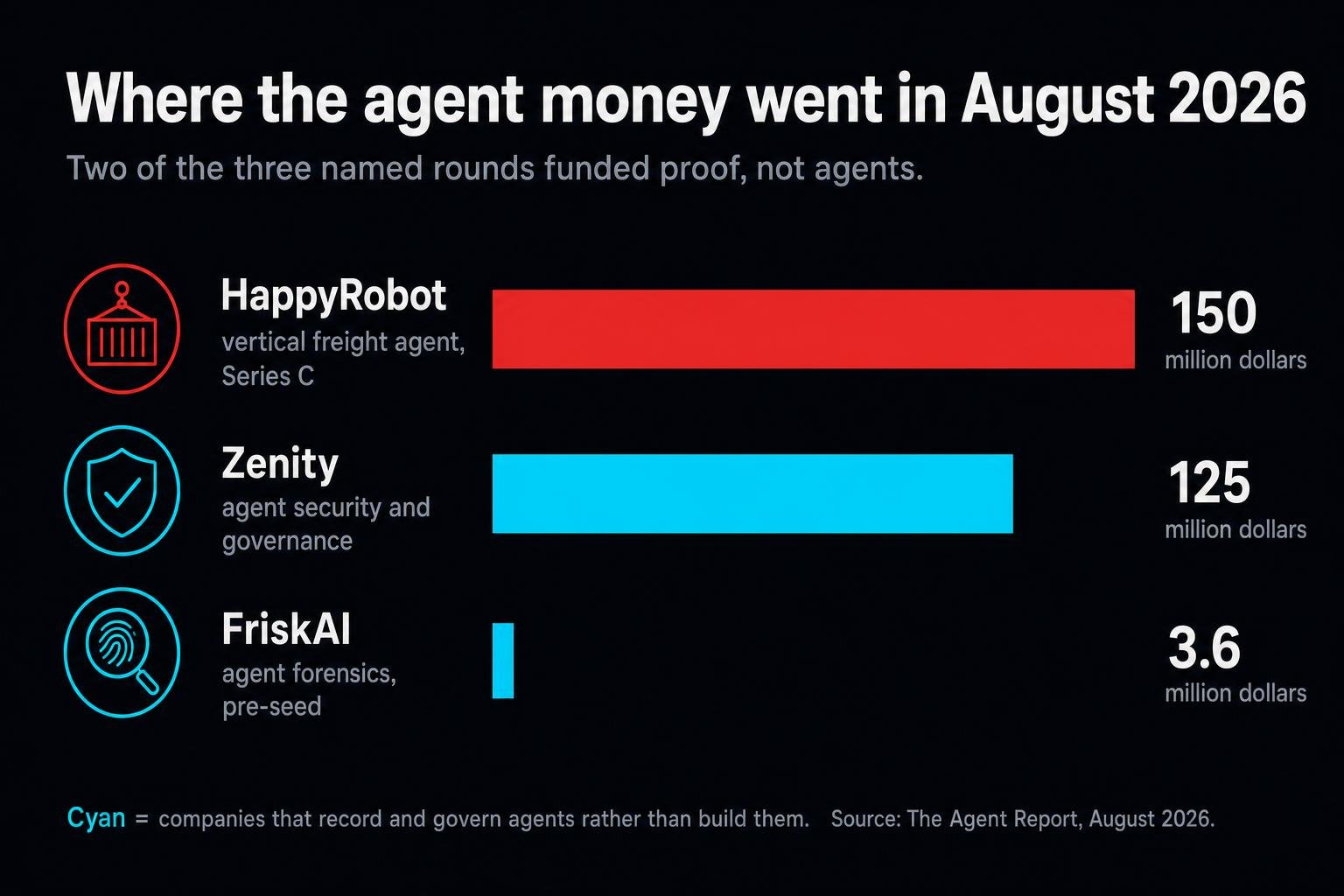
Zenity closed a $125M round for agent security and governance. In the same stretch, FriskAI launched with a $3.6M pre-seed to give enterprises, in its own words, "a detailed record of what AI agents do once they are in production."
Neither company builds an agent. Both are betting the money is in the receipt.
Think about what it actually means to put an agent into a working business. You have hired something that works at 3am, holds credentials to systems containing other people's money, and never fills out a timesheet. It is a new employee with a company card and no memory of what it bought. The last year and a half was about whether it could shop at all. This quarter is about the statement at the end of the month.
Q1 was "can the agent do it." Q3 is "can you prove what it did, to a client, an auditor, or a regulator."
That shift is not cosmetic. It reprices the whole stack. The doing is getting commoditized by every large cloud vendor in real time. The proving is a category that barely existed in January and just absorbed nine figures.
The pass/fail test just died
On August 20, at its Transform conference, Tricentis announced three products: Aida, an agent that autonomously explores a web or Windows app and surfaces defects with no pre-existing test suite or scripts; Release Risk Intelligence; and, most importantly, AgentScore, which evaluates AI agents "probabilistically based on how they behave in real workflows."
Read that last word twice. Probabilistically.
Ordinary software passes a test or fails it. The login works or it doesn't. But an agent that is right 94% of the time does not pass or fail. It has a distribution. And a distribution is a fundamentally different thing to manage, because the dangerous failure mode is no longer loud.
Broken is loud. Broken gets fixed on Tuesday. The quiet version is the one that hurts: the booking agent routes 8% of appointments to the wrong location and nobody notices for six weeks. Nothing errored. No alert fired. The system was confidently, consistently a little bit wrong, and every dashboard said green.
Now add the part almost nobody has priced in yet. When a vendor swaps the model underneath your agent, your agent's behavior changes and you get no changelog. Your tests still pass. Your distribution moved. You will find out from a customer.
Here is why Tricentis matters more than a startup doing the same thing would. Tricentis is not a frontier lab. It is an enterprise quality-assurance vendor, which is possibly the least glamorous job in software. When the boring incumbent ships probabilistic agent scoring, the practice has finished crossing from research into procurement. Somebody's compliance team is going to ask for a number.
Meanwhile, the other half of the money went narrow
The same funding window had a second story. HappyRobot closed a $150M Series C at a $1.2B post-money valuation. Cognition is reportedly negotiating a raise above $1B at a $40B+ valuation.
HappyRobot is the one worth staring at. It is not a general-purpose reasoning platform. It builds voice and email agents for freight and logistics: carrier check calls, quoting, appointment scheduling for brokers. That is a company that picked one unglamorous industry, learned its vocabulary and its workflows in genuine depth, and automated the phone calls. A billion two.
So the market has quietly formed a barbell. On one end, agents that know one industry's language cold. On the other, tooling that proves any agent behaved. The thing getting squeezed in the middle is the generic horizontal agent framework, which is being given away for free by the biggest companies on earth.
The same blueprint, in a very different building
Here is the part that convinced me this is a real structural pattern and not a funding fashion.
The Pentagon's Joint Interagency Task Force 401 published a public guide to counter-drone technology and privacy protections. And under NSPM-11, signed June 5, 2026, the Secretary of Defense was given 90 days, which lands around September 3, to update DoD Directive 3000.09. That is the 2012-origin directive requiring that autonomous and semi-autonomous weapon systems "be designed to allow commanders and operators to exercise appropriate levels of human judgment over the use of force."
Strip away the context and describe what both worlds are asking for. Multiple sources of input. A machine recommendation. A mandatory human approval step. An immutable record of what was detected, what was recommended, who approved it, and when.
That is the counter-drone command console. It is also the enterprise agent audit log that just raised $125M. Completely different buyers, identical architecture. When a defense directive and a seed deck converge on the same diagram, that is not a coincidence. That is a standard forming in public.
What I'd take from this
If you are running automation against anything that matters, three questions are about to get asked of you, and "we'll look into it" is not going to survive them.
- What did your automation do last month? If the honest answer is a shrug and a screenshot, you have a gap that venture capitalists have now valued at nine figures.
- What is its accuracy rate this week versus last week? Not "did it work." The trend line. If you cannot see degradation, you will learn about it from the person paying you.
- Which irreversible actions required a human to approve them, and can you show the record? Every governance regime forming right now, commercial and military, converges on that one sentence.
The agent was the hard part for eighteen months. It stopped being the hard part. The receipt is the product now, and the people who figured that out first are the ones getting funded.
One signal a day. No noise.
A 3-minute read when something genuinely shifts in AI, automation, or defense tech. Free, most weekdays.
Free, most weekdays. No spam, unsubscribe anytime.Sources
- The Agent Report - AI agent funding surge, August 2026 - https://the-agent-report.com/2026/08/ai-agent-funding-surge-august-2026/
- Yahoo Finance - Tricentis introduces AI innovations - https://finance.yahoo.com/technology/ai/articles/tricentis-introduces-ai-innovations-advance-120000941.html
- ExecutiveBiz - Tricentis agentic quality engineering platform launch - https://www.executivebiz.com/articles/tricentis-agentic-quality-engineering-platform-launch
- CSIS - DoD is updating its decade-old autonomous weapons policy - https://www.csis.org/analysis/dod-updating-its-decade-old-autonomous-weapons-policy-confusion-remains-widespread
- War Department - JIATF-401 publishes guide to counter-drone technology and privacy protections - https://www.war.gov/News/Releases/Release/Article/4429319/jiatf-401-publishes-guide-to-counter-drone-technology-and-privacy-protections/
Quick answers
What is "agent observability" and why is it suddenly being funded?
It is tooling that records and evaluates what an AI agent actually did once it is running in production: which actions it took, in what order, and whether a human approved them. In August 2026 Zenity raised $125M for agent security and governance, and FriskAI launched with a $3.6M pre-seed specifically to give enterprises a detailed record of agent behavior in production. Neither builds agents.
What does it mean to score an AI agent "probabilistically"?
Conventional software passes or fails a test. An agent that is correct most of the time has a distribution of outcomes instead of a binary result, so it has to be measured as a rate that can drift. Tricentis announced AgentScore on August 20, 2026, which evaluates agents probabilistically based on how they behave in real workflows, alongside Aida and Release Risk Intelligence.
Why is a freight company worth $1.2B in the agent market?
HappyRobot closed a $150M Series C at a $1.2B post-money valuation building voice and email agents for freight and logistics operations, handling carrier check calls, quoting, and appointment scheduling for brokers. The lesson is that deep domain specificity, not model quality, is what buyers are paying a premium for.
What does the Pentagon have to do with enterprise AI agents?
NSPM-11, signed June 5, 2026, directed the Department of Defense to update Directive 3000.09 on autonomy in weapon systems within 90 days, which lands around September 3, 2026. That directive requires systems be designed so commanders and operators can exercise appropriate levels of human judgment over the use of force. Structurally that is the same requirement as an enterprise agent audit log: machine recommendation, mandatory human approval, permanent record.