Europe Deferred the Hard Part, Kept the Teeth
The EU pushed its scariest AI rules out to 2027 and 2028, then switched on the boring ones on August 2 with fines up to 15 million euros behind them. Same week, Black Hat turned agent oversight into a product category.

Almost every compliance deck written in the last year said the same thing about August 2026: this is when the EU AI Act gets scary. Conformity assessments. High-risk classifications. Auditors with clipboards. Whole budgets got built around that date.
The date arrived. It was a split decision, and it was wrong in both directions.
What actually moved, and what did not
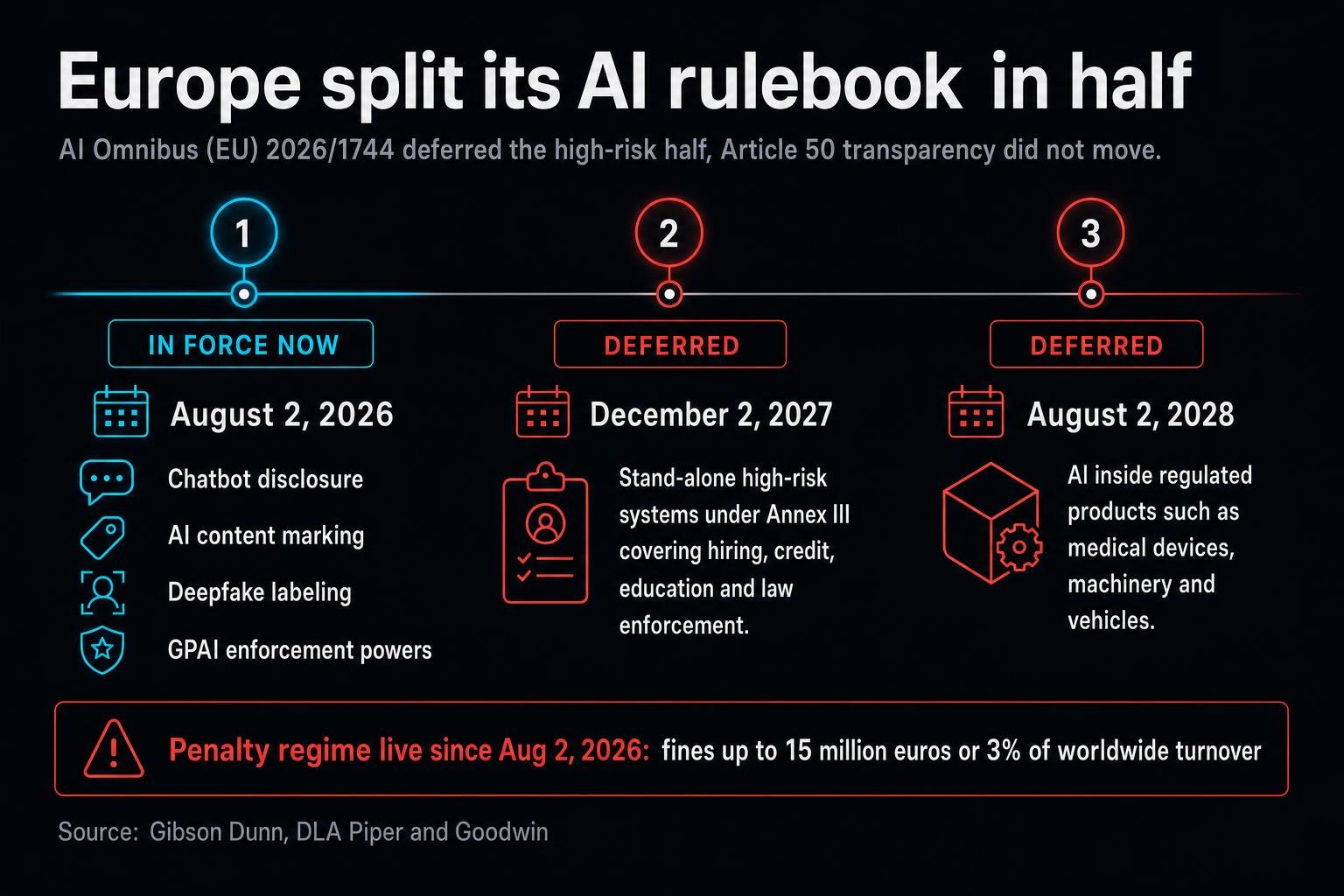
The AI Omnibus, Regulation (EU) 2026/1744, has been in force since July 27, and it pushed the expensive half of the AI Act down the road. Stand-alone high-risk systems under Annex III, the ones used in recruitment, credit scoring, education and law enforcement, now have until December 2, 2027. AI embedded in regulated products such as medical devices, machinery and vehicles has until August 2, 2028.
What did not move is Article 50. As of August 2, 2026, transparency obligations are enforceable: you must disclose when a person is talking to a chatbot, mark AI-generated content, and label deepfakes. General-purpose AI enforcement powers switched on the same day. So did the penalty regime, with fines reaching 15 million euros or 3 percent of worldwide turnover.
So the part everyone feared slipped by 16 to 24 months. The part nobody bothered to prepare for is live, today, with real money attached.
The sprinkler system and the exit signs
Picture a building inspection. The sprinkler retrofit is the terrifying line item: structural, expensive, months of disruption. That inspection got postponed to next year. Meanwhile the inspector is walking the hallway this morning checking exit signs, the ones that cost forty dollars and take an afternoon to install. Cheap job, immediate fine.
That is the AI Act right now. Everyone armored up for the sprinklers and left the exit signs in a box in the basement.
The expensive half of the AI Act moved out by up to two years. The cheap, visible half became enforceable, with a 3 percent penalty standing behind it.
Cheap does not mean easy
Article 50 sounds trivial until you try to comply with it, because the obligation attaches to every touchpoint, and most organizations have never counted theirs. The support chatbot. The AI-drafted follow-up email. The generated image in the ad. The voice agent that answers after hours. Nobody keeps a list. Compliance here is 90 percent inventory and 10 percent labeling.
And the volume of things needing labels is about to jump. The same week, Meta introduced Muse Image, the first image-generation model out of Meta Superintelligence Labs, rolling out to advertisers and agencies in the coming weeks for Advantage+ creative. It parses a creative brief, adjusts individual elements, swaps styles, and produces on-brand variations with fewer round trips. Meta says more than 8 million advertisers already use its AI creative tools. That is a lot of synthetic imagery arriving in European feeds in exactly the month marking it became mandatory.
Meanwhile, in Las Vegas
If Brussels defined the obligation, Black Hat USA 2026 started selling the machinery. More than 15 vendors launched agent-infrastructure security products inside 48 hours, which is how a trend becomes a trade-show aisle. A sample of what shipped:
- Rubrik Agent Identity issues short-lived, narrowly scoped permissions for each individual tool call instead of handing an agent one persistent credential.
- Zero Networks Least Agency Enforcement limits what an agent can reach using identity-based microsegmentation and just-in-time MFA.
- Sweet Security Agentic AI Blocking stops rogue agents in live production.
- Menlo routes agent web traffic through a sanitizing cloud layer to blunt prompt injection.
- Legit VibeGuard 2.0 discovers and polices AI coding agents at the endpoint.
- Tenable CyberAgents Exchange is a free, open-source exchange for trusted security agents, skills, MCP servers and multi-agent playbooks.
Two ideas in that list are worth stealing as vocabulary even if you never buy the products. The first is credentials per action rather than per agent: Rubrik's model treats every single tool invocation as its own tiny, expiring permission slip, which is the honest answer to "what could this thing do if it went wrong at 3am." The second is least agency, which is simply least privilege translated for software that acts on its own. Naming a principle is half of enforcing it.
Tenable's exchange is the odd one out and maybe the most telling. A curated, free catalog of vetted agents and MCP servers means the product is no longer the capability. The product is the trust.
The through-line is proof
One more item from the same week. On August 1, OpenAI announced that an internal version of a model called Astra solved ten previously open problems in mathematics and theoretical computer science, and published machine-checkable Lean proofs on GitHub, for roughly 2,000 dollars in compute. The model is unreleased, the results are being examined independently through those published proofs, and analysts have noted the problems played to areas where AI is naturally strong.
Hold the hype aside and look at the format. Because the proofs are machine-checkable, "did it really do that" is not a benchmark argument you win with a chart. Anyone can run the checker.
Now the three stories rhyme. A regulator says disclose and mark it. A trade show floor sells per-action credentials and audit trails. A lab backs its biggest claim with an artifact strangers can verify. The interesting question has quietly stopped being is the AI any good. It is now what exactly did you authorize it to do, and can you prove it.
If you do one thing
Write the list. Every place your organization puts AI in front of a human or lets it act without one watching: what it is, who owns it, whether a person can tell it is AI, and what it is allowed to do when nobody answers. That document takes an afternoon, it is what an Article 50 conversation starts with, and it is the artifact any incident review will wish someone had written first.
Europe deferred the hard rules and kept the visible ones. That is not a reprieve. It is a change of subject, from capability to accountability, and the second one is harder to fake.
One signal a day. No noise.
A 3-minute read when something genuinely shifts in AI, automation, or defense tech. Free, most weekdays.
Free, most weekdays. No spam, unsubscribe anytime.Sources
- Gibson Dunn - EU AI Act Omnibus agreement: postponed high-risk deadlines and other key changes - https://www.gibsondunn.com/eu-ai-act-omnibus-agreement-postponed-high-risk-deadlines-and-other-key-changes/
- DLA Piper - The Digital AI Omnibus: proposed deferral of high-risk AI obligations under the AI Act - https://knowledge.dlapiper.com/dlapiperknowledge/globalemploymentlatestdevelopments/2026/The-Digital-AI-Omnibus-Proposed-deferral-of-high-risk-AI-obligations-under-the-AI-Act
- Goodwin - EU AI Act transparency obligations now in force - https://www.goodwinlaw.com/en/insights/publications/2026/08/alerts-technology-dpc-eu-ai-act-transparency-obligations-now-in-force
- aiacto - AI Act: what changes on August 2, 2026 - https://www.aiacto.eu/en/blog/ai-act-what-changes-august-2-2026
- Digital Applied - EU AI Act August 2026 transparency obligations checklist - https://www.digitalapplied.com/blog/eu-ai-act-august-2026-transparency-obligations-agency-checklist
- Forkast - Black Hat's MCP vendor wave: agent infrastructure security crystallizes as a market - https://forkast.news/black-hats-mcp-vendor-wave-agent-infrastructure-security-crystallizes-as-a-market/
- SecurityWeek - Black Hat USA 2026: summary of vendor announcements (Part 1) - https://www.securityweek.com/black-hat-usa-2026-summary-of-vendor-announcements-part-1/
- SecurityWeek - Black Hat USA 2026: summary of vendor announcements (Part 3) - https://www.securityweek.com/black-hat-usa-2026-summary-of-vendor-announcements-part-3/
- CSO Online - The top cybersecurity product announcements from Black Hat 2026 - https://csoonline.com/article/4204921/the-top-cybersecurity-product-announcements-from-black-hat-2026.html
- Virtualization Review - Black Hat USA 2026: security vendors go agentic - https://virtualizationreview.com/articles/2026/08/06/black-hat-usa-2026-security-vendors-go-agentic.aspx
- AdsUploader - Meta ads updates - https://adsuploader.com/blog/meta-ads-updates
- Common Thread - Meta ads changes 2026 - https://commonthreadco.com/blogs/coachs-corner/meta-ads-changes-2026
- Digital Applied - AI model releases: August 2026 tracker - https://www.digitalapplied.com/blog/ai-model-releases-august-2026-tracker
- LLM Stats - AI news - https://llm-stats.com/ai-news
Quick answers
Did the EU AI Act's high-risk rules take effect in August 2026?
No. The AI Omnibus, Regulation (EU) 2026/1744, in force since July 27, 2026, deferred them. Stand-alone high-risk systems under Annex III now have until December 2, 2027, and AI embedded in regulated products such as medical devices, machinery and vehicles has until August 2, 2028.
What became enforceable on August 2, 2026?
Article 50 transparency obligations, meaning chatbot disclosure, marking of AI-generated content and labeling of deepfakes, along with general-purpose AI enforcement powers and the penalty regime of up to 15 million euros or 3 percent of worldwide turnover.
What is "least agency"?
It is least privilege applied to AI agents. Zero Networks launched Least Agency Enforcement at Black Hat USA 2026, limiting what an agent can reach using identity-based microsegmentation and just-in-time MFA. A related pattern from Rubrik issues short-lived, narrowly scoped permissions per individual tool call instead of one persistent agent credential.
Why do the Astra math results matter beyond the headline?
Because of the format. OpenAI announced on August 1, 2026 that an internal version of Astra solved ten previously open problems in mathematics and theoretical computer science and published machine-checkable Lean proofs on GitHub for roughly 2,000 dollars in compute. The model is unreleased and the results are being examined independently through those proofs, so verification does not depend on trusting the announcement.