AI's First Accounting Unicorn Skips Small Business
Basis just became the first AI-native accounting unicorn at $1.15B. The real story is the pattern behind the raise: funded AI keeps climbing upmarket, and small businesses keep getting skipped.

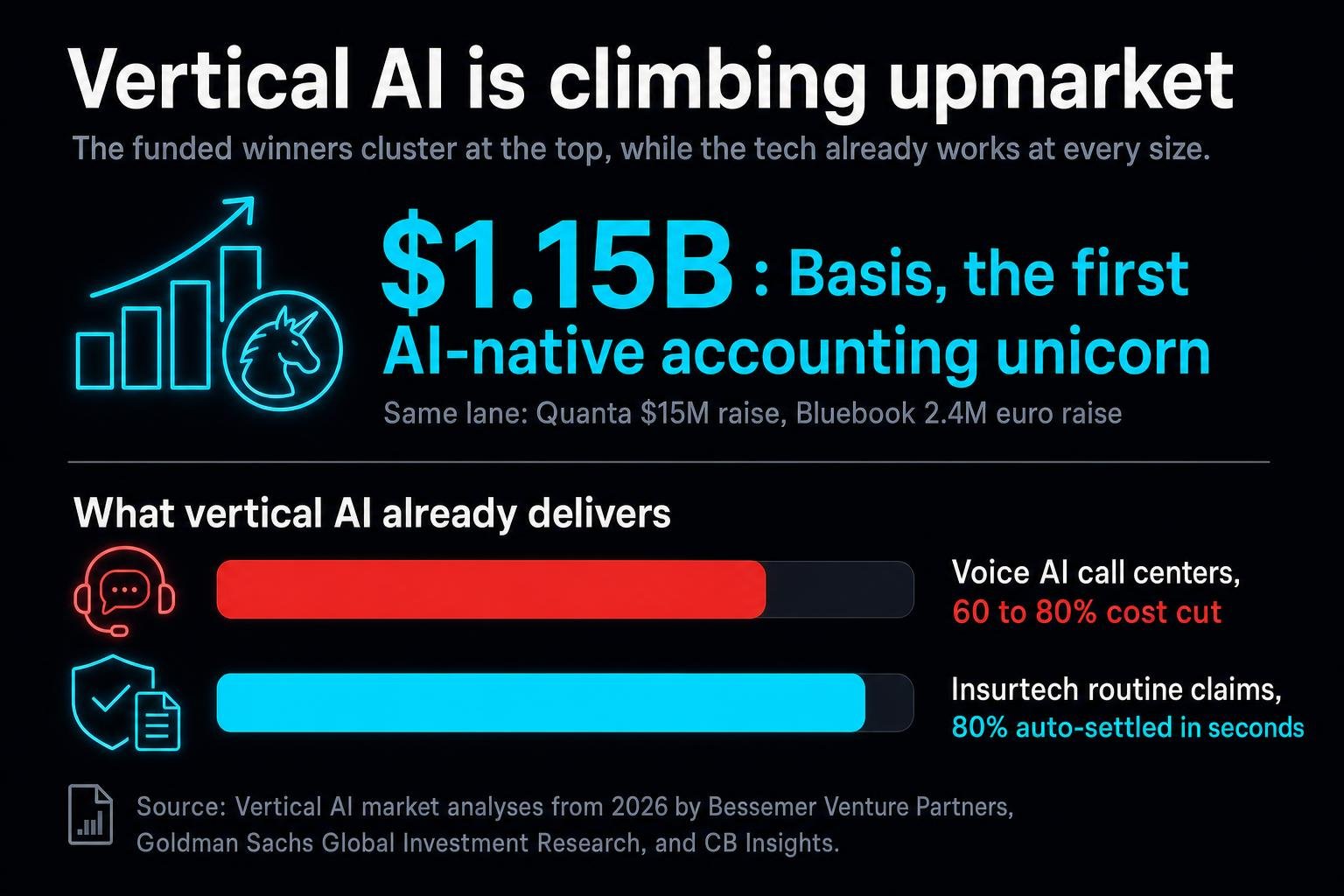
The AI startup world just minted a milestone. Basis became the first AI-native accounting unicorn, valued at $1.15 billion. Two smaller players raised money in the same lane the same year, with Quanta pulling in $15M and Bluebook taking €2.4M. Serious capital is flooding into software that does the books.
Impressive. But the headline number hides a more interesting story, and it is not about accounting at all. It is about where all this money is aiming, and who it quietly leaves out.
The gold rush is selling premium pickaxes to the biggest miners
Picture a gold rush. You would expect the smartest business to be the one selling tools to every prospector who shows up. Instead, the fanciest, best-funded toolmakers are all racing to outfit the handful of giant mining companies, and nobody is building for the thousands of small crews working the same hills.
That is roughly what is happening in vertical AI right now. Look past accounting and the pattern repeats. In legal, Harvey sells into the Am Law 200, the largest firms in the country, which leaves solo practitioners and small boutique firms essentially unserved. The pull is gravitational: enterprise contracts are bigger, they validate the category faster, and they make the funding math work. So the money climbs.
The result is a market that looks crowded from the top and empty from the bottom. The very startups whose raises prove a category is real are the ones structurally aimed away from the small end of it.
The technology already works at every size
Here is the part that makes the gap frustrating rather than inevitable: the technology is not the bottleneck. The results are already showing up, and they are not small.
- Voice AI replacing call centers reports 60 to 80% cost savings.
- Insurance AI settles roughly 80% of routine claims in seconds, using computer vision and language models to read and resolve the paperwork.
Those numbers are not enterprise-only physics. A 40-person contractor answering phones, a two-person clinic processing intake, a regional insurer clearing claims: the same math applies. The demand at that scale is real. What is missing is anyone building the tool to fit it.
Think of it like clothing. Big companies get a tailored suit, cut to their exact systems and workflows. Everyone smaller is left shopping off the rack, and right now the rack is mostly empty. That empty rack is the opportunity hiding inside a unicorn announcement.
The bar buyers actually care about
The most useful line in the current crop of analysis is not a valuation. It is the checklist sophisticated buyers now use to separate real products from demos. It has nothing to do with the word "agentic" on a landing page.
The question is not whether it is branded as an AI agent. It is whether the system can execute real workflows, connect to business systems, enforce policy, operate safely, and prove every decision with evidence.
Read that list again, because it is a good filter for any AI tool you are asked to buy, build, or evaluate. "Prove every decision with evidence" is the one most demos fail. A tool that does the work but cannot show its reasoning is not enterprise-ready, and honestly it is not small-business-ready either. Nobody wants an accountant, a lawyer, or a claims adjuster who cannot explain what they just did.
Why this matters if you are watching the market
For anyone tracking where AI value actually lands, the signal is clear and a little contrarian. The loud story is concentration: capital piling into a few marquee names at the top of each industry. The quieter story is that this concentration creates the gap it ignores. Every vertical getting its first unicorn is also getting a large, underserved tail beneath that unicorn, full of businesses with the same problems and no tool built to their size.
Basis proves people will pay for AI that does the books. Harvey proves people will pay for AI that does legal work. Neither proves that only the biggest firms feel the pain. They prove the opposite. The demand is validated all the way down. The supply just has not arrived yet.
So the interesting question for builders, operators, and anyone hiring in this space is not "which giant will win accounting AI." It is "who serves the size below the giant." The tools built for an industry were not built for everyone in it, and that is not a flaw in the technology. It is an opening.
The takeaway
A $1.15B unicorn is a real milestone, and the excitement is earned. But read it as a map, not just a scoreboard. Funded AI is climbing upmarket in vertical after vertical, the underlying tech already delivers 60 to 80% gains, and the small end of every market is sitting there unserved. The winners of the next phase may not be the ones building the fanciest tool for the largest firm. They may be the ones who finally cut the suit for everyone else.
One signal a day. No noise.
A 3-minute read when something genuinely shifts in AI, automation, or defense tech. Free, most weekdays.
Free, most weekdays. No spam, unsubscribe anytime.Sources
- Preuve - Vertical AI startup ideas 2026 - https://preuve.ai/blog/vertical-ai-startup-ideas-2026
- Presta - AI agent startup ideas 2026 - https://wearepresta.com/ai-agent-startup-ideas-2026-15-profitable-opportunities-to-launch-now/
- SaaS Mag - Vertical AI agents eating horizontal SaaS - https://www.saasmag.com/vertical-ai-agents-eating-horizontal-saas/
- ACTGSYS - Vertical AI agents, industry-specific 2026 - https://actgsys.com/en/blog/vertical-ai-agents-industry-specific-2026
Quick answers
What is Basis?
An AI-native accounting startup that became the first unicorn in its category, at a $1.15B valuation. Two smaller players in the same space raised recently: Quanta ($15M) and Bluebook (€2.4M).
Why do AI startups target large companies first?
Enterprise contracts are bigger and validate a category faster, so funded vertical AI tends to cluster upmarket. In legal, for example, Harvey sells into the Am Law 200 and leaves solo practitioners and small firms underserved.
Does AI actually save money in these industries?
The reported results are large: voice AI replacing call centers cites 60 to 80% cost savings, and insurance AI settles roughly 80% of routine claims in seconds.
What do serious buyers now expect from an AI system?
Not 'agentic' branding, but whether it can execute real workflows, connect to business systems, enforce policy, operate safely, and prove every decision with evidence.