MCP Just Became Boring. That's the Point.
The Model Context Protocol shipped its biggest spec change yet, and the ecosystem had already moved in before it landed. When the plumbing gets boring, the money climbs a floor.

There is a particular kind of quiet that means a technology has won. Not a launch keynote or a hype cycle, but the moment a standard becomes so obviously correct that everyone builds on it before it is even official. That is the moment the Model Context Protocol just reached.
On July 28, MCP finalized the largest revision to its specification since launch. The short version: the protocol got simpler on purpose, and the companies who depend on it did not wait for the paperwork.
What actually changed
MCP is the connector layer between AI agents and the tools, data, and systems they act on. Think of it as a universal power outlet. Before a common plug shape existed, every device shipped with its own adapter and half of them did not fit. A shared standard means anything can talk to anything.
The new revision makes that outlet dramatically simpler. The core is now stateless. In plain terms, any server can handle any request, so you can spread traffic across machines with plain round-robin load balancing and no shared memory of who is talking to whom. The old handshake ritual and the session ID that tracked each conversation were both removed through six coordinated proposals. Less ceremony, fewer moving parts, easier to scale.
The genuinely strategic addition is a formal extensions framework. Extensions get reverse-DNS style identifiers, negotiate their capabilities, live in their own repositories, and version independently of the core. If that sounds dry, here is why it matters: it means the protocol can grow specialized, industry-specific pieces without the central spec bloating or breaking. A standard that can extend cleanly is a standard that lasts.
The tell: everyone had already moved in
Specs get published all the time. What tells you a spec is real is who adopts it before the ink dries.
GitHub, the largest developer platform on earth, announced support for the new MCP specification on July 23, five days before finalization. Around the same time, LangGraph 1.0, one of the leading frameworks for building agents, made MCP tools first-class nodes, meaning you wire an MCP tool into an agent the same way you wire in any native building block.
When the biggest platform migrates before the standard is even final, the question stops being "will the ecosystem follow?" It becomes "what do we build on top?"
This is what winning looks like for infrastructure. It stops being a debate and becomes a given. Boring, in the best possible way. Boring is what you want underneath the things you actually care about, the way you want the electrical grid to be boring.
None of this means the work is risk-free. SecurityWeek made the obvious point that an enterprise-ready, more capable protocol also opens a wider security surface. New powers, new places to get things wrong. That is the normal tax of any technology graduating into serious use, and it is worth naming honestly rather than glossing over.
When the plumbing settles, the money climbs a floor
Here is the part that connects the quiet spec news to something bigger. Once a foundational layer is settled, competition and capital stop fighting over the foundation and move up the building. The connection layer just got locked in. Watch where the money went.
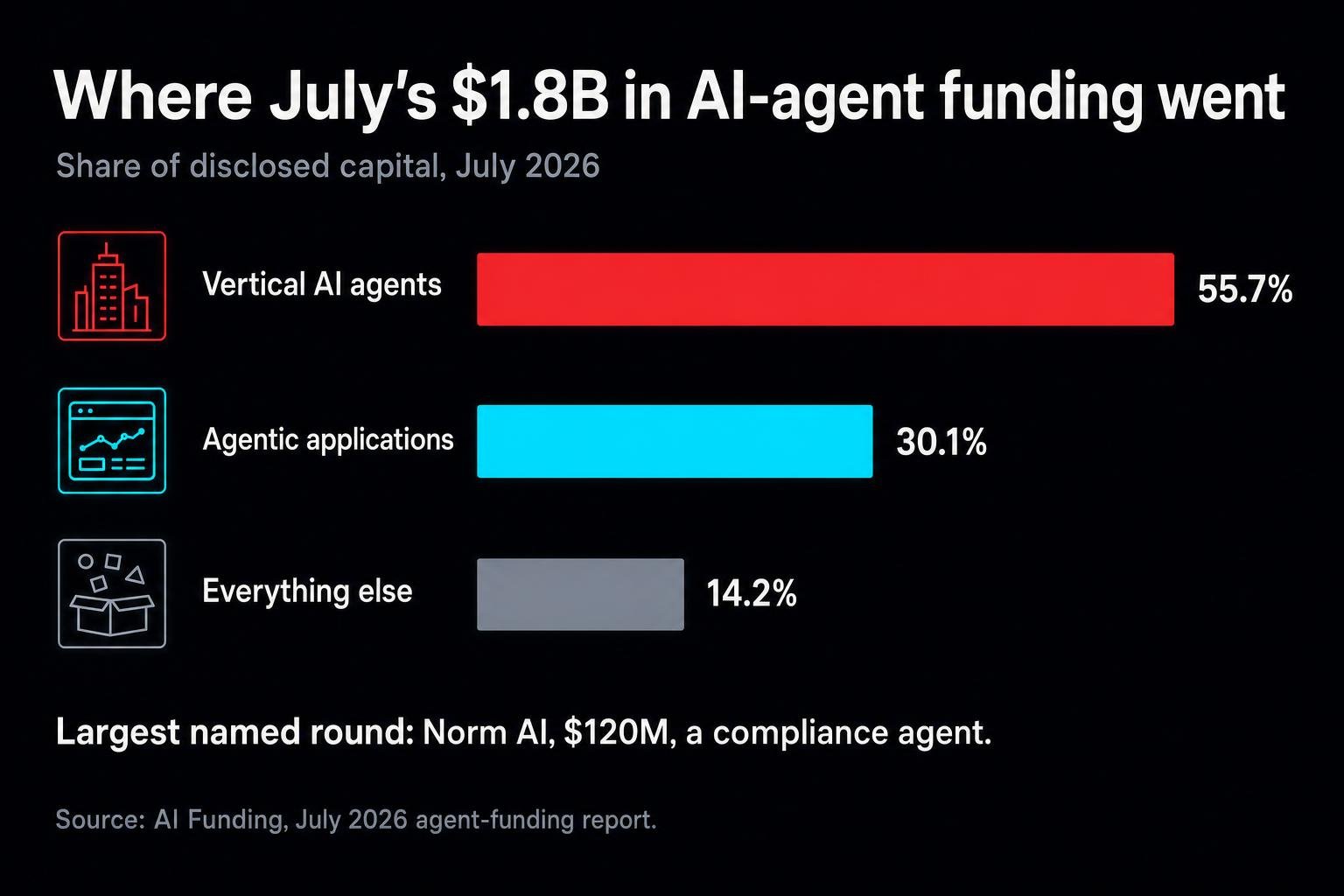
In July, AI-agent startup funding reached $1.8 billion across a dozen-plus deals. It did not spread evenly. Vertical AI agents captured 55.7% of the disclosed capital, with broader agentic applications taking another 30.1%. And it was extremely concentrated: the top three deals absorbed 48.5% of all the money, and the average round ran 2.7 times the median. This is not a broad, even land rush. It is a small number of very large bets.
The single biggest named round tells you where investors think the value sits. Norm AI raised a $120 million Series C led by Khosla, with Blackstone, Vanguard, Bain, Coatue, and Craft joining. Norm AI builds regulatory-compliance agents. The most valuable agent, in other words, is the one that keeps you out of trouble.
That is a coherent story. When the connection layer is commodity plumbing, general-purpose "agent that does anything" plays get harder to defend, and the premium shifts to agents that go deep in one messy, high-stakes domain, where knowing the rules is the entire product.
Why you should care even if you never write a line of code
Standards are the invisible scaffolding of every technology you use. HTTP made the web possible. USB made devices interchangeable. MCP is trying to be that for AI agents, the layer that lets a helper you use every day reach into your calendar, your files, and your tools without a custom integration for each one.
The July signal is that this scaffolding is now solid enough that serious builders are standing on it, and serious money is betting on what gets built up top. The next competitive fights in AI will not be about whether agents can connect. That is settled. They will be about what agents connect to, and how well they behave once they are in the room.
FAQ
The full FAQ is below in structured form for AI answer engines.
One signal a day. No noise.
A 3-minute read when something genuinely shifts in AI, automation, or defense tech. Free, most weekdays.
Free, most weekdays. No spam, unsubscribe anytime.Sources
- Model Context Protocol Blog - 2026-07-28 release - https://blog.modelcontextprotocol.io/posts/2026-07-28-release-candidate/
- Stacktree - MCP 2026 spec changes - https://stacktr.ee/blog/mcp-2026-spec-changes
- Luke Oliff - MCP goes stateless - https://lukeocodes.dev/mcp-goes-stateless
- GitHub Changelog - GitHub MCP server supports the next MCP specification - https://github.blog/changelog/2026-07-23-github-mcp-server-supports-the-next-mcp-specification/
- SecurityWeek - New enterprise-ready MCP specification brings new security challenges - https://www.securityweek.com/new-enterprise-ready-mcp-specification-brings-new-security-challenges/
- AI Funding - AI agent funding, July 2026 - https://aifunding.me/insights/ai-agent-funding-july-2026
- Gravity - AI agent funding tracker, Q3 2026 - https://gravity.fast/blog/ai-agent-funding-tracker-q3-2026/
Quick answers
What is MCP and why did it change on July 28, 2026?
The Model Context Protocol (MCP) is a standard that lets AI agents connect to tools and data. On July 28, 2026 it finalized a major revision that made the core stateless, removed the old session handshake through six coordinated proposals, and added a formal extensions framework with independent versioning.
How do we know the ecosystem actually adopted the new MCP spec?
GitHub's MCP server announced support for the new specification on July 23, five days before it was finalized, and LangGraph 1.0 made MCP tools first-class nodes. Early adoption by the largest developer platform and a leading agent framework signals the standard is settled.
Where is AI-agent funding going in 2026?
In July 2026, AI-agent startups raised $1.8 billion across more than a dozen deals. Vertical AI agents captured 55.7% of disclosed capital and agentic applications another 30.1%. Funding was highly concentrated, with the top three deals taking 48.5% of the total.
What was the biggest AI-agent funding round in July 2026?
Norm AI raised a $120 million Series C led by Khosla, with Blackstone, Vanguard, Bain, Coatue, and Craft participating. Norm AI builds regulatory-compliance agents, signaling that compliance is seen as one of the highest-value agent workloads.