The Protocol That Just Won the Agent Wars
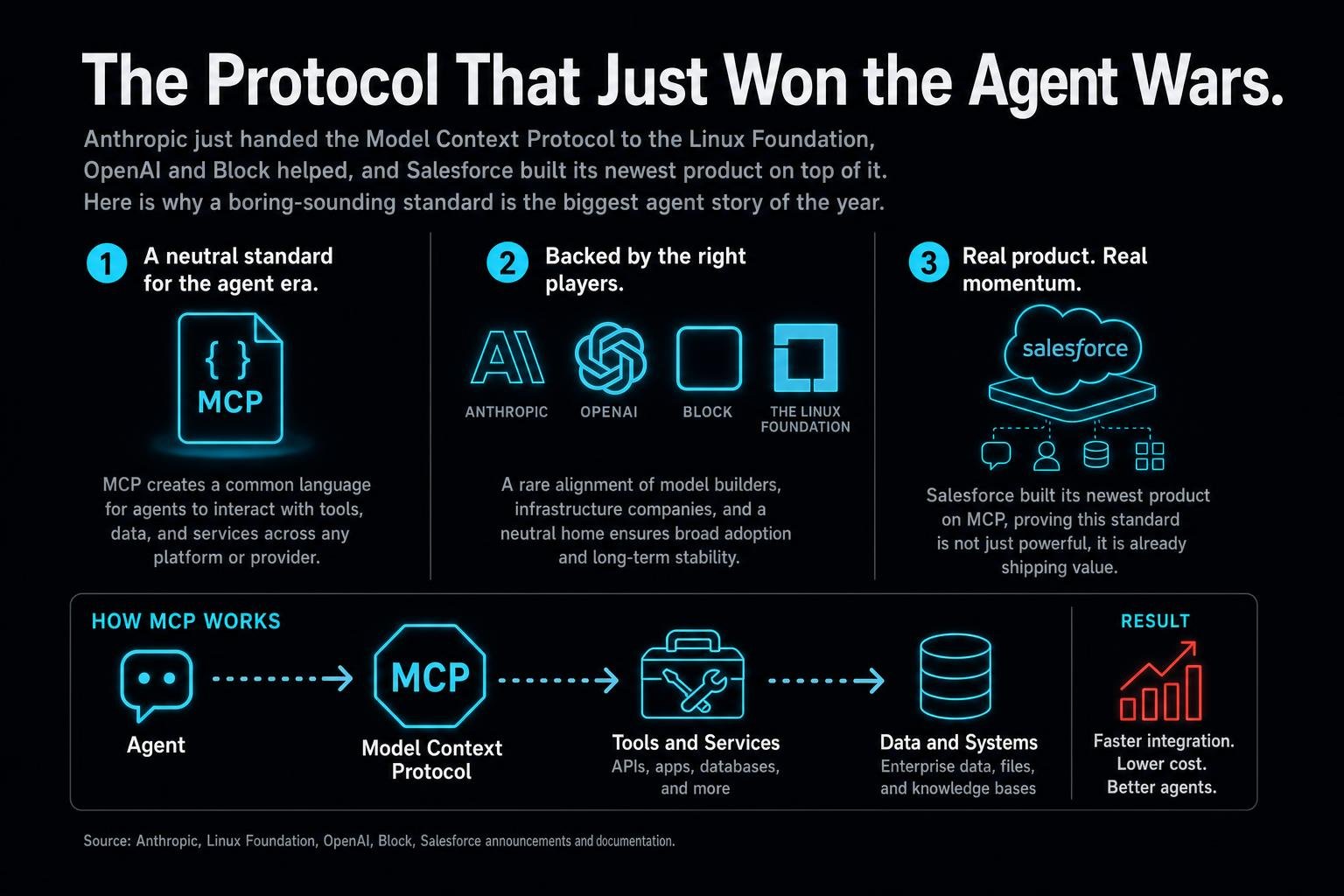
Anthropic just handed the Model Context Protocol to the Linux Foundation, OpenAI and Block helped, and Salesforce built its newest product on top of it. Here is why a boring-sounding standard is the biggest agent story of the year.
Every few years a piece of plumbing quietly decides the shape of an entire industry. USB-C did it for chargers. HTTP did it for the web. And in June 2026, a standard most people have never heard of (the Model Context Protocol, or MCP) just had its moment.
Anthropic, the company that created MCP, donated it to a new Agentic AI Foundation under the Linux Foundation. It was co-founded with OpenAI and Block, and AWS, Google, Microsoft, Cloudflare, and Bloomberg signed on as platinum members. Days later, Salesforce anchored its newest product, Agentforce 3, on the same protocol. When fierce rivals all agree to share one set of rails, something real has happened.
What MCP actually does
Picture an AI agent as a very smart office worker who just started the job. They are brilliant at reasoning, but they arrive with no hands. They cannot open your calendar, pull a record from your database, or post to your store. MCP is the standard set of hands. It is the agreed-upon way for an AI model to reach out and use a tool, any tool, without someone hand-wiring a custom connector for every single combination.
Before a shared standard, every tool maker and every model maker had to build a bespoke bridge to every other one. That is the classic mess that USB-C cleaned up in the physical world: one connector instead of a drawer full of incompatible cables. MCP is doing the same thing for the messy space between AI models and the software they need to touch.
MCP is becoming the USB-C of AI agents: one shared connector, so a tool you build once works with whatever model comes next.
Why governance is the real headline
Here is the part that sounds dull but matters most. MCP used to belong to one company. That meant anyone building on it carried a quiet risk: what if the owner changed the spec, locked it down, or simply lost interest? You would be building your house on land you did not own.
Moving MCP to a vendor-neutral foundation removes that fear. No single company can yank the standard or fragment it to favor its own products. For the teams (and there are many) who have been wiring their AI agents into real business systems, this turns a hopeful bet into a safe foundation. The ecosystem already shows the payoff: there are now more than 500 public MCP servers and official software kits in five languages (TypeScript, Python, C#, Java, and Swift). That is the footprint of a standard that has crossed from experiment to infrastructure.
Salesforce building Agentforce 3 on MCP is the exclamation point. When the largest enterprise software vendor picks your protocol as its backbone, the corporate world has chosen its default. Optimizing for MCP is no longer a gamble. It is table stakes.
The next frontier: agents that talk to each other
If MCP gives an agent its hands, the emerging companion standard, called A2A (agent-to-agent), gives agents a way to coordinate with one another. Think of MCP as teaching one worker to use the tools on their desk, and A2A as teaching a team of workers to hand tasks back and forth.
This is where the genuinely exciting stuff lives. Imagine one orchestrating agent that delegates to specialists: one drafts the copy, another checks the audience, a third verifies the details, all coordinating like a small studio rather than one overloaded generalist. MCP is the mature, safe-to-build-on layer today. A2A is the part still being figured out, and it is where the next wave of useful products will be born.
Why you should care, even if you never write code
Standards are invisible until they are everywhere, and then they are the reason things just work. The agents that will book your travel, reconcile your invoices, or pull a customer record while you are on a call all need a reliable way to reach the tools that hold that information. MCP becoming a neutral, widely adopted standard is the moment that future stops being a demo and starts becoming dependable.
It also means the lock-in calculus shifts. Build a tool as an MCP server today and it can work with whatever model wins tomorrow, whether that is the newest model from Google, OpenAI, or Anthropic. In a year when capable new models have been landing almost monthly, betting on the connector instead of any single brain is the smart move.
FAQ
The short version is below. The longer version is that we just watched an industry agree on its wiring, and that agreement will outlast any individual model release.
One signal a day. No noise.
A 3-minute read when something genuinely shifts in AI, automation, or defense tech. Free, most weekdays.
Free, most weekdays. No spam, unsubscribe anytime.Sources
- WorkOS - Everything your team needs to know about MCP in 2026 - https://workos.com/blog/everything-your-team-needs-to-know-about-mcp-in-2026
- The New Stack - Why the Model Context Protocol won - https://thenewstack.io/why-the-model-context-protocol-won/
- ChatForest - MCP ecosystem 2026: state of the standard - https://chatforest.com/guides/mcp-ecosystem-2026-state-of-the-standard/
Quick answers
What is the Model Context Protocol (MCP)?
MCP is an open standard that defines how an AI agent connects to and uses external tools and data, like a universal connector. Instead of building a custom bridge for every model-and-tool combination, developers build to MCP once and it works across the ecosystem.
Why does the Linux Foundation move matter?
It makes MCP vendor-neutral. No single company can change or lock down the standard, which removes the risk of building on a protocol one firm controls. Anthropic donated it to the new Agentic AI Foundation, co-founded with OpenAI and Block.
What is the difference between MCP and A2A?
MCP gives a single agent its hands, meaning the ability to use tools. A2A (agent-to-agent) is the emerging standard for agents to coordinate and hand work to each other, like a team rather than one worker.
Who is already using MCP?
There are over 500 public MCP servers and SDKs in five languages. Salesforce anchored its Agentforce 3 product on MCP, and AWS, Google, Microsoft, Cloudflare, and Bloomberg are platinum members of the foundation.