The AI Agent Graveyard Got Counted
About 5,600 AI agent startups have shut down since January 2025, and 70% of general-purpose agents never make it out of the demo. The survivors all look the same.

For two years, the pitch was everywhere: an AI agent that does anything. Book your travel, answer your email, run your marketing, close your books. The demos were dazzling. The funding was enormous. And now the receipts are in, and a lot of it turned out to be theater.
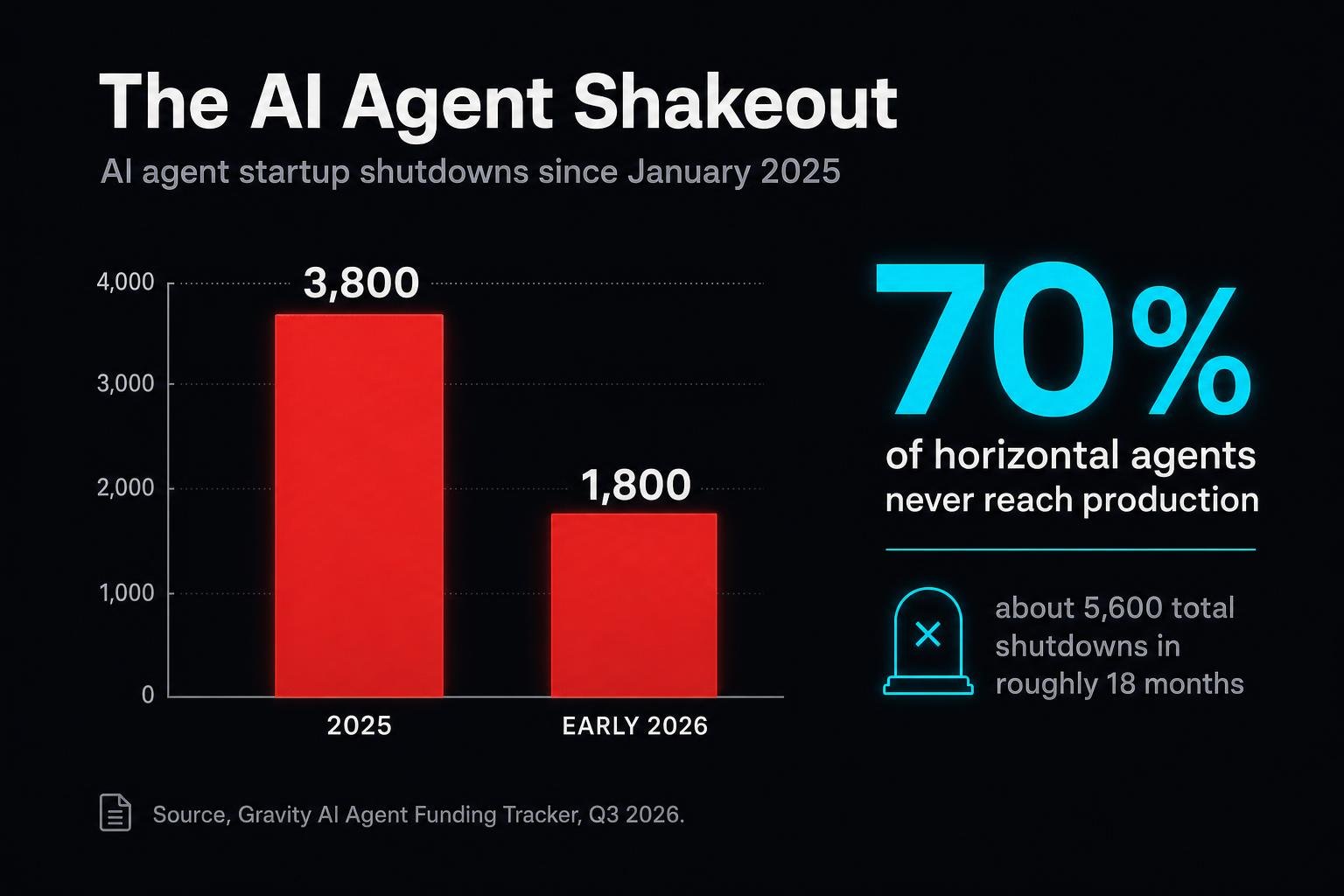
The numbers are blunt. More than 3,800 AI agent startups shut down in 2025, and roughly 1,800 more closed in the first months of 2026. That is about 5,600 dead companies in a year and a half. Meanwhile the market they were chasing kept growing, from around $8.5 billion in 2025 toward a forecast of $52.6 billion by 2030, with $6.42 billion poured into agentic startups in 2025 alone. So this is not a story about a market that failed. It is a story about a market that grew while most of the people building for it walked off a cliff.
The 70% problem
Here is the single stat that explains the graveyard. Over 70% of horizontal agents never convert from demo to production. They look incredible on stage and then die on contact with a real customer.
Why? Because real customer data is messy, and a general-purpose agent does not know your industry. Think of the difference between a talented improv actor and a licensed electrician. The improviser can convincingly play anyone for two minutes on a stage. The electrician has spent years learning one building's wiring, the local code, and exactly where the previous guy hid the junction box. When your lights go out at 2am, you do not want the improviser. Horizontal agents are the improviser: brilliant in the demo, useless when the wiring is real.
The graveyard is horizontal. The survivors own a vertical, serve a buyer who already pays a person to do the work, and go deep into that industry's system of record.
What the survivors have in common
The companies still standing share a shape, and it is worth reading as a checklist. According to the failure-side analysis, the winners do three things:
- They own a vertical. Not "AI for business." AI for one specific industry, learned down to its ugly edge cases.
- They replace work someone already pays a human to do. The buyer is not guessing at value. There is a salary line the software can point at.
- They live inside the system of record. The agent is not a clever chat window bolted on the side. It reads and writes the database, calendar, or ledger that the business actually runs on.
A fresh example landed the same week the numbers did. On July 20, Netchex launched Mesh, an AI HR system built specifically for restaurants, hotels, and other deskless workplaces. That is the survivor pattern in one product: a named vertical, a real job being done by real staff, and integration into the messy world of shift work and hourly labor. Nobody is going to pitch Mesh as "an agent that can do anything." That is exactly why it might live.
Why this matters beyond the startups
If you are a business considering AI agents, this is the most useful map you will get, and it costs you nothing. When a vendor shows you a slick general-purpose agent, run the three questions: Does it know my specific industry? Does it replace a job I actually pay for? Does it plug into the system I already run on? If the answer to two of those is no, you are probably looking at a demo that will never survive your real data. That is not cynicism. It is a 70% failure rate, measured.
There is a deeper lesson hiding in the pattern too. The whole promise of a general agent was that one flexible thing could beat many specialized things. The evidence says the opposite, at least for now. Depth beats breadth. The narrow tool that knows one world cold is outlasting the broad tool that knows everything shallowly. That is a very old truth in software, and every generation of hype has to relearn it.
The honest read
It would be easy to spin 5,600 dead startups as "the AI bubble popped." It did not. The market is still on track to grow roughly sixfold by 2030. What popped was a particular fantasy, the do-anything agent, and what is emerging in its place is less glamorous and far more durable: software that picks one job, in one industry, and does it inside the tools that industry already trusts.
The demo era is ending. The deployment era is starting. And the companies that survive the transition will not be the ones with the most impressive stage show. They will be the electricians.
One signal a day. No noise.
A 3-minute read when something genuinely shifts in AI, automation, or defense tech. Free, most weekdays.
Free, most weekdays. No spam, unsubscribe anytime.Sources
- Gravity - AI Agent Funding Tracker Q3 2026 - https://gravity.fast/blog/ai-agent-funding-tracker-q3-2026/
- SaaS Mag - Vertical AI Agents Are Eating Horizontal SaaS - https://www.saasmag.com/vertical-ai-agents-eating-horizontal-saas/
- 8seneca - Vertical AI Agents in the Enterprise 2026 - https://www.8seneca.com/en/blog/technology/vertical-ai-agents-enterprise-2026
- Mean.ceo - Latest AI Announcements, July 2026 - https://blog.mean.ceo/latest-ai-announcements-news-july-2026/
Quick answers
How many AI agent startups have shut down?
More than 3,800 shut down in 2025 and roughly 1,800 more closed in early 2026, about 5,600 in total over roughly 18 months.
Why do most AI agents fail?
Over 70% of horizontal, general-purpose agents never move from demo to production because real customer data is messy and general agents lack the domain knowledge of a specific industry.
Is the AI agent market shrinking?
No. The market was around $8.5 billion in 2025 and is forecast to reach about $52.6 billion by 2030. The startups failed while the market grew.
What do the surviving AI agent startups have in common?
They own a specific vertical, replace work a business already pays a human to do, and integrate deeply into that industry's system of record.