When Regulators Build Their Own AI Agents
France's competition authority didn't just read about AI shopping agents. It built its own, ran 550 prompts, and mapped who really controls the checkout.

Most regulators study a new market by reading reports and interviewing the companies inside it. France just did something more interesting. To understand the market for AI agents, the software that can browse, reason, and buy things on your behalf, the country's competition authority built its own agents and sent them shopping.
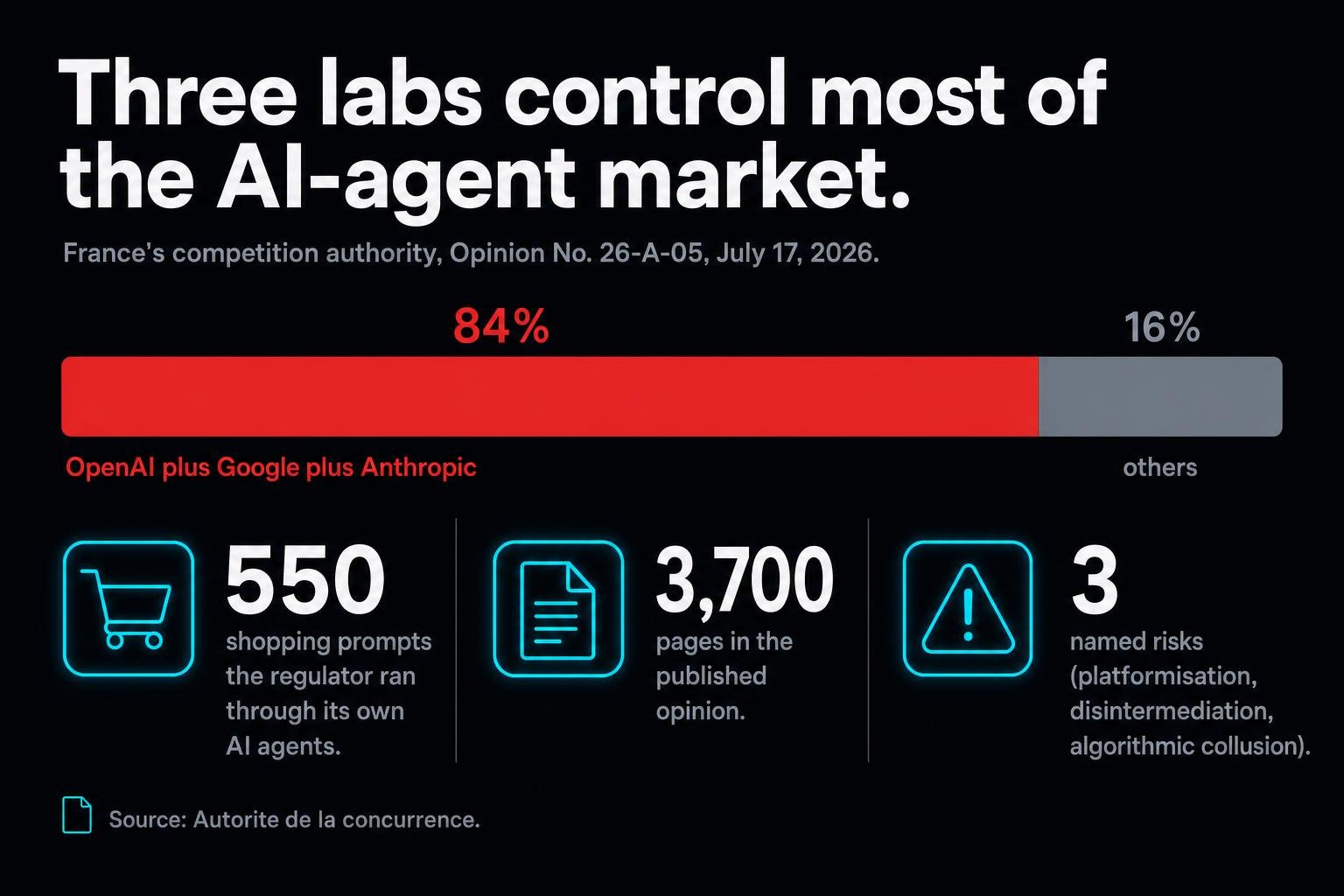
On July 17, the Autorité de la concurrence published Opinion No. 26-A-05, a 3,700-page analysis of how competition actually works in the AI-agent layer. It is the first time a major competition authority has looked past the training of large models and studied the deployment layer, the place where agents plan a task and carry it out. And the headline number is blunt: OpenAI, Google, and Anthropic together hold more than 84% of the global AI-agent market.
Why the method is the real story
Plenty of reports would have stopped at citing analysts. This one ran an experiment. The authority built agents of its own and pushed 550 shopping prompts through them, logging exactly which websites the agents visited and which ones they cited back to the user.
Think of it like a health inspector who doesn't just read your menu and check your permits. She walks into the kitchen, cooks a dish herself, and watches what actually comes out of the pans. That is what a regulator measuring "agentic shelf space" looks like. Instead of asking the platforms how open their systems are, it observed where the agents actually sent people, and how often the same handful of destinations kept showing up.
A regulator just proved that if you want to know who controls a market, you can build the customer and watch where it walks.
What 84% actually means for the web
For twenty years, the fight over online attention was about search rankings and ad auctions. If an AI agent is the one doing the shopping, the game changes. The agent decides which stores get visited and which get mentioned. If three companies supply the overwhelming majority of those agents, then three companies quietly shape which merchants get seen at all.
The authority named three specific risks. The first is platformisation, where a few gatekeepers set the rules everyone else has to play by. The second is disintermediation, the polite word for cutting the store out of its own sale. If an agent completes a purchase without you ever landing on the merchant's page, the merchant loses the relationship, the branding moment, and a lot of the data. The third is algorithmic collusion, the worry that automated systems could coordinate on prices or behavior without any human explicitly deciding to.
Picture a shopping mall where three landlords own most of the walkways. Every shopper is guided by a concierge those landlords hired. The stores are still there, but whether a shopper ever reaches them depends on decisions made upstream, by software most people never see.
The remedy vocabulary is a signal too
What the authority asked for is as telling as what it found. Alongside full enforcement of existing competition rules, it called for interoperability and open standards. In plain terms: agents built by one company should be able to work with tools and data from another, and the plumbing that connects them should be shared rather than locked to a single vendor.
The timing is hard to ignore. This landed the same month the industry has been rallying around open connection standards for agents, the shared "ports" that let any agent talk to any tool. When a G7 regulator names open standards as the fix for market concentration, it stops being a purely technical preference and starts looking like the direction of travel. Europe has a long track record of setting rules that ripple outward, and French authority opinions have often previewed wider action.
What this means if you sell anything
Here is the practical takeaway, and it is usable this week. If a national regulator can run 550 prompts through shopping agents to see who gets cited, so can you. Pick your product categories, run them through the leading AI shopping assistants, and simply record whether your store shows up. That is the new version of checking your search ranking, and right now most brands have never looked.
The concentration number matters for builders, too. When 84% of a critical layer sits with three vendors, betting your entire stack on one of them is a fragility, not a convenience. Designing systems that can route across models is the same instinct that made businesses keep more than one supplier. It is boring, and it is exactly why it works.
The deeper shift is about who owns the customer relationship. As agents handle more of the buying, the storefront visit gets thinner. The one asset no policy change can take away is the relationship you already own: your contacts, your purchase history, your direct line to the people who bought from you. Everything mediated by someone else's agent is rented. Everything you hold directly is yours.
France didn't hand down a punishment here. It handed down a map. The most useful thing about it is the method: if you want to know who controls a market, stop reading about it and go build the customer.
FAQ
These short answers summarize the public findings for quick reference.
- What did France's competition authority publish? Opinion No. 26-A-05, released July 17, a 3,700-page analysis of competition in the AI-agent market.
- How concentrated is the AI-agent market? The authority found OpenAI, Google, and Anthropic together hold more than 84% of the global market.
- How did the regulator reach that conclusion? It built its own AI agents and ran 550 shopping prompts through them, logging which websites the agents visited and cited.
- What fixes did it propose? Full enforcement of existing competition rules, plus interoperability and open standards between agents and the tools they use.
One signal a day. No noise.
A 3-minute read when something genuinely shifts in AI, automation, or defense tech. Free, most weekdays.
Free, most weekdays. No spam, unsubscribe anytime.Sources
- Autorité de la concurrence - Press release: AI agents opinion on competitive functioning - https://www.autoritedelaconcurrence.fr/en/press-release/ai-agents-autorite-de-la-concurrence-issues-its-opinion-competitive-functioning-ai
- Concurrences - The French Competition Authority issues an opinion on AI - https://www.concurrences.com/en/bulletin/news-issues/july-2026-iv/the-french-competition-authority-issues-an-opinion-on-the-competitive-136457
- ppc.land - France flags lock-in risk as OpenAI, Google, Anthropic hold 84% of AI agents - https://ppc.land/france-flags-lock-in-risk-as-openai-google-anthropic-hold-84-of-ai-agents/
Quick answers
What did France's competition authority publish?
Opinion No. 26-A-05, released July 17, a 3,700-page analysis of competition in the AI-agent market.
How concentrated is the AI-agent market?
The authority found that OpenAI, Google, and Anthropic together hold more than 84% of the global AI-agent market.
How did the regulator reach that conclusion?
It built its own AI agents and ran 550 shopping prompts through them, logging which websites the agents visited and cited.
What remedies did it propose?
Full enforcement of existing competition rules, plus interoperability and open standards between agents and the tools they use.