The Bots Are Browsing, Not Buying
OpenAI quietly shelved in-chat checkout after five months. The lesson isn't that AI shopping failed - it's that the money moved to being discovered, just as agentic browsing heads to 200 million phones.

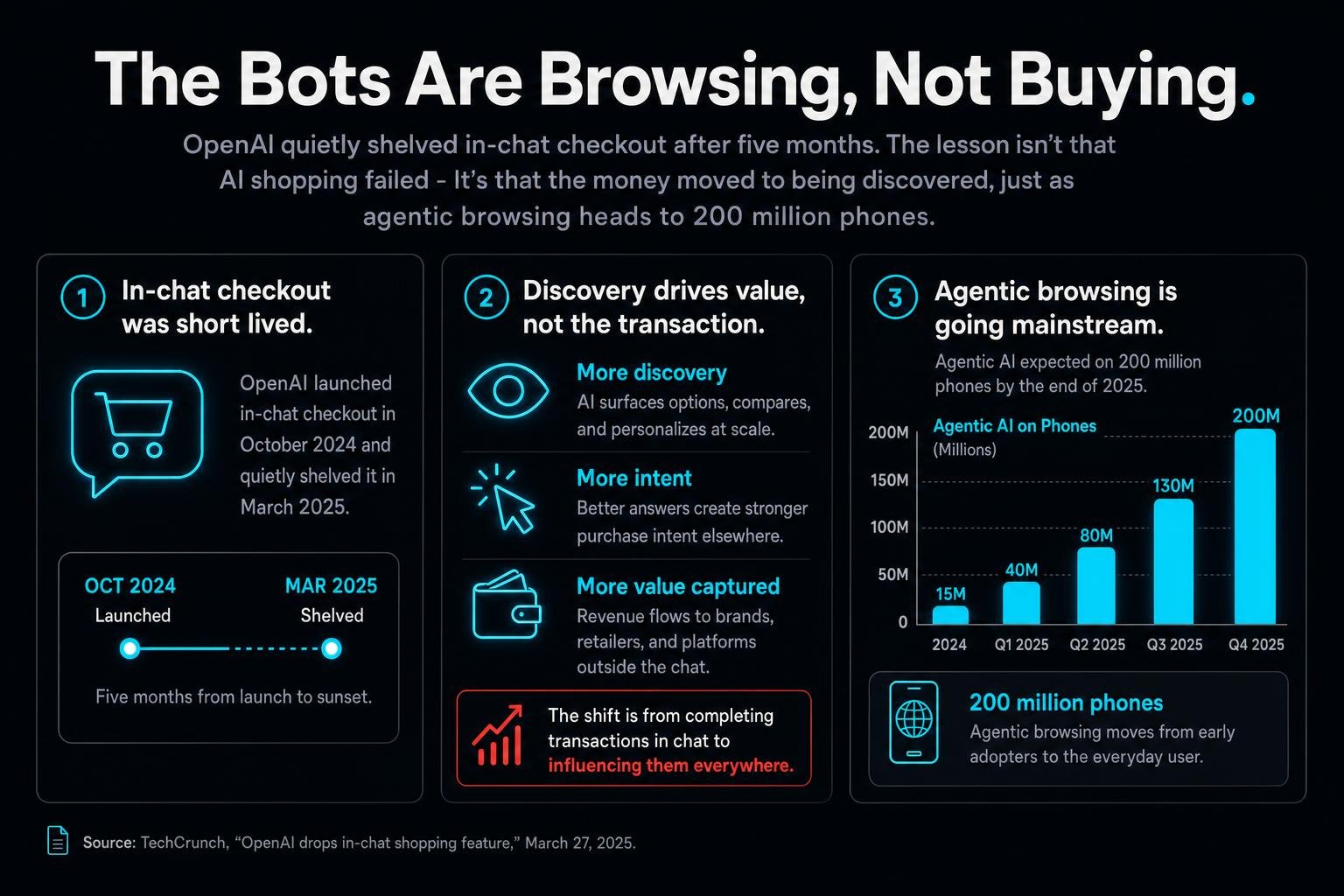
For the past year, the loudest promise in AI shopping was a single seamless moment: you ask a chatbot for running shoes, it shows you three, you say "buy the blue ones," and you're done - no cart, no checkout, no store. It sounded inevitable. It turns out it wasn't.
On March 24, OpenAI shelved Instant Checkout, its in-chat buying feature, after just five months. The numbers tell the story: of Shopify's millions of merchants, only about twelve ever went live. And OpenAI hadn't built the unglamorous machinery real commerce runs on - sales-tax calculation, fraud protection, real-time inventory sync. People used ChatGPT to research what to buy, then went somewhere else to actually buy it.
Why "buy it in the chat" was harder than it looked
Think of checkout like the plumbing in a house. The faucet - the part you see - is easy and pretty. The pipes behind the wall are tax rules that change by zip code, fraud systems that decide whether a card is stolen, and inventory feeds that know whether the blue shoes are actually in stock. OpenAI built a gorgeous faucet and discovered the pipes take years.
So instead of forcing the sale, OpenAI is pivoting to something more honest about how people already behave: discovery plus a commission on referral. Help someone find the right product, hand them off to the merchant, take a cut. It's keeping its checkout protocol (with Stripe and PayPal) on the shelf for later, not in the trash - but the near-term bet is clearly on being the place where shopping starts, not where it ends.
The near-term money in AI commerce isn't owning the checkout button. It's getting your product seen, cited, and recommended by the agent doing the looking.
Everyone else is still wiring the rails
This isn't OpenAI giving up on agentic commerce - it's the whole industry realizing the foundation comes first. In June, Mastercard launched "Agent Pay for Machines," a payment system built for always-on agents that buy on your behalf. Google is pushing a competing protocol with Walmart, Target, Shopify, and 20-plus partners already signed on. There are now at least three rival "rails" for agent payments, none dominant.
And here's the gap that should reframe how you think about all of it: today only about 3% of transactions involve an AI agent in any way - but 89% of merchants say they're preparing for it. That's not a market; that's a starting gun. The behavior is barely real yet, but nearly everyone selling something is bracing for a world where it becomes real fast.
The reason it'll become real: the browser itself is learning to shop
The piece that turns this from "interesting" to "inevitable" is happening one layer down, in the browser. Google announced Chrome auto-browse coming to Android at the operating-system level - meaning the phone itself can navigate websites and take actions, not just display them. It ships first on the Pixel 10 and Galaxy S26 in late June 2026, with a stated rollout to 200 million devices by year's end.
Sit with that number. When a browser on hundreds of millions of phones can fetch pages, fill forms, and act on its own, the basic unit of web traffic shifts from a human clicking to an agent fetching. Your landing page, your pricing table, your contact form - increasingly, the thing on the other end isn't a pair of eyes. It's a piece of software reading on someone's behalf, deciding in milliseconds whether to recommend you or move on.
What this actually means for anyone with a website
Put the two halves together and a clear playbook falls out. Checkout integration - the part everyone obsessed over - is officially wait-and-see. With three protocols fighting (OpenAI's ACP, Google's, Mastercard's) and no winner, committing hard to one rail today is a coin flip. The signal to watch is simple: when any one protocol gets more than a hundred real merchants live, that's the rail to build on. Until then, building checkout is building on sand.
What's not wait-and-see is discoverability. If agents do the researching now and the buying later, the durable advantage is being the answer they surface. In practice that means the boring fundamentals suddenly matter more, not less: clean, machine-readable product information; structured pricing and availability; clear answers to obvious questions in the first 200 words of a page; review signals an agent can actually parse. The web is quietly being re-audienced - written, for the first time, partly for machines.
The romantic version of AI shopping - the magic "buy it for me" button - got paused this spring. The unglamorous version that replaced it is, ironically, the one worth preparing for: get found, get cited, get recommended. Because in eighteen months, the shopper reading your page may not be a person at all.
One signal a day. No noise.
A 3-minute read when something genuinely shifts in AI, automation, or defense tech. Free, most weekdays.
Free, most weekdays. No spam, unsubscribe anytime.Sources
- CNBC - OpenAI revamps shopping experience in ChatGPT after Instant Checkout - https://www.cnbc.com/2026/03/24/openai-revamps-shopping-experience-in-chatgpt-after-instant-checkout.html
- TechCrunch - OpenAI's plans to make ChatGPT more like Amazon aren't going so well - https://techcrunch.com/2026/03/24/openais-plans-to-make-chatgpt-more-like-amazon-arent-going-so-well/
- Mastercard - Mastercard launches Agent Pay for Machines - https://www.mastercard.com/us/en/news-and-trends/press/2026/june/mastercard-launches-agent-pay-for-machines.html
- Fast Company - Shop 'til you bot: Google, OpenAI and the race to build agentic commerce - https://www.fastcompany.com/91533534/shop-til-you-bot-google-openai-and-the-race-to-build-agentic-commerce
- No Hacks - Agentic browser landscape 2026 - https://nohacks.co/blog/agentic-browser-landscape-2026
Quick answers
Did OpenAI cancel AI shopping?
No. OpenAI shelved its in-chat Instant Checkout feature after five months and only about 12 Shopify merchants going live, but it's pivoting to a discovery-and-referral model - helping users find products and earning a commission - and keeping its checkout protocol for later.
Why did in-chat checkout fail?
OpenAI hadn't built the core infrastructure real commerce requires: sales-tax calculation, fraud protection, and real-time inventory sync. Users researched products in ChatGPT but completed purchases elsewhere.
What is Chrome auto-browse?
It's a Google feature where the browser itself can navigate websites and take actions on a user's behalf, rolling out at the OS level on Android. It ships first on the Pixel 10 and Galaxy S26 in late June 2026, targeting 200 million devices by year's end.
How should businesses prepare for AI shopping agents?
Since agents currently do the researching, focus on discoverability: clean machine-readable product data, structured pricing and availability, fast clear answers to common questions, and parseable review signals. Hold off committing to any single checkout protocol until one clearly wins.