The Year AI Agents Got Hands
In 2026 the AI agent stopped being a chatbot and became a coworker. The software you already run now speaks its language, Meta put an autonomous agent inside its ad tools, and Shopify has the sales numbers to prove people are buying through them.

For most of the last few years, "AI agent" was a generous word for a chatbot with a personality. You typed, it typed back, and if you wanted anything done in the real world, you did it yourself. That gap is closing fast. Three separate pieces of news this week, read together, tell one story: the AI agent grew hands. It can now reach into the systems where your work actually lives, act on your behalf, and, increasingly, close a sale.
The plumbing standardized while nobody was watching
The least glamorous news is the most important. There is an emerging standard called the Model Context Protocol (MCP), a common language that lets any AI agent talk to any piece of software. Think of it as the USB port of the AI era. Before USB, every device needed its own weird cable. After it, you plugged anything into anything. MCP is trying to be that for agents.
This week the big enterprise vendors stopped just using MCP and started serving it. ServiceNow announced general availability of an MCP server that, in its own words, opens "its full system of action to every AI agent in the enterprise." Snowflake shipped managed MCP servers so agents can query company data under existing security rules with no new infrastructure. Salesforce made its Agentforce product a native MCP client, able to discover and connect to any compliant system. First-party support is now live or coming from Salesforce, ServiceNow, Workday, Snowflake and SAP, with governance handed to the Linux Foundation's new Agentic AI Foundation, backed by co-founders from Anthropic, Block and OpenAI and supported by Google, Microsoft and AWS.
Here is why that matters to anyone who does not care about acronyms: your customer records, your data warehouse and your help desk are now designed to be operated by an AI. The standard has both sides plugged in. The question for the software small businesses run has shifted from "if" to "when."
Meta put an agent in the driver's seat
The second signal is a piece of news that quietly slipped past a lot of people. Meta acquired Manus AI, a Singapore-based autonomous-agent developer, for a reported two billion dollars in late 2025, and had it rolling out inside Ads Manager by mid-February, a seven-week turnaround.
Manus is not a suggestion box. It breaks a goal into steps and executes them. It ships a "Meta Ads Analyzer" that diagnoses ad campaigns, does audience research, pulls competitor insights, and, crucially, can schedule recurring tasks so it keeps working when you log off. July's commentary has been blunt about the implication, with headlines declaring "the end of the media buyer."
The platform did not build a better calculator for advertisers. It hired an analyst, sat it inside the dashboard, and gave it a calendar.
That is worth sitting with. The layer of work that agents absorb first is the repetitive pulling, sorting and reporting. What they do not absorb is judgment: knowing which numbers matter, what a regulated industry is allowed to claim, and who is accountable when the recommendation is wrong. The value did not disappear. It moved up a floor.
The receipts showed up
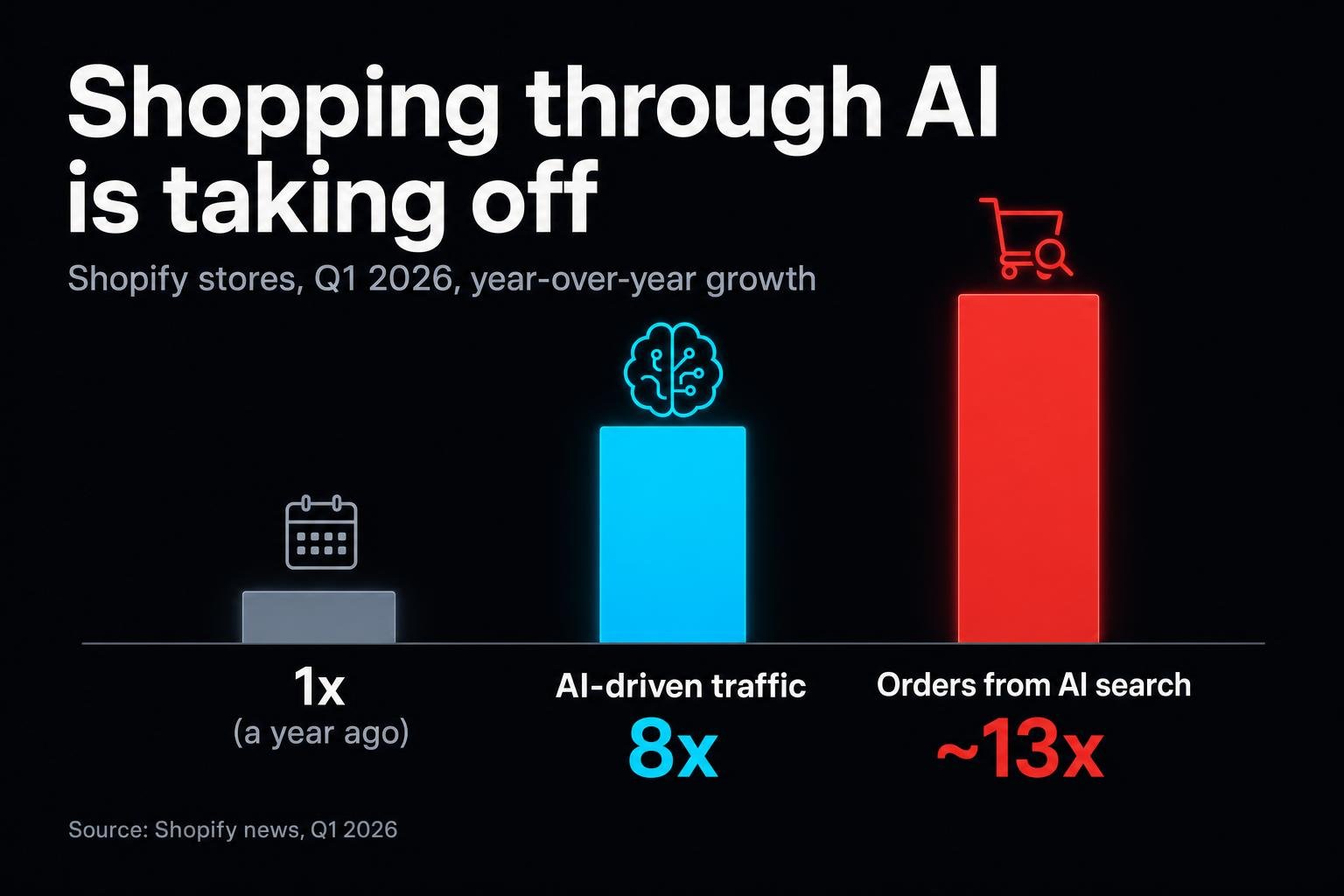
The third signal answers the natural skeptic's question: does anyone actually buy things this way? Shopify published its own numbers, and they are loud. In the first quarter of 2026, AI-driven traffic to Shopify stores grew eightfold year over year, and orders from AI-powered searches grew nearly thirteenfold. Millions of merchants can now sell directly inside AI chats, and Shopify's president is framing these agents as "personal shoppers." The research firm eMarketer expects this so-called agentic commerce to lift overall ecommerce adoption, not just shuffle it around.
Eightfold and thirteenfold are the kind of multiples that only happen at the very start of a curve, off a tiny base. But direction matters more than size here. A sales channel that barely existed eighteen months ago is now measurable, growing, and largely won by whoever has the cleanest product data. A funded startup, Nudge, just raised a small pre-seed round to build tooling for exactly this. When vendors start putting their own numbers on a trend and startups form around it, the trend is real.
What it means for the rest of us
Put the three together and the shape is clear. The connectors got standardized (MCP), the platforms shipped agents that take action (Meta and Manus), and customers are already transacting through them (Shopify). This is the difference between a demo and a channel.
The practical takeaway is not to panic about being replaced. It is to notice which work is being commoditized and move toward the work that is not. The pulling-and-reporting layer is going to the agents. The judgment layer, the context, the compliance, the accountability, is not. If your product listings are messy, that is now a sales problem, because an AI personal shopper reads structured data, not your clever brand voice. And if you run ads or a store, it is worth learning what the resident agent in your tools already does, so you are the one directing it rather than being surprised by it.
The chatbot era was about talking. This one is about doing. The companies and operators who figure out how to supervise a capable agent, rather than compete with a basic one, are the ones who come out ahead.
One signal a day. No noise.
A 3-minute read when something genuinely shifts in AI, automation, or defense tech. Free, most weekdays.
Free, most weekdays. No spam, unsubscribe anytime.Sources
- ServiceNow - opens its full system of action to every AI agent - https://newsroom.servicenow.com/press-releases/details/2026/ServiceNow-opens-its-full-system-of-action-to-every-AI-Agent-in-the-enterprise/default.aspx
- Snowflake - managed MCP servers for secure data agents - https://www.snowflake.com/en/blog/managed-mcp-servers-secure-data-agents/
- Agentic AI Foundation - MCP is growing up - https://aaif.io/blog/mcp-is-growing-up/
- MediaPost - Meta integrates Manus AI in Ads Manager - https://www.mediapost.com/publications/article/412845/meta-integrates-manus-ai-in-ads-manager.html
- Search Engine Land - Meta adds Manus AI tools into Ads Manager - https://searchengineland.com/meta-adds-manus-ai-tools-into-ads-manager-469410
- Shopify - agentic commerce momentum - https://www.shopify.com/news/agentic-commerce-momentum
- PYMNTS - Shopify bets big on agentic AI - https://www.pymnts.com/news/ecommerce/2026/shopify-bets-big-on-agentic-ai/
- eMarketer - Shopify expects agentic commerce to lift ecommerce adoption - https://www.emarketer.com/content/shopify-expects-agentic-commerce-lift-ecommerce-adoption
Quick answers
What is an AI agent, in plain terms?
It is AI that does not just answer questions but takes actions for you, like pulling reports, researching audiences, or scheduling recurring tasks. Meta's Manus tool inside Ads Manager is one example.
What is MCP and why does it matter?
The Model Context Protocol is a common language that lets any AI agent connect to any software, much like USB standardized device connections. This week ServiceNow, Snowflake and Salesforce began serving it natively, so agents can operate enterprise systems directly.
Are people actually buying through AI?
Yes. Shopify reported that in Q1 2026, AI-driven traffic to its stores grew eightfold and orders from AI-powered searches grew nearly thirteenfold year over year, off an early base.
Does this mean marketing and ops jobs disappear?
The repetitive pulling-and-reporting work is being automated, but judgment, compliance and accountability are not. The advantage goes to people who can supervise a capable agent rather than compete with a basic one.