AI's Next Big Model Went to Washington First
OpenAI's next model family, Astra, surfaced not on a launch page but in a policymaker preview, announced by solving ten decade-old math problems. The order of events is the real story.

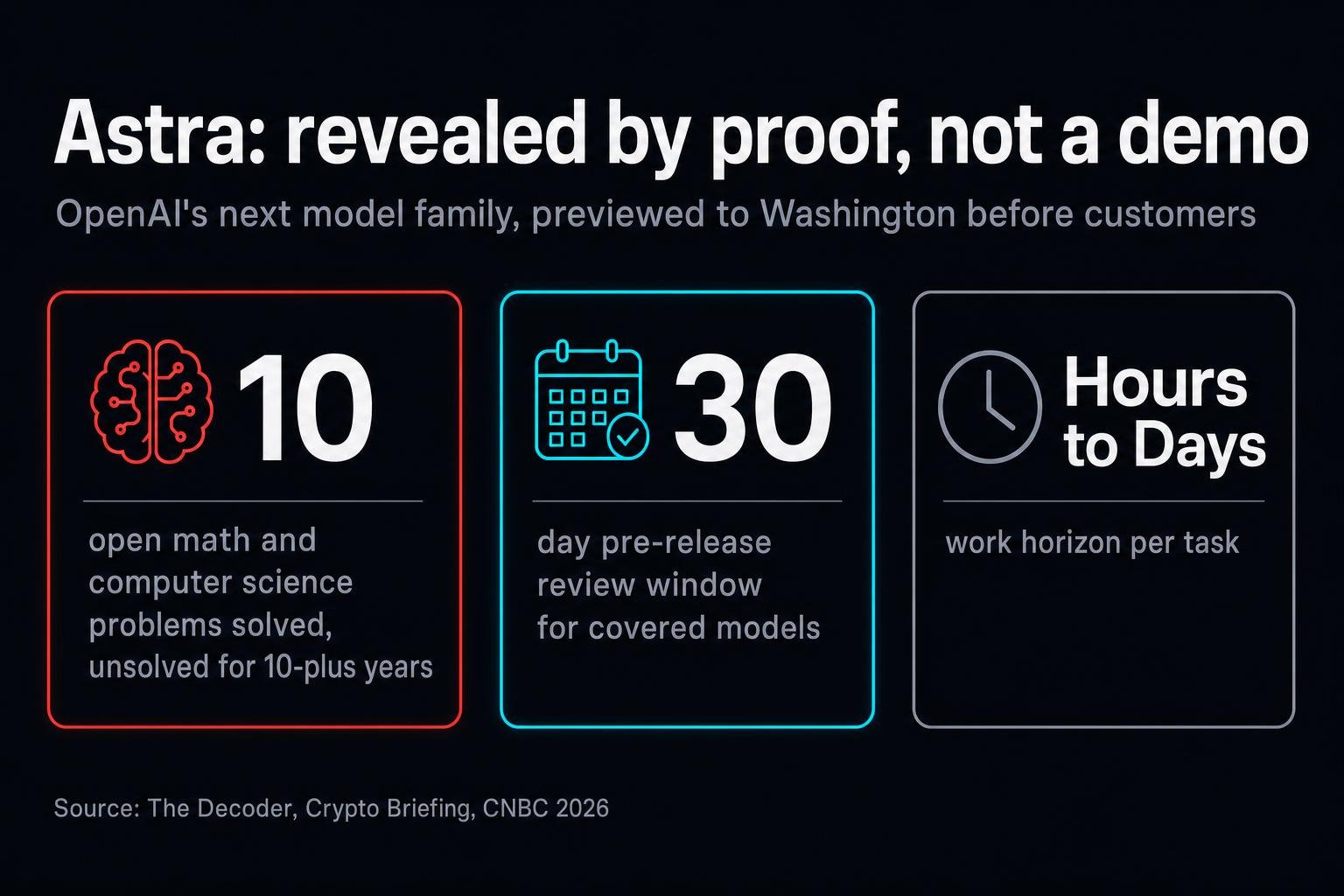
Normally a big AI model arrives the way a blockbuster arrives: a countdown, a keynote, a shiny landing page, a flood of demos. This one showed up differently. According to reporting, OpenAI's next major model family, called Astra, first surfaced in a preview shown to policymakers in Washington, and its coming-out party was not a benchmark chart. It was ten math problems.
A model built to work for days, not seconds
Astra is described as a multi-agent architecture. Instead of one model answering one question, it is built to plan, delegate to sub-tasks, revise its own work, and keep grinding in the background for hours or even days on research, coding, and scientific problems. Think of the difference between asking a single expert a quick question versus handing a whole project to a small team that goes away, works the problem, checks each other, and comes back with something finished.
Reporting suggests Astra will sit alongside OpenAI's other model lines (named Sol, Terra, and Luna), and the company is reportedly still deciding whether it is important enough to carry the name GPT-6. That naming choice is not trivia. Calling something a new generation versus just another tier is a signal about how big a jump the company believes it is.
Ten problems instead of a benchmark table
Here is the part that made me sit up. The way OpenAI reportedly chose to prove Astra's ability was to have an internal version solve ten open problems in mathematics and theoretical computer science, problems that had resisted progress for at least a decade.
That is a meaningfully different kind of proof. Benchmark scores are useful, but they can be gamed, memorized, or quietly trained toward. A genuinely unsolved problem is different: either you produce the answer or you do not. It is closer to a chef being handed a locked pantry and asked to cook, rather than reciting a menu.
When benchmarks stop impressing anyone, the new flex is a solved problem nobody could solve before. Proof of work beats proof on paper.
If this becomes the pattern, expect fewer glossy score comparisons and more "here is a hard thing that was impossible last year, and now is not." That is a healthier bar for the whole field, because it is much harder to fake.
Why regulators saw it before customers
The most interesting detail is the sequence. Per the reporting, Sam Altman showed Astra to policymakers in Washington, and it may be among the first models to pass through a new federal pre-release review for advanced AI.
The framework taking shape reportedly works like this: a government body determines which models are powerful enough to be "covered" through classified benchmarking, developers agree to a 30-day pre-release window before a covered model ships, and a government-and-industry cybersecurity clearinghouse gets set up to handle findings. The formal announcement was expected in early August.
Sit with what that means. A major capability jump was reportedly shown to the government before it was shown to customers. For years the running joke was that AI moved faster than regulation could ever hope to. This is the opposite picture: the frontier model arriving on a government-mediated clock. Whether you find that reassuring or worrying, it is a real change in how the most capable systems reach the world.
The quiet half of the story
Now flip to the other giant. Reporting says Google's flagship Gemini 3.5 Pro is months behind schedule, while the company keeps shipping smaller, faster models instead. Its efficient Gemini 3.5 Flash became the default model in AI Mode for Search globally, and the recent release run has been almost entirely lightweight tier: Gemini 3.6 Flash, 3.5 Flash-Lite, and 3.5 Flash Cyber.
Put the two stories side by side and a shape appears for the second half of 2026. The flagship tier is getting harder to deliver: OpenAI's is going through a regulatory preview, Google's is running late. Meanwhile the efficient "workhorse" tier ships on time, month after month, and quietly becomes the engine behind the most-used AI surface on Earth, Google Search.
That is a useful thing to know if you build with these tools. The most reliable, most widely deployed AI right now is not the biggest possible model. It is the well-tuned, efficient one, running at the point where billions of people actually touch it.
What it means for the rest of us
Three plain takeaways. First, AI is shifting from "answer my question" to "go work on this for a while," which changes what we will ask software to do. Second, the way capability gets proven is maturing from scoreboards toward solved-once-impossible problems, which is harder to fake and better for everyone. Third, the biggest models are now arriving on a slower, more supervised clock, while the smaller ones carry the daily load. The future is not one giant brain. It is a team of them, checked at the door.
One signal a day. No noise.
A 3-minute read when something genuinely shifts in AI, automation, or defense tech. Free, most weekdays.
Free, most weekdays. No spam, unsubscribe anytime.Sources
- The Decoder - OpenAI is reportedly building Astra, a model family designed to work on problems for hours or days - https://the-decoder.com/openai-is-reportedly-building-astra-a-model-family-designed-to-work-on-problems-for-hours-or-days/
- The Decoder - OpenAI announces its next major model Astra by dropping ten previously unsolved math solutions - https://the-decoder.com/openai-announces-its-next-major-model-astra-by-dropping-ten-previously-unsolved-math-solutions/
- Crypto Briefing - OpenAI Astra AI model DC preview - https://cryptobriefing.com/openai-astra-ai-model-dc-preview/
- CNBC - White House AI access, Anthropic, OpenAI - https://www.cnbc.com/2026/07/17/white-house-ai-access-anthropic-openai.html
- Axios - Google's DeepMind AI model race - https://www.axios.com/2026/07/23/googles-deep-mind-ai-model-race
Quick answers
What is OpenAI's Astra?
According to reporting, Astra is OpenAI's next major model family, built as a multi-agent system that can plan, delegate, and keep working on research, coding, and scientific tasks for hours or even days rather than answering in a single shot.
How was Astra announced?
Rather than a benchmark table, an internal version was said to have solved ten open problems in mathematics and theoretical computer science that had resisted progress for at least a decade, a proof-of-work style demonstration.
Why did policymakers see Astra before customers?
Reporting says Sam Altman showed it in Washington, and it may be among the first models to pass through a new federal pre-release review, under which powerful 'covered' models get a 30-day pre-release window before shipping.
What is happening with Google's Gemini?
Reporting indicates Google's flagship Gemini 3.5 Pro is months behind schedule, while its efficient Flash models keep shipping and Gemini 3.5 Flash became the default model in AI Mode for Search globally.