The AI Phone Book Is Almost Empty
Forty five percent of consumers now ask AI for local recommendations, up from six percent a year ago. Only 1.2% of businesses show up in those answers.
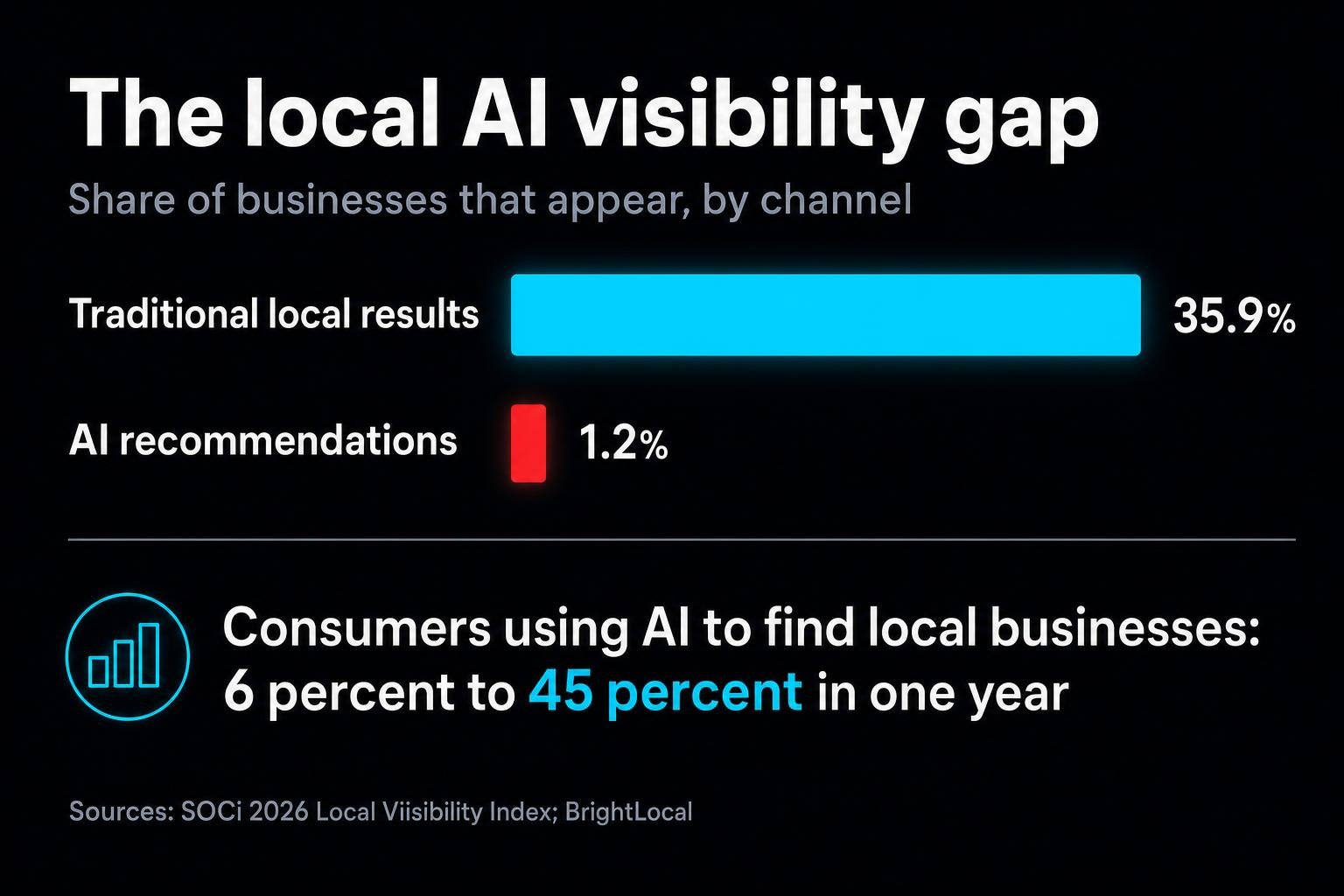
A year ago, six percent of consumers used an AI tool to find a local business. Today it is forty five percent. In twelve months, asking a chatbot who to call went from a party trick to something close to a reflex.
Here is the part almost nobody has internalized: the businesses did not move with them.
The number that should stop you cold
SOCi's 2026 Local Visibility Index found that only 1.2% of businesses appear in AI recommendations at all. In traditional local search results, that figure is 35.9%. Same businesses, same towns, same demand. Two channels, roughly thirty times apart.
Picture a city that quietly printed a second phone book. The old one is thick, dog-eared, and brutally competitive, and everyone has spent twenty years fighting over placement in it. The new one, the one that nearly half of your customers are now reaching for, has about thirty pages of entries. Most of the town has not noticed it exists.
And this is not a fringe surface. Google AI Overviews now appear on as many as 68% of local queries. The answer box is not a preview of the results anymore. For a lot of people, it is the result.
Ranking first no longer means getting recommended
The most uncomfortable finding in the SOCi data is this one: only 45% of the brands that lead in traditional local search also show up among the most recommended businesses in AI results. If you are winning the map pack today, you have roughly a coin flip's chance of being named when someone asks an assistant the same question in plain English.
That gap exists because the two systems are doing genuinely different jobs. Search ranks documents. It asks which page looks most authoritative, most linked-to, most trusted. A language model is not ranking pages at all. It is assembling a sentence, and it needs facts it can state without hedging. Your services. Your hours. Your locations. What you accept, what you specialize in, who is credentialed to do it.
Search rewarded the business that looked most authoritative. AI rewards the business that is easiest to state as a fact.
If your site says you offer "tailored solutions for every stage of your journey," a search engine can still rank it on the strength of your backlinks. A model reading the same page has nothing to lift. It will go quote the competitor who wrote a plain list.
The crawler dividend
Duda analyzed 68 million AI crawler visits, and the pattern on the other side of that gap is striking. Local sites that get crawled by AI engines generate:
- 3.2x more human traffic
- 2.7x more form submissions
- 2.5x more click-to-call actions
than sites the engines ignore.
Be honest about what that is: a correlation, not a proof of causation. Sites that AI crawlers can read tend to be sites that are well built in every other way too, and well built sites convert better regardless. But the direction is unambiguous, and the form-fill and click-to-call numbers matter more than the traffic number. Those are people who decided to act, not people who bounced. Being legible to the machines is tracking with being chosen by the humans.
The work is unglamorous, which is why the gap persists
The moat here is not backlinks, and it is not a decade of domain age. It is structured, crawlable, unambiguous facts that a model can repeat without inventing anything.
Concretely, that means the boring stuff. A services page that lists services as services, not as a mood. Hours and locations that are correct and marked up in schema. Credentials stated plainly. What you accept, what you do not, and where you do it. Questions answered in the format people actually ask them, rather than buried three scrolls into a page written to impress a competitor.
This is content engineering, not campaign work, and it has a property most marketing work does not: you can test it yourself in about twenty minutes. Open ChatGPT, Gemini, Perplexity and Claude. Ask the ten questions your best customers actually ask before they call you. Write down whether you appear, and what gets said about you when you do. Then read your own site and find the sentence the model would have needed.
Most people who run that test for the first time discover something worse than being ranked low. They discover they are not in the conversation at all.
Why the 1.2% is the whole story
Every channel gets expensive eventually. Paid search did. SEO did. Social did. The pattern is always the same: early participants pay attention instead of money, then late participants pay money instead of attention, and eventually everyone pays a lot for a little.
A channel where 1.2% of businesses appear, and where 45% of consumers are already asking questions, is not a saturated channel. It is an empty one with a crowd standing in it. That combination does not last, and it does not last because the fix is genuinely easy. Cleaning up your factual surface area is a few days of unglamorous work, not a twelve month link-building campaign. The barrier is not difficulty. The barrier is that almost nobody has looked yet.
Consumers went from 6% to 45% in a year. The businesses have not gone anywhere. That is the arbitrage, and it closes the moment enough people run the twenty minute test.
One signal a day. No noise.
A 3-minute read when something genuinely shifts in AI, automation, or defense tech. Free, most weekdays.
Free, most weekdays. No spam, unsubscribe anytime.Sources
- Boulder SEO Marketing - AI search visibility for local businesses (analysis of the Duda study) - https://boulderseomarketing.com/ai-search-visibility-local-businesses/
- ALM Corp - How AI is impacting local search (BrightLocal and AI Overview data) - https://almcorp.com/blog/how-ai-is-impacting-local-search/
Quick answers
How many businesses actually show up in AI recommendations?
Only 1.2%, according to SOCi's 2026 Local Visibility Index. By comparison, 35.9% of businesses appear in traditional local search results.
If I already rank well in local search, am I covered?
Not reliably. SOCi found that only 45% of brands leading in traditional local search also appear among the most recommended businesses in AI results, so strong local rankings translate to AI visibility roughly half the time.
How many people are actually using AI to find local businesses?
BrightLocal data puts it at 45% of consumers, up from 6% a year earlier. Separately, Google AI Overviews now appear on up to 68% of local queries.
Does being crawled by AI engines make a measurable difference?
Duda's analysis of 68 million AI crawler visits found that local sites crawled by AI engines generate 3.2x more human traffic, 2.7x more form submissions and 2.5x more click-to-call actions than sites the engines ignore. It is a correlation rather than proof of causation, but the direction is consistent.