Google Ranks, AI Cites, and the Lists Don't Match
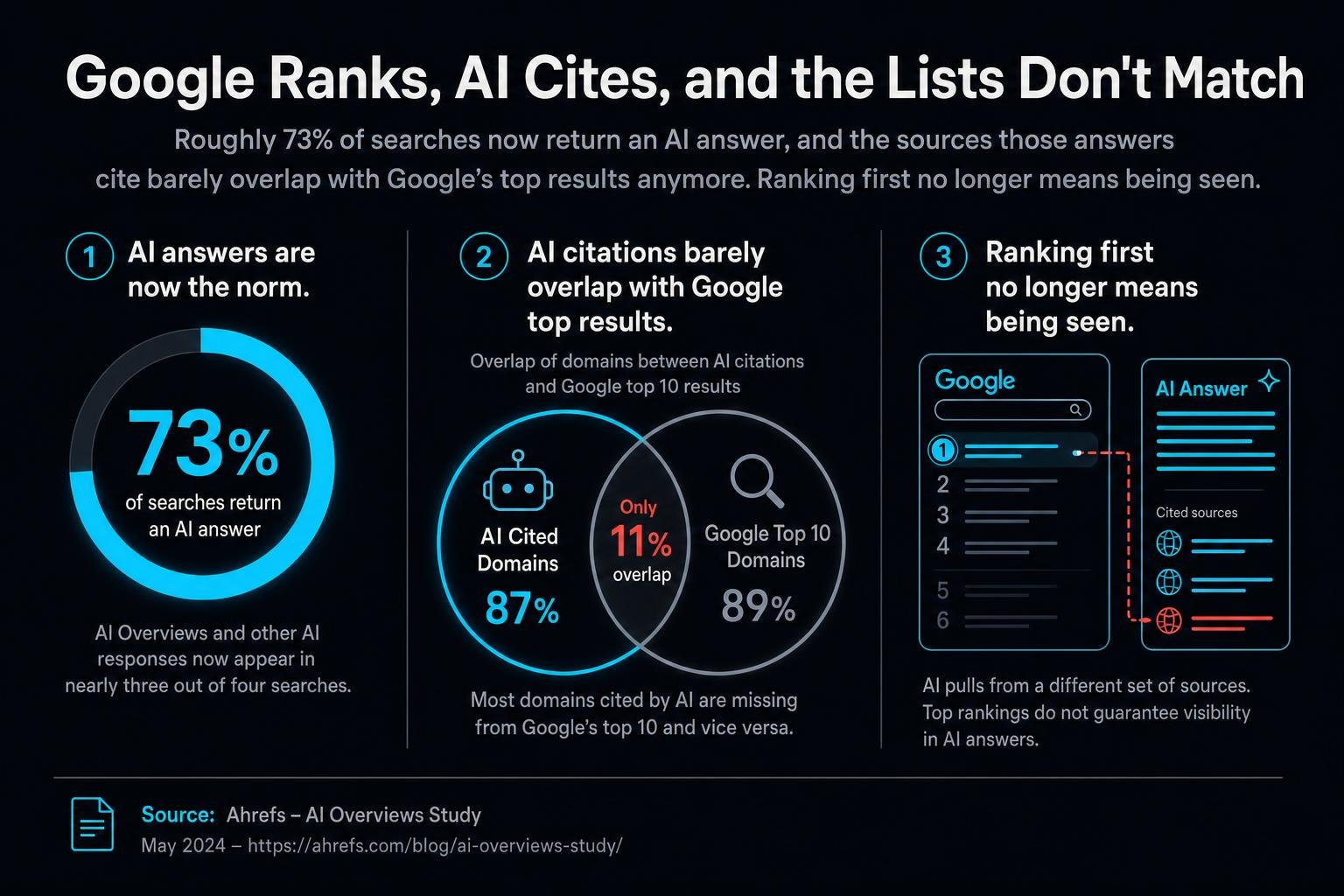
Roughly 73% of searches now return an AI answer, and the sources those answers cite barely overlap with Google's top results anymore. Ranking first no longer means being seen.

For about twenty-five years, the goal of being found online was simple to state: rank on the first page of Google. Get into the top ten blue links and you had a shot at the click. That was the whole game.
The game is quietly changing under our feet, and most people haven't noticed yet. According to recent reporting, around 73% of search queries now trigger an AI-generated answer sitting above or instead of the familiar list of links. McKinsey put intentional use of AI search at roughly 50% of consumers by late 2025. More and more, the first thing a person reads about a product, a service, or a question isn't a webpage. It's a paragraph an AI wrote, stitched together from a handful of sources it decided to trust.
And here is the part that should make every marketer sit up straight. The overlap between the pages that rank in Google's top ten and the sources that AI engines actually cite has reportedly fallen from about 70% to below 20%.
Ranking first on Google used to guarantee you were in the conversation. Now the AI answering the question may be quoting a completely different set of pages, and yours might not be on the list.
Why the two lists drifted apart
Think of it like two restaurant critics in the same city. For years they mostly agreed, so a good review from one predicted a good review from the other. Then one critic changed how they judge. Suddenly the places topping one list barely show up on the other. Nothing about the restaurants changed. The judging did.
Search engines rank pages. AI answer engines, the ChatGPTs and Perplexitys and Google's own AI Mode, do something different. They read, summarize, and cite. They reward content that is clearly structured, factually dense, and easy for a machine to extract a confident sentence from. A page can be perfectly optimized for traditional search and still be invisible to the model writing the answer, because the model is looking for something else.
The front door is moving, too
This isn't just happening inside search boxes. The agents are moving to where people already are. At its 2026 developer event, Google said it is shipping Gemini directly inside Chrome on Android, baked into the operating system rather than bolted on as an app or extension. It's launching on flagship phones first, with a stated target of 200 million devices by year-end.
When an AI browsing assistant is the default on hundreds of millions of phones, a real shift follows. The buyer's first interaction with your brand increasingly happens through an agent reading your page on their behalf, not a human scrolling it. That changes what a webpage is for. It still has to persuade a person. But now it also has to be legible to a machine that may be the only thing that ever reads it in full.
What this actually means for you
If you sell anything, run a site, or advise people who do, the takeaway is uncomfortable but clear: being on page one is no longer the same as being in the answer. Those are now two separate scoreboards, and a lot of organizations are still only watching the old one.
The discipline forming around this even has a name now: Generative Engine Optimization, or GEO. It's the practice of earning citations inside AI-generated answers, the way SEO was the practice of earning rankings. It is early. Most playbooks are still being written. But the underlying logic is hard to argue with: if half your potential customers are reading machine-written answers, and those answers cite a different set of pages than Google ranks, then you need to know whether you're in them.
A simple test anyone can run
You don't need a budget or a tool to start. Pick ten questions a customer would actually type before buying what you sell. Ask them to ChatGPT, Perplexity, and Google's AI Mode. Write down who gets cited. If your competitors keep showing up in the answers and you don't, that gap is the whole story. It's also measurable month over month, which makes it the kind of thing you can actually improve rather than just worry about.
The web spent a generation learning to win a ranking. The next few years are about learning to win a citation. The companies that figure out the difference early will look, from the outside, like they simply got lucky with the robots. They didn't. They just started watching the new scoreboard before everyone else did.
One signal a day. No noise.
A 3-minute read when something genuinely shifts in AI, automation, or defense tech. Free, most weekdays.
Free, most weekdays. No spam, unsubscribe anytime.Sources
- Search Engine Land - What is generative engine optimization (GEO) - https://searchengineland.com/what-is-generative-engine-optimization-geo-444418
- Evertune - Top generative engine optimization (GEO) platforms for 2026 - https://www.evertune.ai/resources/insights-on-ai/top-15-generative-engine-optimization-geo-platforms-for-2026
- Chrome for Developers - Chrome at I/O 2026 - https://developer.chrome.com/blog/chrome-at-io26
Quick answers
What is Generative Engine Optimization (GEO)?
GEO is the practice of getting your content cited inside AI-generated answers from tools like ChatGPT, Perplexity, and Google's AI Mode. It's the AI-era counterpart to SEO, which focused on ranking in traditional search results.
Does ranking high on Google still get me into AI answers?
Less and less. The overlap between Google's top-10 ranked links and the sources AI engines cite has reportedly fallen from about 70% to below 20%, so a strong Google rank no longer guarantees you appear in the AI answer a customer reads.
How common are AI-generated answers in search now?
Around 73% of search queries reportedly trigger an AI-generated answer, and McKinsey put intentional AI-search use at roughly 50% of consumers by late 2025.
How can I check if AI engines cite my site?
Pick ten questions a customer would ask before buying, run them through ChatGPT, Perplexity, and Google's AI Mode, and note who gets cited. Re-check monthly to track whether your share of AI answers is improving.