The Day the Open Web Got a Bouncer
Cloudflare's AI crawler defaults flipped on 15 September, closing the door on training and agent bots for a big slice of the web. The channel everyone is migrating to, AI answers, turns out to be unstable by construction.

For about thirty years, the web worked like a public park. You put something up, anyone could walk past and read it, and the only real etiquette was a text file called robots.txt that politely asked certain visitors to stay off the grass. Nobody checked ID at the gate.
As of today, 15 September 2026, a large slice of that park has a bouncer.
What actually changed
Cloudflare, which sits in front of a very large share of the internet, changed its defaults. Training crawlers and agent crawlers are now blocked by default on ad-supported pages. That applies to all new sites, to newly added sites on existing accounts, and to all existing free-plan customers. Search bots stay allowed. Paid customers who already configured their own rules keep those rules (MLQ News, NovaProxy).
Cloudflare paired the flip with a programme called Pay Per Use, which compensates publishers when their content actually surfaces inside an AI answer. So this is not a pure wall. It is a toll booth with a wall attached, and the interesting part is which lane your traffic ends up in.
Notice the distinction buried in that sentence, because almost nobody is making it. A training crawler is reading your page to teach a model something permanent. An agent crawler is fetching your page live, right now, because a human just asked a question and the machine needs an answer. Those are completely different transactions. One is a library acquisition. The other is a customer walking into your shop. Most site owners are about to make a single decision that covers both.
The part that could cost somebody their search traffic
Here is the wrinkle that deserves a siren. According to Crawl Lab, the big mixed-use crawlers blend search, training and agent behaviour into a single fetcher. Googlebot, Bingbot and Applebot do not show up wearing three different uniforms. They show up as one visitor doing three jobs.
Which means that where a site owner has chosen to block training, those mixed-use bots can get blocked wherever that choice applies. A well-intentioned click on "block AI training" could quietly take classic search indexing down with it.
Blocking a mixed-use crawler to stop it training on you is like firing the delivery driver because you did not like the flyer they left. Same person, two jobs, one decision.
I want to be honest about confidence here: that mechanic is the single most consequential claim floating around today, and I have seen it reported in one place. If you administer sites, verify it in your own dashboard before you touch a setting. This is not a toggle to flip on vibes and a headline. The failure mode is not dramatic, it is worse than dramatic. Traffic sags three weeks from now, nobody connects it to a checkbox ticked in September, and the content team gets blamed.
Meanwhile, the escape hatch has a wobbly floor
The obvious response to a closing door is to run toward the new one. If search is being disintermediated by AI answers, then get cited in AI answers. There is a real business case for it. Work compiled by Seer Interactive suggests brands cited in AI Overviews earn 35% more organic clicks and 91% more paid clicks than brands left out, measured across 25.1 million organic impressions and 42 organizations. And 32% of digital marketing leaders now rank generative engine optimisation as their top priority, per Conductor.
Except the new channel has a property nobody has priced in. Research by Julius Schulte, Don't Measure Once: Measuring Visibility in AI Search, analysed citation behaviour across multiple AI platforms from January to March 2026 and found that the sources cited and brands mentioned in AI answers fluctuate substantially day to day (arXiv). Not as a glitch. As a persistent structural property of how these systems work.
Think about a thermometer that gives you a different reading every time you look at it, not because the room is changing but because that is how the thermometer is built. You would not throw it away. You would stop quoting a single reading as a fact. That is exactly the discipline AI visibility now demands: one measurement is one sample from a distribution that moves. A trend line over weeks is a measurement. A number from Tuesday is an anecdote wearing a lab coat.
What the research says the lever actually is
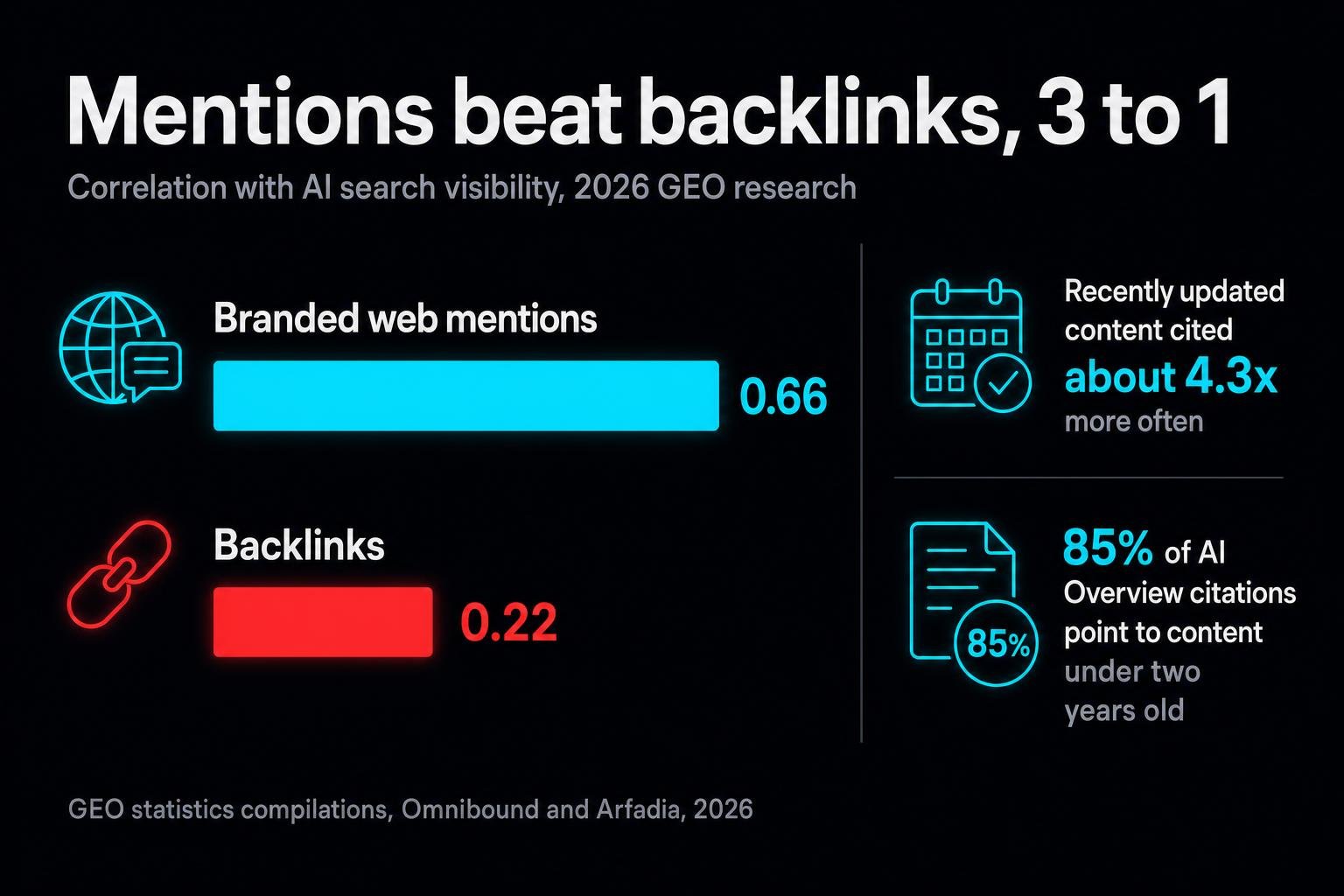
Two findings from the same body of GEO work are worth more than most of the tactics currently being sold. First, branded web mentions correlate with AI visibility roughly three times more strongly than backlinks do, about 0.66 against 0.22. Second, recently updated content is cited around 4.3 times more often, and roughly 85% of AI Overview citations point to content less than two years old (figures compiled by Omnibound and Arfadia).
Read together, that is a strategy in two sentences. Being talked about beats being linked to. Being recent beats being comprehensive. That is closer to public relations than to the link-building craft the last decade was built on, and it rewards people who publish consistently over people who publish monuments.
Fair warning on those numbers: several of them reached me through statistics roundups rather than the originating studies, and the widely-quoted Seer click-lift study is dated September 2025, which makes it a year old in a field that reinvents itself quarterly. The direction is consistent across independent compilations. The decimal places are not something I would put in a contract.
The through-line
One side of the web is adding doors and toll booths. The other side, the destination everyone is sprinting toward, cannot be measured reliably with a single reading. Neither of those is a catastrophe. Together they describe a market where the scarce skill stopped being publish more and became know what is actually happening, repeatedly, over time.
The park is becoming a city. Cities are fine. You just need to learn the streets, and check what your own front door is set to before you assume it is open.
One signal a day. No noise.
A 3-minute read when something genuinely shifts in AI, automation, or defense tech. Free, most weekdays.
Free, most weekdays. No spam, unsubscribe anytime.Sources
- MLQ News - Cloudflare sets September 15 deadline for AI companies to separate training crawlers or face default blocks - https://mlq.ai/news/cloudflare-sets-september-15-deadline-for-ai-companies-to-separate-training-crawlers-or-face-default-blocks/
- Crawl Lab - Cloudflare blocks AI crawlers, September 2026 - https://crawl-lab.com/en/blog/robots-txt/cloudflare-blocks-ai-crawlers-september-2026/
- NovaProxy - Cloudflare will block AI crawlers by default on September 15, 2026: what actually changes - https://www.novaproxy.io/blog/cloudflare-will-block-ai-crawlers-by-default-on-september-15-2026-heres-what-actually-changes
- arXiv - Julius Schulte, Don't Measure Once: Measuring Visibility in AI Search (GEO) - https://arxiv.org/pdf/2604.07585
- Omnibound - Generative engine optimization statistics - https://www.omnibound.ai/blog/generative-engine-optimization-statistics
- Arfadia - AI search and GEO statistics 2026, sourced and updated - https://blog.arfadia.com/ai-search-geo-statistics-2026-sourced-updated/
Quick answers
What exactly changed at Cloudflare on 15 September 2026?
Cloudflare flipped its defaults so that AI training crawlers and agent crawlers are blocked on ad-supported pages. It applies to all new sites, newly added sites on existing accounts, and all existing free-plan customers. Search bots remain allowed, and paid customers with an existing configuration keep it.
Could blocking AI crawlers hurt my Google search rankings?
Possibly, and it is worth checking rather than assuming. Crawl Lab reports that mixed-use crawlers such as Googlebot, Bingbot and Applebot blend search, training and agent behaviour into one fetcher, so a choice to block training can catch them wherever that choice applies. Verify the behaviour in your own dashboard before changing a setting.
Is there a difference between training crawlers and agent crawlers?
Yes, and it matters. Training crawlers read your content to build a model's baseline knowledge. Agent crawlers fetch your page live so an AI can answer a question someone just asked. If you want to appear in AI answers, agent crawlers are the ones you need to let in.
Why is AI search visibility hard to measure?
Research by Julius Schulte, analysing citation behaviour across multiple AI platforms from January to March 2026, found that the sources cited and brands mentioned in AI answers fluctuate substantially day to day as a structural property of generative search. A single reading is one sample from a moving distribution, so trends over time are more meaningful than a one-off score.