Salesforce Just Became a Plugin
Salesforce shipped 37 sales skills into Claude, and Google started buying things for you. Two different companies, one pattern: the surface where the customer acts is leaving the website you built.
For twenty years the fight in software was a fight over the icon. Get onto the home screen. Get into the browser tab. Get the user to log in on Monday morning and stay logged in all week. Nearly every SaaS valuation on earth rests on the same quiet assumption: people will keep coming to the app.
On August 26, Salesforce stopped assuming that.
The CRM moved into somebody else's window
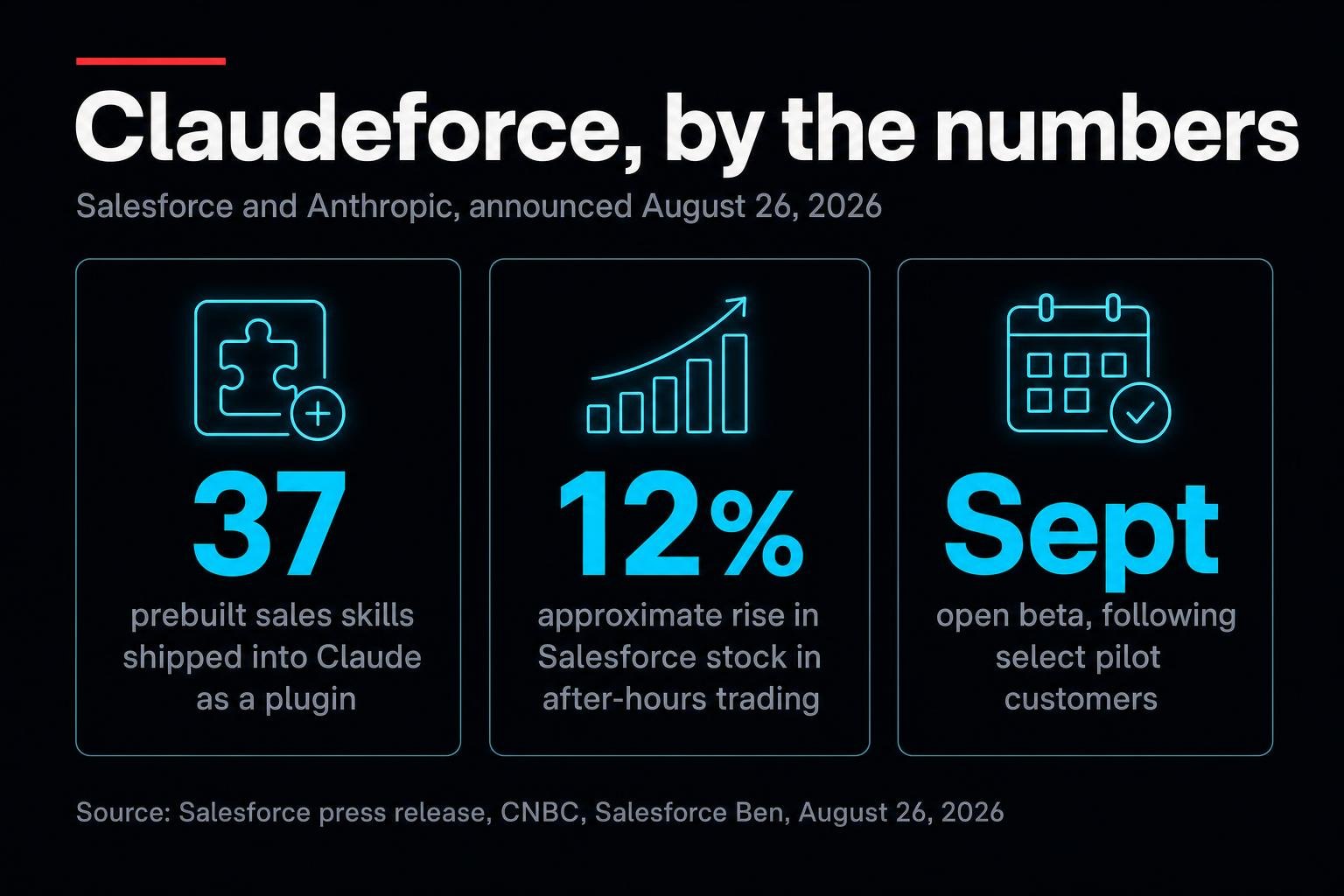
Salesforce and Anthropic announced Claudeforce, and it runs in two directions at once. Claude moves into Salesforce as a reasoning model. And Salesforce moves into Claude as a plugin, with 37 prebuilt sales skills: compose the email, update the record, reason over live pipeline, take governed action, all without opening Salesforce at all. Claude also becomes the default model inside Slack, powering Slackbot and a new "Claude Tag" feature.
Select pilot customers have it now. Open beta lands in September, with more business-function skills promised in Q3. The market's read was immediate: Salesforce stock rose roughly 12% after hours.
Sit with how strange that is. Salesforce owns one of the most defensible moats in enterprise software: the record of every customer relationship, plus the daily habit of a million salespeople opening the same tab. And the conclusion Salesforce reached is to ship 37 skills into someone else's chat window. Marc Benioff has a name for the shift underneath it, the "SaaSpocalypse," and the plain-language version is this: the interface stops being where work happens. The model is.
The unit of software distribution just changed. It is no longer the app. It is the skill.
Meanwhile, Google started making phone calls
Same week, different company, same pattern. Google Shopping shipped agentic checkout: track an item's price and Google will go buy it for you, on the merchant's own site, using Google Pay. Separately, search a product "near me" and tap "Let Google Call." Duplex, upgraded with Gemini, phones nearby stores, asks about inventory, price and promotions, then texts or emails you the summary.
It is live with select participating US merchants, rolling out first in toys, health and beauty, and electronics.
Read those two features slowly, because they are quietly radical. In the first, a purchase completes on a merchant's site with no human ever looking at the page. In the second, the phone call your business answers was placed by a machine relaying a person's intent. Both are the same event wearing different clothes: the place where the customer acts is being pulled away from the thing you built and paid to optimize.
Why these are one story
Here is the analogy I keep coming back to. For most of the internet era, a business was a shop with a window on a busy street. You paid for the corner spot, you dressed the window, you counted who walked in. Search ads, landing pages, conversion rate optimization: all of it is the craft of dressing a window for a street full of humans.
Now the street is filling up with assistants running errands for people who stayed home. The assistant does not care about your hero image. It does not scroll, it does not get charmed, it does not abandon a cart out of doubt. It wants your inventory, your price, your availability and a clean way to complete the transaction. If your shop cannot answer in the format the assistant expects, it walks to the next one, and the human who sent it never learns you existed.
Claudeforce is the enterprise version of the same trade. Instead of dressing a window for a salesperson, you publish a set of actions an assistant can call, with permissions attached. That is a different product shape, a different kind of documentation, and a completely different definition of "integration."
The quieter consequence: picking a model is becoming an infrastructure decision
One reading of the deal, argued in the Yahoo Finance coverage, is that it ends model-agnostic enterprise AI: companies will now choose a model the way they once chose a cloud. That is a strong claim and worth watching rather than swallowing. But the logic is easy to follow. Once your CRM's skills, your chat client's default assistant and your team's daily muscle memory all sit with one provider, "just swap the model" stops being a config change and becomes a migration.
The frontier went quiet, and that is the tell
Here is the detail that ties the week together. In the week of August 27, none of OpenAI, Google or Anthropic shipped a frontier model. The most recent tracked releases from those three are ChatGPT Work in July and Claude Opus 5 on July 24. What kept shipping, at a near-weekly cadence, was the cheap and fast tier: GLM-5.3 Flash on August 26, DeepSeek V4 Flash Vision Exp on August 21, Gemini 3.7 Flash on August 13.
So the movement right now is not raw capability at the top. It is distribution. Who owns the window where the work happens, who gets called when somebody wants to buy something, whose skills are already installed. That is a much older kind of competition than "whose model scores higher," and historically it is the one that decides who gets paid.
What I would watch
- Whether the September open beta publishes those 37 skill definitions. If they are readable, they become the first public template for what a governed, agent-callable business action actually looks like.
- Whether participating-merchant status for agentic checkout opens beyond invitation in the US, and whether ecommerce platforms turn it into a simple toggle.
- Your direct and unattributed traffic. If purchases start completing through agents, analytics will show conversions with no obvious session behind them. The reporting gets strange before anyone sends an announcement.
None of this is a prediction that websites die. People still walk into shops. But for the first time the assistant is a real customer with real spending authority, and it reads a very different kind of storefront.
One signal a day. No noise.
A 3-minute read when something genuinely shifts in AI, automation, or defense tech. Free, most weekdays.
Free, most weekdays. No spam, unsubscribe anytime.Sources
- Salesforce - Salesforce and Anthropic announce Claudeforce - https://www.salesforce.com/news/press-releases/2026/08/26/salesforce-and-anthropic-announce-claudeforce/
- CNBC - Salesforce and Anthropic partnership: Claudeforce - https://www.cnbc.com/2026/08/26/salesforce-anthropic-partnership-claudeforce.html
- VentureBeat - Salesforce just put its entire CRM inside Claude - https://venturebeat.com/orchestration/salesforce-just-put-its-entire-crm-inside-claude-and-says-youll-never-need-its-app-again
- Salesforce Ben - Claudeforce announced in Q2 '27 earnings - https://www.salesforceben.com/salesforce-and-anthropic-announce-claudeforce-in-q2-27-earnings/
- Yahoo Finance - What the Claudeforce deal signals - https://finance.yahoo.com/technology/ai/articles/salesforce-claudeforce-deal-anthropic-signals-102859998.html
- Google - Agentic checkout and AI holiday shopping - https://blog.google/products-and-platforms/products/shopping/agentic-checkout-holiday-ai-shopping/
- Google - Agentic commerce AI tools for retailers and platforms - https://blog.google/products/ads-commerce/agentic-commerce-ai-tools-protocol-retailers-platforms/
- eMarketer - Google brings checkout to AI Mode - https://www.emarketer.com/content/google-brings-checkout-ai-mode-races-rivals-agentic-commerce
- LLM Gateway - model release timeline - https://llmgateway.io/timeline
- AI Release Tracker - latest releases - https://aireleasetracker.com/latest
Quick answers
What is Claudeforce?
A partnership announced by Salesforce and Anthropic on August 26, 2026. It works in two directions: Claude becomes a reasoning model inside Salesforce, and Salesforce becomes a plugin inside Claude with 37 prebuilt sales skills such as composing emails, updating records and reasoning over live pipeline. Claude also becomes the default model for Slack.
When can businesses actually use it?
Select pilot customers have access now, with an open beta in September 2026 and more business-function skills promised in Q3.
What is Google's agentic checkout?
A Google Shopping feature where you track an item's price and Google completes the purchase for you on the merchant's site using Google Pay. It is live with select participating US merchants, rolling out in toys, health and beauty, and electronics. A companion feature, "Let Google Call," uses Duplex with a Gemini upgrade to phone nearby stores about inventory, price and promos, then send you a summary.
Why do these two announcements matter together?
Both move the point of action away from the interface a business controls. Enterprise work shifts from the CRM screen into a chat window, and shopping shifts from a product page into an agent's transaction. That breaks assumptions behind conversion optimization and attribution, and it makes structured, machine-readable answers about price, inventory and availability more valuable than page design.