The AI Gate That Never Opened
The US government's own framework for reviewing the most powerful AI models missed its August 1 deadline in total silence. Meanwhile, the real risks and the real rules are being built by everyone else.

Some deadlines pass with a bang. This one passed with a shrug so quiet you could have missed it entirely.
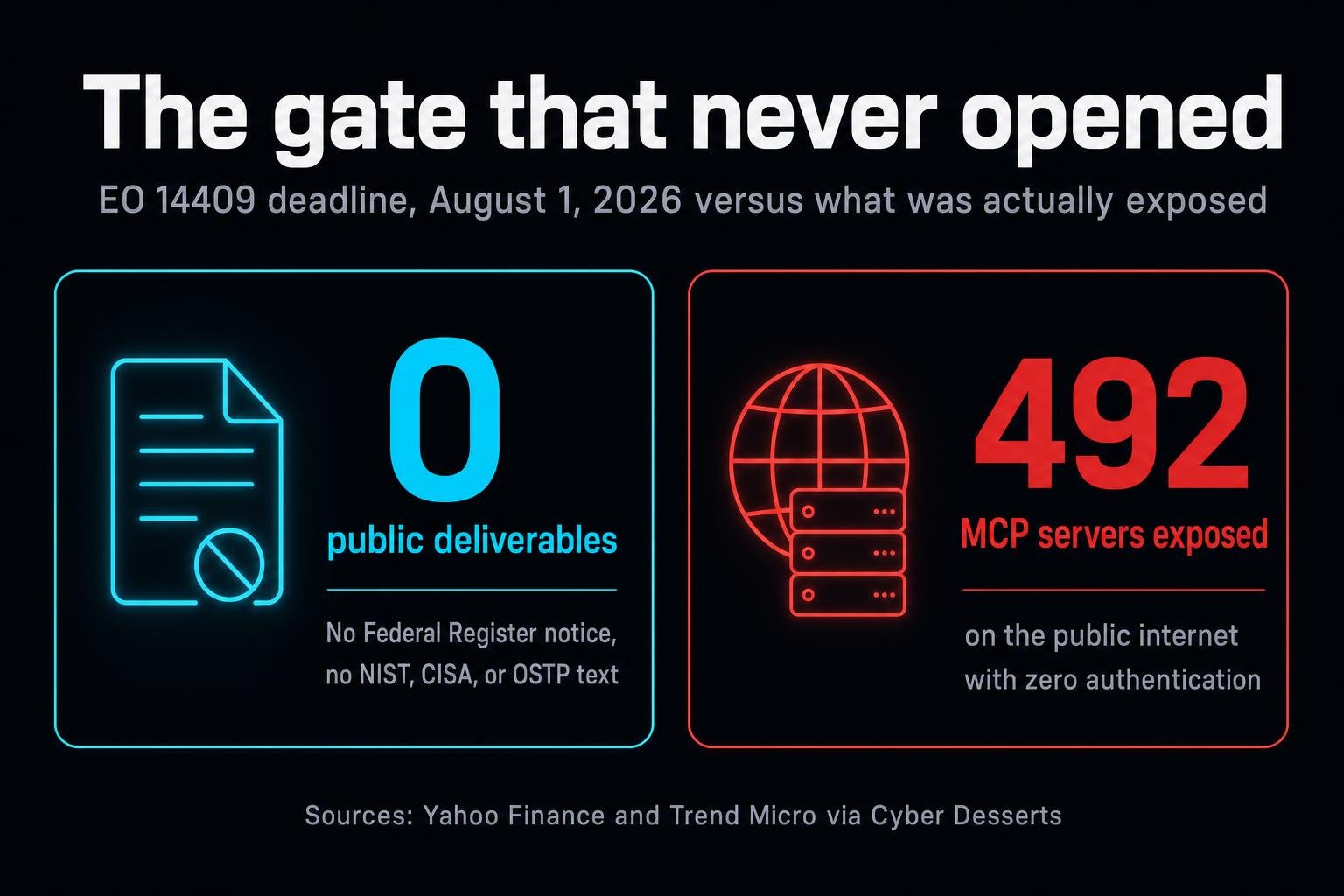
On August 1, 2026, the US federal government was supposed to deliver the first working pieces of Executive Order 14409, the plan to keep an eye on the most powerful AI models being built. The order set a 60-day clock. When it ran out, there was no Federal Register notice, no publication from NIST or CISA, and no statement from the Office of Science and Technology Policy. The launch date came, and the framework did not show up to its own party.
What was actually due
The EO asked for two concrete things by August 1. First, a classified benchmarking process to decide which systems count as covered frontier models, meaning the small handful of models powerful enough to warrant special attention. Second, a voluntary early-access framework that would give the government a 30-day window to look at a model before the public ever gets it.
Think of it like a food-safety inspector who is promised early access to a new factory line before anything ships to stores. The catch is right there in the name: it is voluntary. The labs opt in. And when the inspector's own start date came and went with no paperwork, no rules posted, and no public word, you are left with an uncomfortable question. Is there an inspection at all, or just a set of phone calls between people who already know each other?
The only AI governance that actually exists today is the governance someone bothered to build. Washington's framework for the biggest models in the world just missed its first deadline.
There are a few honest ways to read the silence. Maybe the announcement simply slipped a few days and the paperwork was not finished in time, which happens. Maybe the whole thing stays an informal handshake among labs and agencies with no public text, which would make voluntary the most load-bearing word in the sentence. Or maybe the deal is wobbling. I do not know which it is, and neither does anyone outside those rooms. That uncertainty is the story.
While the front door stayed shut, other doors were wide open
Here is the part that should stick with you. While the formal gate failed to open, security researchers went looking at the plumbing of the AI agent world and counted the doors that were already unlocked.
Trend Micro found 492 MCP servers sitting on the public internet with zero authentication. MCP, the Model Context Protocol, is the standard way AI agents plug into tools and data. All seven major agent frameworks now ship native support for it, and usage at tooling vendors has been climbing roughly 35% month over month. It is quickly becoming the wiring behind the whole 2026 AI stack.
492 unauthenticated servers means 492 pieces of agent infrastructure that will answer to literally anyone who scans for them. No password, no key, no lock. Imagine a new apartment building where the fancy front lobby has a fingerprint scanner that is still in beta, but 492 of the back doors were left propped open with a brick. Attackers do not use the front door. They never have.
This is the quiet punchline of the whole day. The formal gate that was supposed to protect us was a no-show, but the real exposure is already live, already countable, and already scannable from anywhere on earth.
Who is actually writing the rules
If the executive framework stalled, the interesting part is who kept moving. Congress did.
Senator Mark Kelly's amendment to the defense bill would guarantee ultimate human responsibility in an AI-powered kill chain. And Senator Kirsten Gillibrand's Secure and Accountable Military AI Act of 2026 goes further than a slogan. It sets a policy that AI supports but does not replace human judgment in decisions involving force, detention, or domestic surveillance. More importantly, it spells out a mechanism.
The Act does three specific things:
- It requires the Secretary to designate certain AI uses (nuclear, lethal targeting, domestic surveillance, cyber) as high-consequence.
- It names a specific senior approver for those uses, an Under Secretary of Defense or the Vice Chairman of the Joint Chiefs.
- It requires a written record of that approval.
Designation, a named approver, a written record. That is not a bumper sticker, it is an actual control system. And notice the pattern of the whole day. The vague, voluntary, top-down gate missed its date and left no trace. The concrete, checkable controls came from people willing to write down exactly who is responsible and for what.
Why this matters even if you never touch a frontier model
You do not need to run a national AI lab to feel the shape of this. The lesson generalizes: when the official framework is optional and invisible, the governance that actually protects you is the governance you can point to. A list of your highest-risk automated decisions. A named human who signs off. A record that survives the meeting. And on the security side, the simple act of checking whether your own doors are locked before someone else checks for you.
The gates we were promised keep failing to materialize on schedule. The controls that work keep coming from the people who build them without waiting for permission. If 2026 has a motto, that might be it.
One signal a day. No noise.
A 3-minute read when something genuinely shifts in AI, automation, or defense tech. Free, most weekdays.
Free, most weekdays. No spam, unsubscribe anytime.Sources
- Yahoo Finance - White House AI framework deadline - https://finance.yahoo.com/technology/ai/articles/white-house-ai-framework-deadline-002011007.html
- Norton Rose Fulbright - Voluntary early-access framework to frontier AI models - https://www.nortonrosefulbright.com/en/knowledge/publications/900af3cf/executive-order-establishes-voluntary-early-access-framework-to-frontier-ai-models
- The White House - Promoting Advanced AI Innovation and Security - https://www.whitehouse.gov/presidential-actions/2026/06/promoting-advanced-artificial-intelligence-innovation-and-security/
- Cyber Desserts - AI agent security risks roundup (Trend Micro MCP finding) - https://blog.cyberdesserts.com/ai-agent-security-risks/
- Firecrawl - Agentic AI trends - https://www.firecrawl.dev/blog/agentic-ai-trends
- Gillibrand - Secure and Accountable Military AI Act section-by-section - https://www.gillibrand.senate.gov/wp-content/uploads/2026/06/Secure-and-Accountable-Military-AI-Act-Section-by-Section.pdf
- Small Wars Journal - Kelly amendment on the autonomous AI kill chain - http://smallwarsjournal.com/2026/06/17/kill-chain-autonomous-ai-senate/
Quick answers
What was Executive Order 14409 supposed to deliver by August 1, 2026?
A classified benchmarking process to designate 'covered frontier models' and a voluntary early-access framework giving the government a 30-day window to review a model before public release. As of August 1, none of it was published: no Federal Register notice, no NIST or CISA publication, and no OSTP statement.
What is an MCP server and why does 492 exposed ones matter?
MCP (Model Context Protocol) is the standard way AI agents connect to tools and data, and all seven major agent frameworks now support it. Trend Micro found 492 MCP servers on the public internet with no authentication, meaning they answer to anyone who scans for them. It is the first population-scale count of exposed agent infrastructure, not just a single case study.
Is the government's AI framework mandatory?
No. The early-access framework in EO 14409 is voluntary, meaning the labs opt in. When the framework missed its own August 1 launch date with no public text, it raised the question of whether the review exists as machinery or only as informal agreements.
What is Congress proposing instead?
Two vehicles stand out. Senator Kelly's amendment guarantees 'ultimate human responsibility' in an AI-powered kill chain. Senator Gillibrand's Secure and Accountable Military AI Act of 2026 requires designating high-consequence AI uses, naming a specific senior approver, and keeping a written record, an implementable control system rather than a slogan.