The Frontier Model Price War Just Went Live
OpenAI's GPT-5.6 trio (Sol, Terra, Luna) came out of preview July 9 with pricing aimed straight at the top of the market. The era of paying premium for premium reasoning may be ending.

For the last couple of years, buying the best AI reasoning felt like buying a first-class plane ticket. You knew it cost a lot, you paid it because the destination mattered, and you didn't really shop around. That quiet acceptance ended this morning.
On July 9, OpenAI's GPT-5.6 series came out of gated preview and launched broadly: three models named Sol, Terra, and Luna. What makes this a story isn't just that they're new. It's the price tags. For the first time, the frontier tier of AI is being sold like it's competing on a shelf, because it is.
Three models, three price points
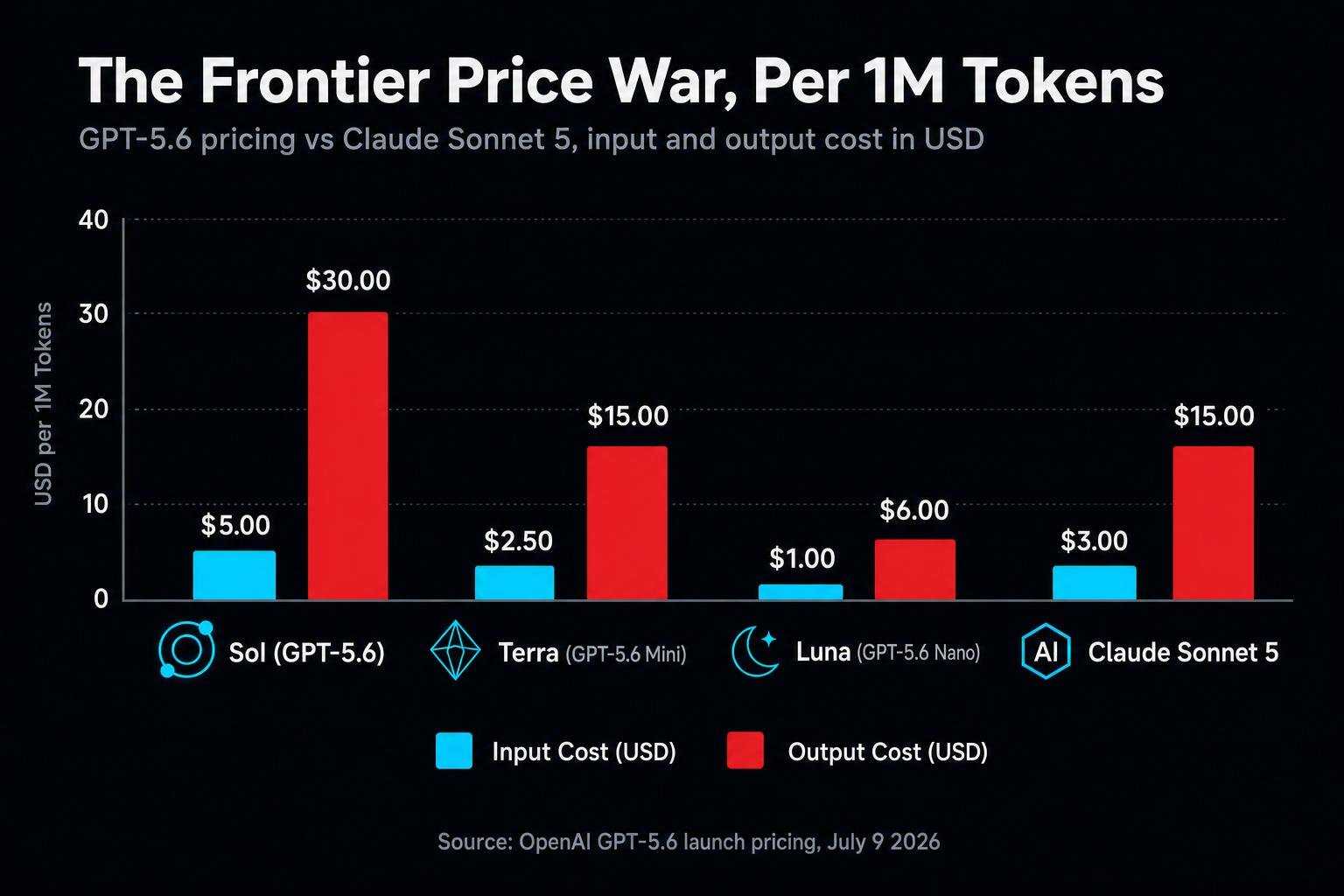
Here is what OpenAI put on the menu, measured per million tokens (roughly, per big chunk of text in and out):
- Sol is the flagship at $5 in / $30 out. It set a new state-of-the-art on Terminal-Bench 2.1, a test of command-line agentic work, meaning tasks where the model actually operates tools step by step rather than just chatting.
- Terra is the workhorse at $2.50 in / $15 out.
- Luna is the budget option at $1 in / $6 out, aimed squarely at high-volume, everyday jobs.
The number that made people sit up is Terra's. At $2.50 in / $15 out, it lands one notch under Anthropic's Claude Sonnet 5, whose post-introductory price is $3 / $15. That is not an accident. That is a company reading a competitor's price list and deliberately parking a car in the spot next door, a dollar cheaper on the meter.
The top of the AI market is now in an open price-per-capability war, and the customer, for once, is the one holding the leverage.
Why undercutting the leader matters
Think about how gas stations work. When one station drops its price by a few cents, the one across the street can't pretend it didn't happen. Drivers notice, and the whole intersection re-prices within a day. Frontier AI has finally reached that intersection.
For most of the recent past, the assumption was that if you wanted genuinely capable reasoning, you paid a premium and that was that. GPT-5.6 attacks that assumption from two directions at once. Terra squeezes the standard tier that Sonnet 5 occupies, and Luna goes after the cheap, do-it-in-bulk layer where volume is everything. Squeeze the middle, undercut the bottom, and suddenly the people writing the checks have real choices at every level of quality.
The interesting open question is what the leader does back. Sonnet 5's introductory pricing is set to end August 31. If Anthropic matches or extends that pricing in response, that is the tell that a genuine price war is underway, not just a one-off launch move.
Speed is becoming its own axis
Price isn't the only front. OpenAI says Sol will run this month on Cerebras hardware at up to 750 tokens per second. If tokens are words, that is a firehose. For anything interactive, a live voice assistant, an agent reacting in real time, a chatbot that shouldn't make you wait, latency has always been the thing that breaks the illusion of a smooth conversation. Pushing the flagship tier to that kind of speed changes what "real-time frontier reasoning" even means. The race is no longer only about who is smartest or cheapest, but who can be all three at once.
There's also a capability wrinkle worth naming honestly. GPT-5.6 includes an "Ultra Mode" that can spawn subagents, essentially the model delegating pieces of a task to copies of itself. That's powerful, and it's exactly the kind of behavior that draws scrutiny. METR, an independent evaluation group, flagged autonomy-risk findings in its pre-release testing. More power at a lower price is great for buyers. It also raises the stakes on making sure these systems behave.
The quiet new step before any launch
Which brings up something that made this whole launch feel routine rather than chaotic. Reporting on the White House's voluntary AI framework has clarified how frontier models now reach the public. The federal government gets up to 30 days to review the national-security implications of a new frontier model before release, with technical teams assessing risks like cyber and CBRN misuse.
The crucial detail: the government's role is described as advisory and flagging, not gatekeeping. It can raise a hand, but it can't block or force changes. Think of it less like a customs checkpoint that stops you and more like a safety inspector who walks the floor and writes notes. It builds on a June executive order, and the still-unsettled fight is over the trigger threshold, how capable a model has to be before the review kicks in. Labs want that line high (fewer reviews); the government wants it lower.
The practical upshot for everyone downstream is simple: top-tier model releases now come with a predictable review calendar attached. GPT-5.6 arriving on schedule, inside the expected window, is a small sign that this new rhythm is starting to work as intended.
What it means for the rest of us
If you build with these tools, or just budget for them, the lesson is to stop treating the frontier as a single expensive lane. There are now clearly separated tiers you can mix and match: a cheap model for bulk work, a mid-tier for standard tasks, a flagship for the calls that need real judgment. Competition is doing what competition does, and the winner is the person choosing.
FAQ
- What is the GPT-5.6 series? Three AI models from OpenAI, Sol, Terra, and Luna, that launched broadly on July 9, 2026 after a gated preview.
- How much do they cost? Per million tokens: Sol is $5 in / $30 out, Terra is $2.50 in / $15 out, and Luna is $1 in / $6 out.
- Why is Terra's price notable? At $2.50 / $15 it lands just under Claude Sonnet 5's post-introductory $3 / $15, a direct pricing challenge to a leading competitor.
- Does the government approve AI models before launch? Under the White House's voluntary framework, agencies get up to 30 days to review national-security risks, but the role is advisory and flagging, not blocking.
One signal a day. No noise.
A 3-minute read when something genuinely shifts in AI, automation, or defense tech. Free, most weekdays.
Free, most weekdays. No spam, unsubscribe anytime.Sources
- OpenAI Community - Introducing GPT-5.6 series: Sol, Terra and Luna - https://community.openai.com/t/introducing-gpt-5-6-series-sol-terra-and-luna/1384931
- OpenAI - Previewing GPT-5.6 Sol - https://openai.com/index/previewing-gpt-5-6-sol/
- explainx - GPT-5.6 release date, features, benchmarks 2026 - https://explainx.ai/blog/gpt-5-6-release-date-features-benchmarks-2026
- LLM Stats - AI news - https://llm-stats.com/ai-news
- TechTimes - GPT-5.6 release nears: Ultra Mode, Terra cost cut, METR risk flag - https://www.techtimes.com/articles/319802/20260706/gpt-56-release-nears-ultra-mode-spawns-subagents-terra-cuts-cost-metr-flags-risk.htm
- explainx - GPT-5.6 Sol, Terra, Luna preview (Cerebras) - https://www.explainx.ai/blog/gpt-5-6-sol-terra-luna-preview-june-2026
- FAQ analysis - White House voluntary AI release standards - https://faq.com.tw/en/policy/2026-07-04-white-house-voluntary-ai-release-standards-en/
- The News - White House prepares voluntary standards for advanced AI releases - https://www.thenews.com.pk/latest/1407897-white-house-prepares-voluntary-standards-for-advanced-ai-releases
- White House - Promoting Advanced AI Innovation and Security (June 2026) - https://www.whitehouse.gov/presidential-actions/2026/06/promoting-advanced-artificial-intelligence-innovation-and-security/
Quick answers
What is the GPT-5.6 series?
Three AI models from OpenAI named Sol, Terra, and Luna that launched broadly on July 9, 2026 after a gated preview.
How much do the GPT-5.6 models cost?
Per million tokens: Sol is $5 in / $30 out, Terra is $2.50 in / $15 out, and Luna is $1 in / $6 out.
Why is Terra's price significant?
At $2.50 in / $15 out, Terra is priced just under Claude Sonnet 5's post-introductory $3 / $15, a direct challenge to a leading competitor.
Does the US government approve AI models before release?
Under the White House's voluntary framework, agencies get up to 30 days to review national-security risks, but the role is advisory and flagging, not blocking.