AI Chat Is the New Storefront
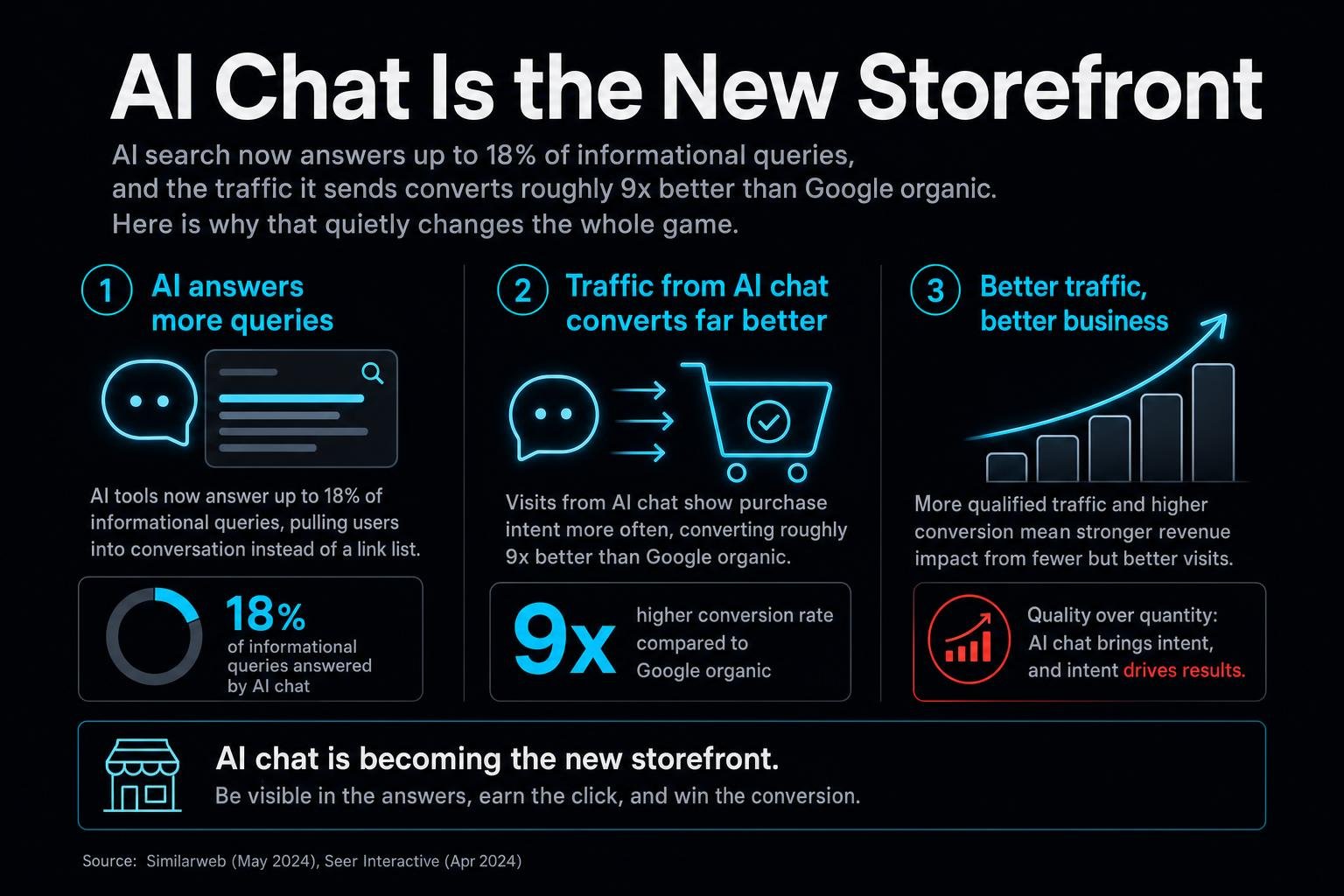
AI search now answers up to 18% of informational queries, and the traffic it sends converts roughly 9x better than Google organic. Here is why that quietly changes the whole game.

For twenty years the internet had one front door: a search box, a list of blue links, and a click. We built entire businesses around being link number one. That door is still open, but a second one has appeared right next to it, and people are pouring through it. The new door is a conversation.
Here is the number that made me sit up. In the first quarter of 2026, AI search is estimated to handle 12 to 18 percent of English-language informational queries. That alone would be a big shift. But the part that actually matters for anyone selling anything is what happens after the AI answers.
The 9x that nobody is talking about loudly enough
According to data from Seer Interactive, referral traffic from ChatGPT converts at roughly 15.9 percent, compared with about 1.76 percent for Google organic traffic. That is close to a 9x difference. Same internet, same buyers, wildly different outcome.
Think about why. When you type a question into Google, you are still shopping. You get ten options, three ads, and a dozen tabs. You are skeptical, comparing, half-distracted. When an AI assistant tells you, in plain sentences, "here is the thing that solves your problem," you have already outsourced the comparison. The hard work of deciding is done. You arrive ready to act, not ready to browse.
Google sends you a crowd of window-shoppers. AI sends you a smaller group of people who have already made up their minds.
That reframes everything. For years the obsession was traffic volume: rank higher, get more clicks, feed the funnel. A 9x conversion gap says the AI channel is not just another traffic source. It is your highest-intent traffic, and it is growing.
From "are we cited" to "does it convert"
The early version of this game was vanity. Brands chased a citation-share dashboard, bragging that an AI mentioned them. That was the equivalent of counting impressions. The market has matured fast. The real question is no longer whether an assistant cites you. It is whether that citation turns into a customer.
This has become a named service category. Edelman's AI Practice now sells something it calls "citation scaffolding": a deliberate web of high-authority content, executive thought leadership, and strategic placements engineered to make a brand the default answer an AI gives. The goal is not to game a ranking. It is to be the obvious, well-sourced thing the machine reaches for when someone asks.
And the conversation is becoming the checkout too
If AI is the new search box, it is also turning into the new cash register. Shopify shipped its Spring 2026 Editions this season, and the headline pieces all point the same direction. There is Campaign Autopilot, an AI that coordinates ad spend across Meta, the Shop app, and messaging. There are new WhatsApp marketing and SMS automation channels. And the one I find most telling: Universal Commerce Protocol checkout inside Microsoft Copilot, where a customer can buy inside the chat itself and pay with Shop Pay.
Shopify even added "Agentic Storefront insights," which grade how your products perform inside AI channels and flag what is missing to convert. Read that again. A major commerce platform now treats "how visible and buyable are you inside an AI conversation" as a metric worth reporting. Discovery and purchase are collapsing into the same chat window.
What this means if you build, sell, or write online
Three practical takeaways, none of which require a crystal ball.
- Write for the machine reader. Structured, clearly-sourced, genuinely authoritative content is what assistants quote. Thin SEO filler does not survive in a world where the answer engine, not the user, decides what to surface.
- Measure conversion, not citations. If you are tracking AI as a channel, track it the whole way down: did the AI-referred visitor become a lead, then a customer? Citation counts are the new impressions, and impressions never paid anyone's salary.
- Get buyable inside the chat. If platforms are wiring in-conversation checkout, the brands that show up purchasable, with clean product data and media, win the moment of intent. The ones that force a customer back out to a website will leak that intent.
None of this means Google search is dead. It is enormous and will be for a long time. But a 9x conversion edge on a fast-growing channel is the kind of quiet statistic that, a few years from now, everyone will claim they saw coming. The honest move is to take it seriously while it is still early enough to matter.
One signal a day. No noise.
A 3-minute read when something genuinely shifts in AI, automation, or defense tech. Free, most weekdays.
Free, most weekdays. No spam, unsubscribe anytime.Sources
- Pixelmojo - GEO playbook: get cited in ChatGPT, Perplexity, Claude - https://www.pixelmojo.io/blogs/geo-playbook-get-cited-chatgpt-perplexity-claude
- BusinessPlusAI - Top AI PR agencies driving citations in ChatGPT, Perplexity, Google AI Mode - https://www.businessplusai.com/blog/top-ai-pr-agencies-driving-citations-in-chatgpt-perplexity-google-ai-mode
- MarTech - Shopify wants to put commerce inside every AI conversation - https://martech.org/shopify-wants-to-put-commerce-inside-every-ai-conversation/
- ThinkCommerce - Shopify Spring 2026 Editions: what merchants need to know - https://thinkcommerce.com/blogs/news/shopify-spring-2026-editions-what-merchants-need-to-know
Quick answers
How much web search does AI now handle?
AI search is estimated to handle 12 to 18 percent of English-language informational queries as of Q1 2026.
Does AI-referred traffic actually convert better?
Yes. Data from Seer Interactive shows ChatGPT referral traffic converting at about 15.9 percent versus roughly 1.76 percent for Google organic, close to a 9x difference, because AI-referred visitors arrive with their decision largely made.
What is citation scaffolding?
It is a service category, sold by agencies including Edelman's AI Practice, that builds a structured web of high-authority content and thought leadership designed to make a brand the default answer AI assistants give.
Can customers buy inside an AI chat now?
Shopify's Spring 2026 Editions added Universal Commerce Protocol checkout inside Microsoft Copilot, letting customers buy within the conversation and pay with Shop Pay.