AI Agents Stop Beeping and Start Doing
Fleet software, email marketing and a 47,000-reseller marketplace all shipped AI agents this month that take action instead of sending alerts. What matters now is less what an agent can do and more who sets its rules, checks its work and pays its bill.

For years most business software has worked like a very loud smoke detector. It beeps, you get up, and you do the actual work. A truck driver is braking hard, so you get an alert. An email campaign underperforms, so a dashboard turns red. The software spots the problem and hands it straight back to a human.
This month, companies in very different industries shipped software that goes further. It does the first step itself. And one of the largest software marketplaces for small businesses shipped the piece that makes this safe to buy: a way to set the rules, watch the meter and cap the spending.
That second part is the real story.
From the beep to the next step
On 19 October, fleet-management company Motive launched Agents. When its cameras and telematics detect a safety, maintenance or operations issue, the agent does not just raise a flag. It contacts the driver, opens a maintenance work order, alerts the manager and coordinates the response. Today customers define the triggers and actions themselves. Motive says a plain-English builder ("describe the workflow") is planned for early 2027.
One caveat matters here: Motive gave no independently validated results for Agents. Treat it as a product that has shipped, not an outcome that has been proven.
In marketing, Klaviyo says its Composer agent is now out of preview. It can answer harder questions across customer, marketing and commerce data, cite its sources, and run reports, performance reviews and audits on a schedule. It can also turn workflows that work into reusable "skills."
Trucks and email newsletters have nothing in common, yet the move is identical. Software is shifting from "here is what happened" to "here is what I already did about it."
The alert is becoming the commodity. The approved next step is the product.
A sprinkler needs a shutoff valve
If an alert is a smoke detector, an acting agent is a sprinkler system. Sprinklers are far more useful. They are also far more dangerous when they misfire, because they act without waiting for you. Nobody installs one without a shutoff valve, a pressure gauge and someone who knows where both are.
That is why the most important launch of the week was not an agent at all.
Pax8 bets on the control plane
On 19 October, Pax8, the software marketplace used by more than 47,000 IT providers who sell to roughly 800,000 small businesses, launched two products.
- 8os lets those IT providers govern agents and models from many vendors as one workforce. Rules are set client by client, each client gets separate memory, usage is metered per user and per customer with hard spending caps, and the partner sets the price.
- 8bot is a managed AI coworker that the partner deploys and supervises.
Early access opens this week, with general availability in early 2027.
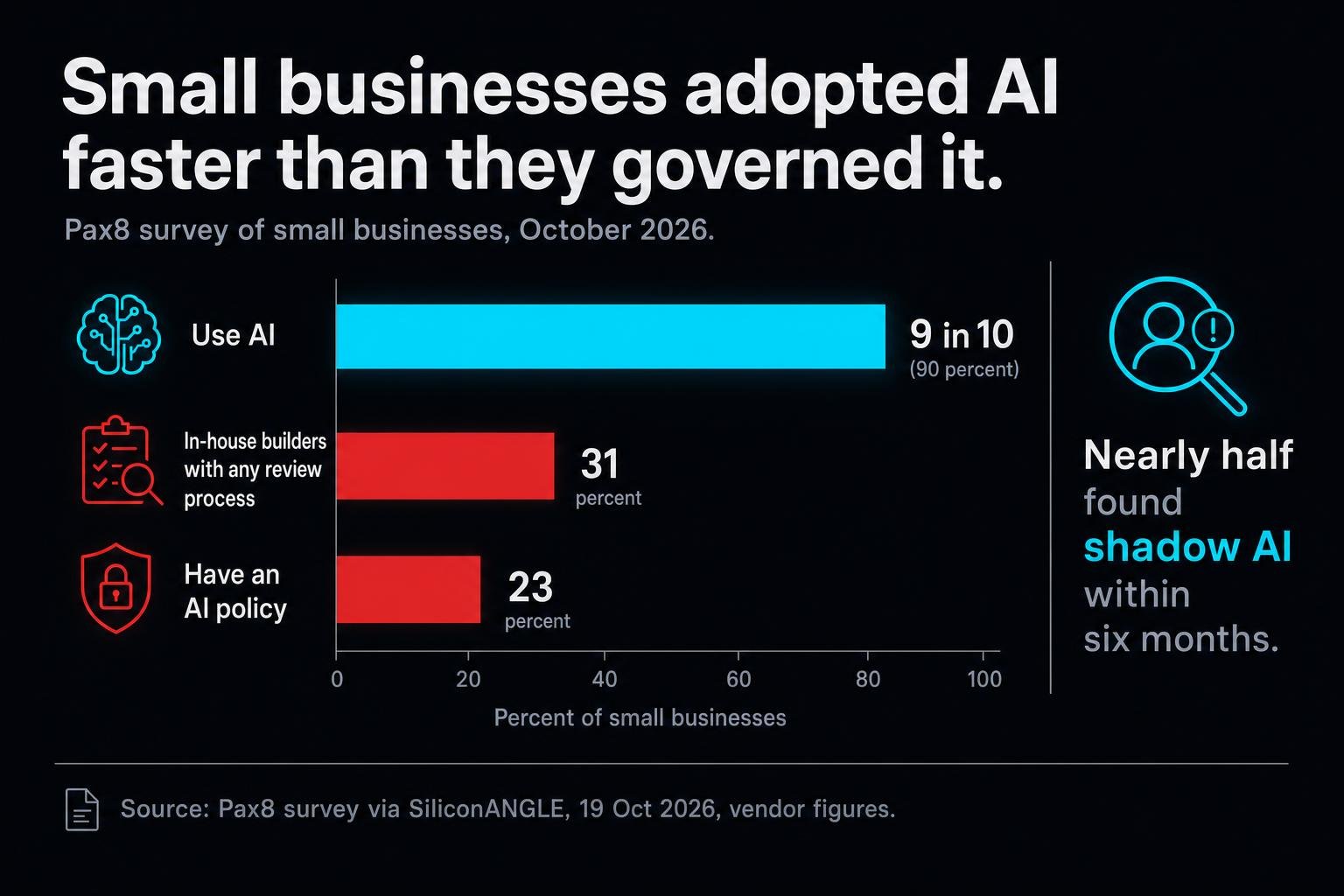
Pax8 also published survey numbers that explain why it built this. By its count, 9 in 10 small businesses use AI, but only 23% have an AI policy. Only 31% of those building AI in-house have any review process at all. And nearly half found "shadow AI" (tools staff adopted without anyone signing off) within six months. These are Pax8's own figures, not independently verified, but the shape is easy to believe: adoption has raced ahead of supervision.
Think of a new hire with a company card. You do not hand it over and hope for the best. You set a spending limit, decide which purchases need a manager's sign-off, and check the statement every month. Pax8 is building the card program for AI agents and handing it to the IT shops that small businesses already trust to manage their laptops and email.
Defense said it first, and louder
The same pattern appears where the stakes are highest. The US Army is expanding Striveworks' Chariot Forge agent platform to Europe under Task Force RAVEN for intelligence analysis, target validation and fire-support coordination. According to the report, AI agents process the intelligence, but "human review and authorization" stay central to operational decisions, and the platform evaluates models before their outputs reach the field.
That gives two control points that are now standard in public descriptions: test the model before its output is used, and have a human authorize the decision. If the military writes them into a deployment, a small business letting an agent email its customers should not skip them.
What to ask before you let an agent act
Whether you are buying an agent, building one or approving one at work, the launches this week point to a short checklist:
- Can I read the rules? Triggers and actions should be visible, not buried in a prompt.
- What needs approval? Decide which actions run on their own and which wait for a human.
- Is there a meter and a cap? Per-user usage tracking and a hard spending limit, set before the bill arrives.
- Is my data kept separate? Memory and context should not leak between teams or customers.
- Is a change tested before it goes live? A new model or prompt version should pass a check first.
The new job description
Agents are becoming coworkers more than tools, and coworkers need managers. The excitement this week is real: software that opens the work order, schedules the audit and calls the driver will save people hours. But the companies moving fastest are not just shipping smarter agents. They are shipping the leash, the meter and the sign-off sheet alongside them.
Over the next year, the question to ask of any agent will shift from "what can it do?" to "who decided it was allowed to?"
One signal a day. No noise.
A 3-minute read when something genuinely shifts in AI, automation, or defense tech. Free, most weekdays.
Free, most weekdays. No spam, unsubscribe anytime.Sources
- SiliconANGLE - Pax8 launches 8os to let IT partners govern AI agents and 8bot as a managed AI coworker - https://siliconangle.com/2026/10/19/pax8-launches-8os-to-let-it-partners-govern-ai-agents-and-8bot-as-a-managed-ai-coworker/
- SiliconANGLE - Motive brings agentic AI to physical operations with agents that act before problems escalate - https://siliconangle.com/2026/10/19/motive-brings-agentic-ai-to-physical-operations-with-agents-that-act-before-problems-escalate/
- Klaviyo - What's New - https://www.klaviyo.com/whats-new
- The Defense Post - US Army expands Striveworks agentic AI to Europe - https://thedefensepost.com/2026/10/16/us-army-striveworks-agentic-ai-europe/
- PR Newswire - Army expands Striveworks AI role to Europe following successful US deployments - https://www.prnewswire.com/news-releases/army-expands-striveworks-ai-role-to-europe-following-successful-us-deployments-302899805.html
Quick answers
What is Pax8 8os?
8os is a control plane Pax8 launched on 19 October 2026 that lets IT providers govern AI agents and models from many vendors as one workforce, with rules set per client, separate memory per client, per-user and per-customer metering, hard spending caps, and partner-set pricing. Early access opens this week, with general availability in early 2027.
What do Motive Agents do?
When Motive's cameras and telematics detect a safety, maintenance or operations issue, the agent contacts the driver, opens a maintenance work order, alerts the manager and coordinates the response. Customers define the triggers and actions, and a plain-English builder is planned for early 2027. Motive has not published independently validated results.
What changed with Klaviyo Composer?
Klaviyo says Composer is out of preview. It can answer questions across customer, marketing and commerce data, cite its sources, run reports, performance reviews and audits on a schedule, and save working workflows as reusable skills.
How should a business govern an AI agent that takes actions?
Make the rules readable, decide which actions need human approval, meter usage with a hard spending cap, keep data separate between teams or customers, and test any new model or prompt version before it goes live. The Army's Striveworks deployment, for example, pairs model evaluation before use with human review and authorization.