Two Rulebooks for AI Agents, One Week
The United States and China put the first real governance rails on AI agents days apart. One is voluntary with teeth, the other is legally binding. Here is what actually shipped.

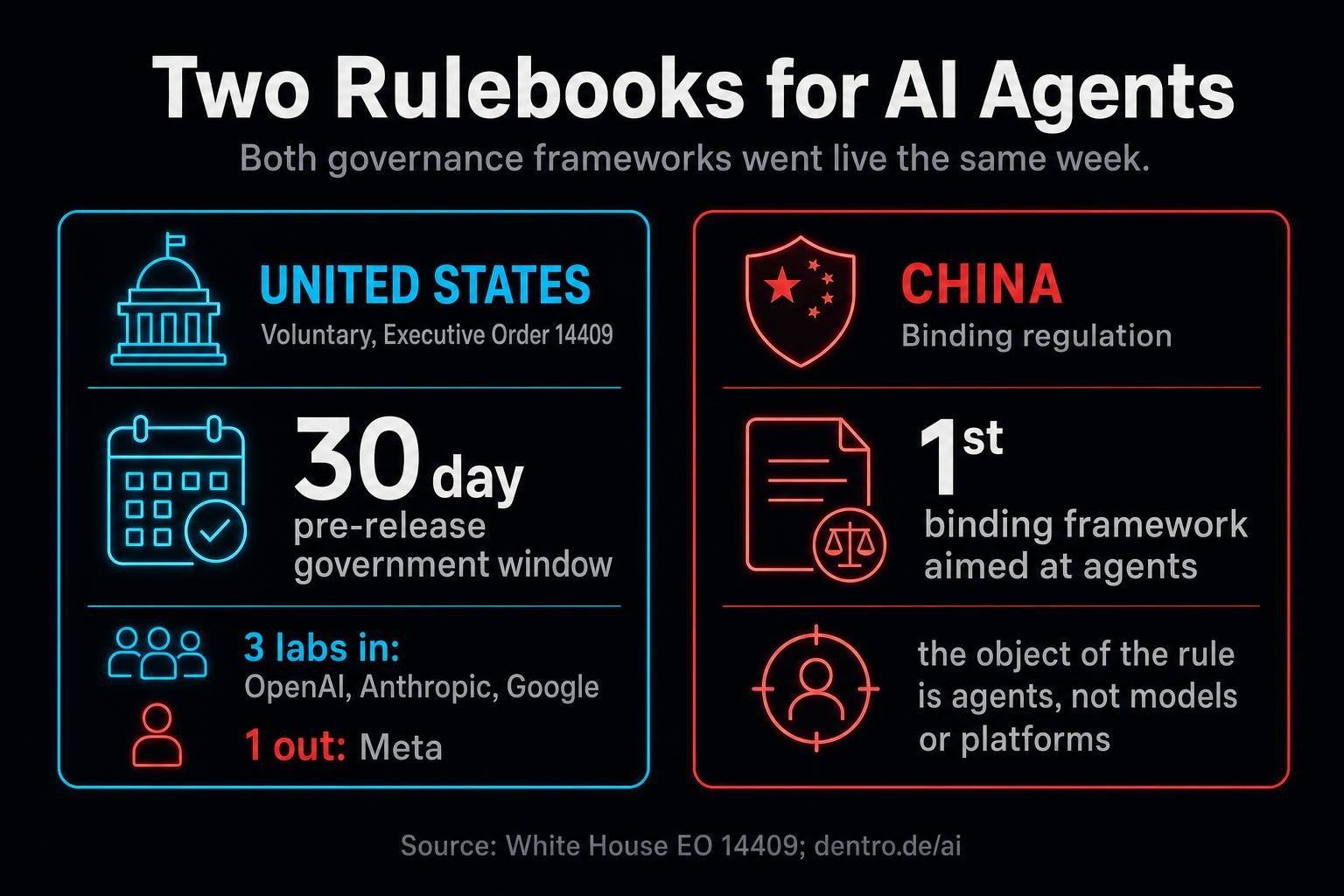
For most of the last year, "who is going to regulate AI" was a debate happening in the future tense. This week it moved to the present tense in two very different places at once. The United States is finalizing a voluntary early-access framework for its most powerful models, and China put into force what appears to be the world's first binding rulebook aimed specifically at AI agents. Two countries, two philosophies, same seven-day window. If you build with these tools, use them at work, or just want to understand where this is heading, this is the moment the map got drawn.
What the United States actually did
Back on June 2, Executive Order 14409 ("Promoting Advanced Artificial Intelligence Innovation and Security") told federal agencies to stand up a framework by August 1. The core mechanic: frontier developers voluntarily give the federal government up to 30 days of pre-release access to what the order calls "covered frontier models," with coverage decided through a classified benchmarking process focused on advanced cyber capability.
As the deadline lands, the reporting says the White House is finalizing the arrangement with three labs in the room: OpenAI, Anthropic, and Google. Meta is not in it. That absence is the interesting part. The word "voluntary" makes this sound optional, but a classified benchmark that decides who is "covered" plus a month-long government preview window starts to look less like a suggestion and more like a gate that opens before the public one does.
What China actually did
In the same stretch, China implemented what is being described as the world's first binding regulatory framework focused entirely on AI agents, the "Implementation Opinions on the Standardized Application and Innovative Development of Intelligent Agents." The detail worth sitting with is the object of the regulation. Not models. Not platforms. Agents, specifically, are the named thing being regulated. That is a first anywhere.
Think of the difference like this. Regulating a model is like regulating the engine. Regulating an agent is like regulating the driver, the car with the engine in it, and where it is allowed to go. The second is a much bigger claim about accountability, and China is the first to make it in law rather than in a white paper.
The two poles of agent governance are now both live: voluntary with teeth in the US, mandatory in China, with the EU's competition-first posture sitting in between.
Why it matters
Put the two side by side and you get a genuine fork in the road, not just a policy news day. The American approach bets that keeping frontier labs at the table voluntarily, while quietly holding a 30-day preview and a classified "is this dangerous" test, gets you safety without smothering the pace of releases. The Chinese approach bets that agents are already consequential enough to need registration, capability disclosure, and human-accountability rules written down and enforced.
Here is the part that reaches beyond either country's borders. Regulatory vocabulary travels. Europe spent years teaching the world the word "GDPR," and companies far outside Europe adopted its habits because it was easier to comply everywhere than to maintain two systems. There is now a Beijing version of that same gravity: any company with China-market exposure inherits agent-specific obligations first, and the terms those rules establish (registration, capability tiers, human oversight) tend to become the default language everyone else argues in.
The Meta detail is the other tell. When a governance framework quietly maps onto the split between labs that ship behind guardrails and labs that release open weights, "in the framework" can start to function as a trust signal on its own, the kind of thing an enterprise buyer or a procurement officer notices. Whether that absence carries a real cost is the open question, and it is worth watching.
The honest caveats
A few things are still fuzzy, and pretending otherwise would be dishonest. On the US side, the framework's actual text has not been fully published against the executive order, so we do not yet know whether it includes any real audit or verification machinery or whether "voluntary" stays voluntary all the way down. On the China side, most of the detailed operative requirements are not yet available in clear English analysis, so the specifics (exactly what registration and capability disclosure demand) are still coming into focus. What we can say confidently is the shape: two live frameworks, two philosophies, both aimed at the same fast-moving thing.
If you take one idea away, take this. The question is no longer "will AI agents get regulated." They already are, in the world's second-largest economy, and previewed by the world's largest. The only open question now is which of these two models your market ends up adopting.
One signal a day. No noise.
A 3-minute read when something genuinely shifts in AI, automation, or defense tech. Free, most weekdays.
Free, most weekdays. No spam, unsubscribe anytime.Sources
- White House - Promoting Advanced Artificial Intelligence Innovation and Security (EO) - https://www.whitehouse.gov/presidential-actions/2026/06/promoting-advanced-artificial-intelligence-innovation-and-security/
- Latham & Watkins - EO Establishing AI Cybersecurity and Frontier Model Framework - https://www.lw.com/en/insights/president-trump-signs-executive-order-establishing-ai-cybersecurity-and-frontier-model-framework
- Norton Rose Fulbright - Executive Order Establishes Voluntary Early-Access Framework - https://www.nortonrosefulbright.com/en/knowledge/publications/900af3cf/executive-order-establishes-voluntary-early-access-framework-to-frontier-ai-models
- Eastern Herald - White House Voluntary AI Frontier Model Standards - https://easternherald.com/2026/07/06/white-house-voluntary-ai-frontier-model-standards/
- TechTimes - White House AI Review Hits August 1 Deadline - https://www.techtimes.com/articles/321497/20260724/voluntary-paper-mandatory-practice-white-house-ai-review-hits-august-1-deadline.htm
- Vorp Labs - Frontier Model Review Framework - https://vorplabs.com/ai-regulatory-updates/frontier-model-review-framework
- dentro.de/ai - AI News - https://dentro.de/ai/news/
- Agentic.ai - News - https://agentic.ai/news
Quick answers
What is the US frontier model framework?
It stems from Executive Order 14409 (June 2) and asks frontier developers to voluntarily give the federal government up to 30 days of pre-release access to 'covered frontier models,' which are designated through a classified benchmarking process. The framework was set to land by an August 1 deadline.
Which AI labs are in the US framework and which is out?
Reporting says the White House is finalizing the arrangement with OpenAI, Anthropic, and Google. Meta is reported to not be in it.
What did China do differently?
China implemented what is described as the world's first binding regulatory framework focused entirely on AI agents, the 'Implementation Opinions on the Standardized Application and Innovative Development of Intelligent Agents.' Unlike the US approach, it is mandatory and it targets agents specifically rather than models or platforms.
Why should a non-specialist care?
Regulatory vocabulary tends to spread. Rules written for one large market often become the default language companies everywhere adopt, so the terms these two frameworks establish (registration, capability disclosure, human accountability, pre-release review) are likely to shape how agents are governed well beyond the US and China.