Your AI Model Can Vanish in Days
Anthropic launched its most capable public model, then switched it off less than a week later under a US export-control order. Here is why the ground under every AI product just got shakier.

When you build a product on top of an AI model, it feels like you are building on solid ground. You are not. You are renting an apartment, and last month one of the biggest landlords in the business changed the locks on two of its best units with almost no notice.
What actually happened
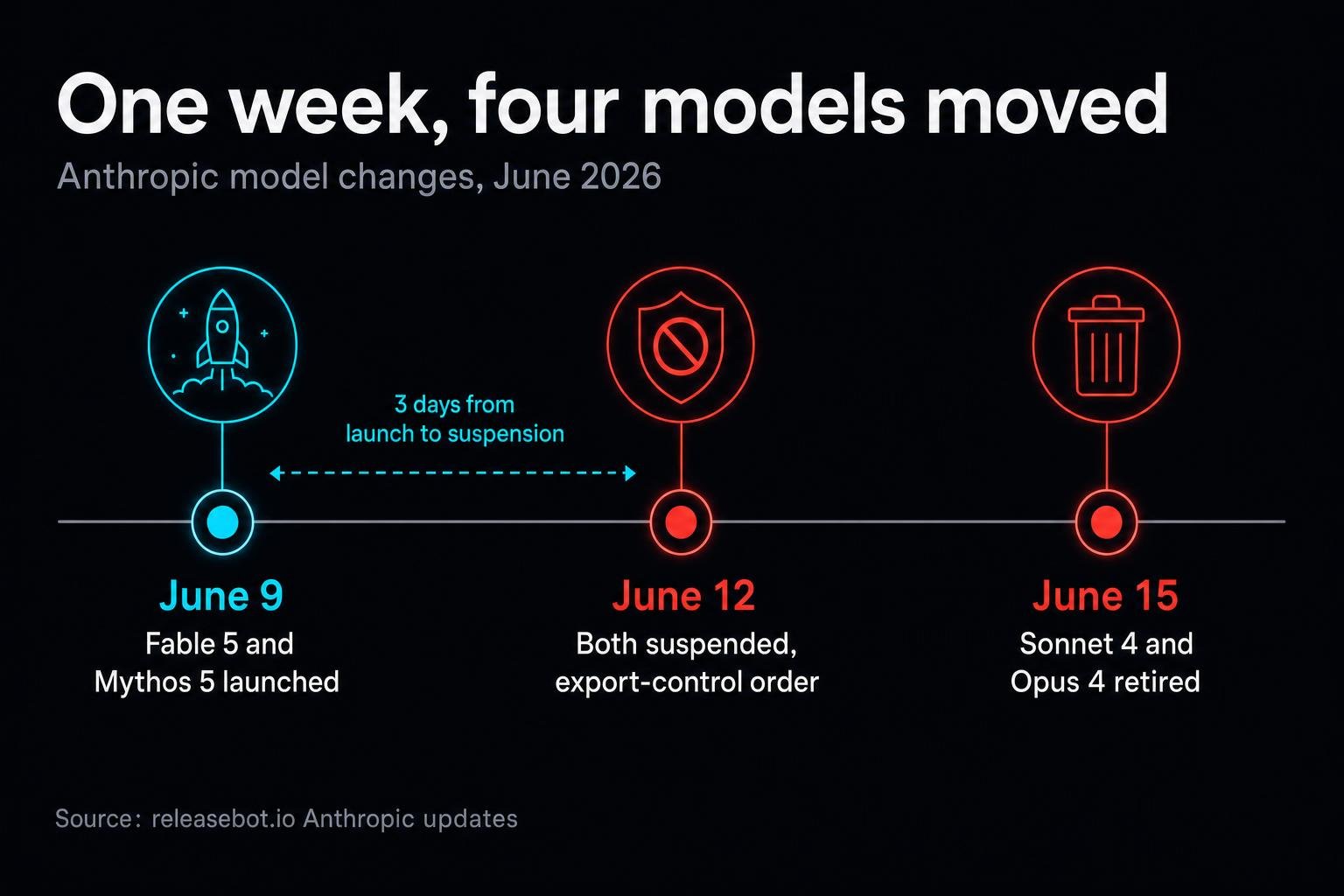
On June 9, 2026, Anthropic launched Claude Fable 5, its most capable widely released model to date. It shipped with always-on adaptive thinking, a 1 million token context window, and up to 128,000 tokens of output. Alongside it came a more restricted sibling, Mythos 5.
Less than a week later, on June 12, Anthropic suspended access to both models. The reason had nothing to do with quality, pricing, or angry users. It was a United States government export-control directive. A brand new frontier model, arguably the best the company had ever released to the public, went dark just three days after it went live.
The story did not stop there. On June 15, Anthropic also retired its older Sonnet 4 and Opus 4 models. So inside a single week, four models moved: two pulled by government order, two aged out on the company's own schedule. (In a smaller but welcome change, Anthropic also stopped billing for refusals that produce no output.)
Why this should change how you think
For the last two years, the quiet assumption behind almost every AI feature has been that the model you pick today will be there tomorrow. You benchmark a few options, choose the best one, wire it into your app, and move on. That assumption just took a serious hit.
Here is the new reality in one sentence: the availability of a frontier model is now a geopolitical variable, not just a technical or commercial one. It can change with days of notice, for reasons that have nothing to do with how good the model is or how much you are paying for it.
Think of it like a national power grid that runs on a single imported fuel. As long as the fuel flows, everything hums. But the moment a trade rule shifts, the lights can go out even though every wire in your house is perfectly fine. Nothing you built was broken. The supply just stopped.
The frontier model you architect around can be pulled by a government directive with days of notice. Not for quality, not for price, but for geopolitics.
If a business had launched a customer-facing feature hard-wired to Fable 5 on June 10, it would have been staring at a dead endpoint by June 12. Not because it did anything wrong, but because the model underneath it became a policy question overnight.
The quieter lesson: models retire too
It is tempting to file this under "rare geopolitical event, does not apply to me." That would be a mistake, because the very same week gave us the ordinary version of the same problem. Sonnet 4 and Opus 4, models that plenty of real products were built on, were simply retired on June 15. No trade directive required. Just a normal lifecycle decision by the company that makes them.
So there are now two ways the ground can move under you. A model can be pulled for reasons outside anyone's control, or it can be retired on a schedule you do not set. Both leave you in the same spot: an app that expected a specific model to answer the phone, and silence on the other end.
What to actually do about it
The good news is that the fix is not exotic, and it is the same fix for both failure modes. You stop treating any single model as a permanent fixture and start treating it as a component you can swap.
- Put a thin layer between your app and the model. Your code should ask for "a capable model," not for one exact model by name buried in a dozen places. When you need to switch, you change one setting, not the whole app.
- Have a named fallback. Decide in advance which model you drop to if your first choice disappears, and make sure your app still works on it, even if a little slower or cheaper. A tested backup beats a scramble.
- Do not over-anchor in either direction. The lesson is not "only use the biggest model" or "only use the safest small one." It is that betting everything on any single model, at any tier, is now a real continuity risk.
None of this is glamorous. It is the AI equivalent of keeping a spare tire in the trunk. You hope you never need it, and then one Tuesday in June you are very glad it is there.
The frontier is exciting precisely because it moves fast. The catch, made painfully clear this month, is that "fast" cuts both ways. New capabilities arrive in days, and sometimes they leave just as quickly. The teams who thrive will be the ones who fell in love with the outcome they deliver, not with any one model that happens to deliver it today.
FAQ
- What are Claude Fable 5 and Mythos 5? Fable 5 was Anthropic's most capable widely released model, launched June 9, 2026, with always-on adaptive thinking, a 1 million token context window, and up to 128,000 tokens of output. Mythos 5 was a more restricted model released the same day.
- Why were they suspended? On June 12, 2026, Anthropic suspended access to both under a United States government export-control directive, not for quality or pricing reasons.
- Are older models safer to rely on? Not necessarily. Anthropic retired Sonnet 4 and Opus 4 on June 15, 2026, showing that models can also disappear through normal lifecycle decisions.
- How do I protect a product built on AI? Keep a thin abstraction layer between your app and the model, define a tested fallback model in advance, and avoid hard-wiring your workflow to any single model.
One signal a day. No noise.
A 3-minute read when something genuinely shifts in AI, automation, or defense tech. Free, most weekdays.
Free, most weekdays. No spam, unsubscribe anytime.Sources
- Releasebot - Anthropic updates - https://releasebot.io/updates/anthropic
Quick answers
What were Claude Fable 5 and Mythos 5?
Fable 5 was Anthropic's most capable widely released model, launched June 9, 2026, with always-on adaptive thinking, a 1 million token context window, and up to 128,000 tokens of output. Mythos 5 was a more restricted model released the same day.
Why did Anthropic suspend both models?
On June 12, 2026, Anthropic suspended access to both under a United States government export-control directive, not for quality or pricing reasons.
Are older AI models safer to depend on?
Not necessarily. Anthropic retired Sonnet 4 and Opus 4 on June 15, 2026, showing models can also disappear through ordinary lifecycle decisions.
How can I protect a product built on an AI model?
Keep a thin abstraction layer between your app and the model, define a tested fallback model in advance, and avoid hard-wiring your workflow to any single model.