Time Is Selling Ads Humans Can't See
Time now publishes a machine-only version of its site for AI crawlers, and has started selling sponsored FAQs inside it. The web is quietly growing a second layer, written for readers who are not human.

Somewhere on Time's website there is a version of every article you will never read. No design, no photos, no navigation. Just plain markdown, built for one audience: the AI crawlers that increasingly do the reading on our behalf. Time started publishing those machine twins last month. Now it has started selling ads inside them.
Ads that only a robot will ever see
Here is the mechanism, stated plainly. Time converted its webpages into stripped-down markdown versions for AI crawlers, and it is now injecting sponsored FAQs "stuffed with brand messaging" into those machine-only pages. It works with an AI ad-tech platform called Mobian, which handles the conversion and generates the agent ads from a brand brief. Ally Bank and the Project Management Institute are the first buyers. The machine pages are served to crawlers from Anthropic, OpenAI and Perplexity.
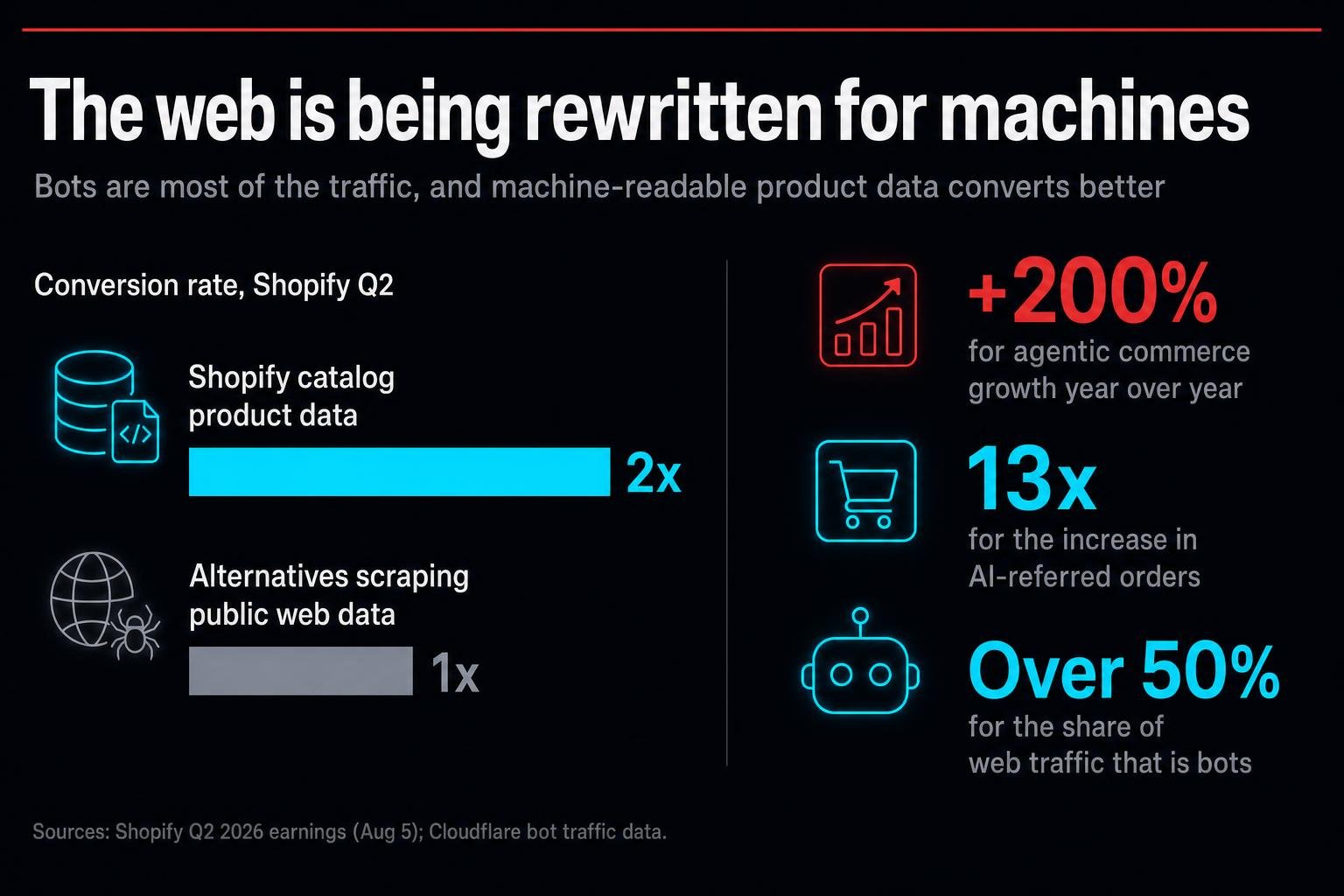
Time's reason for building this is not mysterious. It is arithmetic. The publisher says it sees more bot traffic than human traffic on most days, which lines up with Cloudflare data showing bots are now over half of all web traffic. If most of your visitors are machines, and machines do not look at banner ads, sooner or later somebody builds a product for the machines.
Two menus, one restaurant
Picture a restaurant that prints two menus. The first goes to the people at the table. The second is handed only to the personal assistants who place the order on their behalf, and on that second menu a few dishes carry a little extra praise that somebody paid to put there. The diners never see menu number two. They just notice their assistant keeps recommending the salmon.
That is the shape of what launched here. Not a new ad unit so much as a new room in the building, one that most of the building's occupants do not know exists.
There is now a layer of TIME.com written entirely for machines, and human readers have no idea what is being said to the models on their behalf.
Why this is bigger than one publisher
For the last two years, the advice for showing up well in AI answers has been almost wholesome: write clearly, structure your claims, make your facts easy for a machine to quote. Do the honest work and the models will find you.
Sponsored FAQs on machine-only pages are the paid version of that same advice. Everything you were supposed to earn through clarity is now available as placement on a high-authority domain. Which means a question that used to have one answer now has two. When a brand turns up inside an AI answer, was that citation earned, or was it bought upstream in the source material the answer was assembled from?
Nobody has a good way to tell yet. That is the interesting part.
Meanwhile, the machines are already shopping
If you think this is a niche publishing experiment, look at what showed up in Shopify's Q2 earnings on August 5. The company reported that agentic commerce grew 200% year over year, that AI-referred orders are up 13x, and, most tellingly, that its catalog product converts at twice the rate of alternatives that scrape public web data. Shopify attributes the gap to better product descriptions and metadata.
Read that last number slowly. It is a public company putting a measured conversion premium on the quality of the text a machine reads about your products. The platform's Winter '26 push, which it calls Agentic Storefronts, spells out the requirements for merchants who want to be found and trusted across AI assistants: clean product data, sharp product pages, reliable stock information.
So within the same week we got both halves of the same fact. Machine-readable content about your business now has a measured conversion value (Shopify) and a market price (Time). Whenever something acquires both of those at once, it stops being a technical detail and becomes a budget line.
The disclosure gap nobody has closed
Advertising disclosure rules were written on a simple assumption: a human being can see the ad. Sponsored content is labeled so the reader knows what they are reading. That assumption does not survive contact with a page whose only readers are crawlers.
What is a disclosure worth when the entity reading it is a language model summarizing your article for someone who will never visit the page? The label may technically be present and functionally absent. This is genuinely new territory, and it is going to be tested first in the categories where claims carry the most weight: finance, health, supplements. Paid brand messaging injected into a machine-only layer, in a category where a claim can be regulated, is a problem waiting for its first case.
What to actually do about it
You do not need an ad budget to take this seriously. Three things anyone running a website can do this month:
- Read your own site the way a machine does. Fetch it as a crawler would and compare it against what a human sees. If those two versions disagree, you should be the one who knows first.
- Treat your product data as sales copy. Shopify just priced it at 2x. Descriptions, metadata and stock accuracy are no longer back-office hygiene, they are conversion inputs on the channel that is growing fastest.
- Get skeptical about citations. When a competitor keeps surfacing in AI answers, "earned or bought" is now a real question with real mechanics behind it.
The web spent thirty years being optimized for human attention. We are now watching a second web get built underneath it, optimized for machine attention, with its own economics, its own ad market and, so far, none of its own rules. Time just sold the first billboard on it. It will not be the last.
One signal a day. No noise.
A 3-minute read when something genuinely shifts in AI, automation, or defense tech. Free, most weekdays.
Free, most weekdays. No spam, unsubscribe anytime.Sources
- Digiday - Time has started serving ads to AI agents - https://digiday.com/media/time-has-started-serving-ads-to-ai-agents/
- The Register - Time magazine has a separate version of its website with ads only AI can see - https://www.theregister.com/ai-and-ml/2026/08/05/time-magazine-has-a-separate-version-of-its-website-with-ads-only-ai-can-see/5283640
- MarTech - Time's AI-only ads may be marketing's next frontier - https://martech.org/times-ai-only-ads-may-be-marketings-next-frontier/
- Vincent Schmalbach - Time serves AI bots a different website - https://www.vincentschmalbach.com/time-serves-ai-bots-a-different-website/
- API Evangelist - How Time serves ads to AI agents - https://apievangelist.com/2026/08/03/how-time-serves-ads-to-ai-agents/
- Stock Market Nerd - News of the week, August 3-7 2026 - https://www.stockmarketnerd.com/news-of-the-week-august-3-7-2026/
- Digital Commerce 360 - How Shopify is approaching agentic AI in 2026 - https://www.digitalcommerce360.com/2026/08/06/how-shopify-is-approaching-agentic-ai-2026/
- Shopify - Agentic commerce momentum - https://www.shopify.com/news/agentic-commerce-momentum
- The Fintech Times - Shopify unveils agentic commerce era with Winter '26 edition - https://thefintechtimes.com/shopify-unveils-agentic-commerce-era-with-winter-26-edition/
Quick answers
What exactly is Time selling to AI agents?
Time converted its webpages into stripped-down markdown versions aimed at AI crawlers, and it now injects sponsored FAQs stuffed with brand messaging into those machine-only pages. It works with AI ad-tech platform Mobian, which converts the pages and generates the agent ads from a brand brief. Ally Bank and the Project Management Institute are the first buyers.
Why would a publisher build a version of its site for bots?
Because that is where the traffic is. Time says it sees more bot traffic than human traffic on most days, which matches Cloudflare data showing bots now account for over half of all web traffic. The machine pages are served to crawlers from Anthropic, OpenAI and Perplexity.
Does machine-readable content actually change business outcomes?
Shopify's Q2 earnings, reported August 5, put numbers on it: agentic commerce grew 200% year over year, AI-referred orders are up 13x, and Shopify's catalog product converts at twice the rate of alternatives that scrape public web data, which the company attributes to better product descriptions and metadata.
Is advertising that only machines can see disclosed to readers?
That is the open question. Existing endorsement and disclosure norms assume a human can see the ad, so paid brand claims placed on pages written only for machines sit in genuinely new territory. No settled guidance covers it yet.