Meta Just Took the Steering Wheel Away
In one week, Meta removed a control media buyers have used for a decade, Amazon opened a ChatGPT ad channel with no reporting standard, and the IAB said 86% of buyers expect to change how they measure within a year. Those three things are the same story.

There is a specific kind of panic that hits a media buyer when a button disappears from a dashboard. Not a big button. A boring one, in a collapsed section, that you click maybe once per campaign setup and never think about again. And then one day it is gone, and you realise it was doing a lot more work than you gave it credit for.
That happened this month. And it happened in the same week as two other things that, taken together, describe where digital advertising is actually going.
The button that vanished
Meta is removing the ability to exclude individual ad placements, platforms, devices and operating systems from ad sets. Advertisers began reporting the control quietly missing from Ads Manager around 25 August 2026, and Meta communicated the change more broadly in the 8 to 11 September window. There is no firm removal date. Meta is calling it "soon" and drip-feeding warnings into the product.
What replaces it is a value rules mechanism that caps bid reductions at 90%. Read that carefully, because it is the whole story in one number. You can no longer say "do not run my ad on Audience Network." You can only say "run it there, but bid 90% less."
It is the difference between a light switch and a dimmer. You can take the room down to almost dark. You cannot turn the light off.
Account-level placement rules, under Advertising Settings and then Account Controls, reportedly survive and are now the stronger instrument for any standing restriction. That is practitioner reporting rather than a Meta announcement, so anyone relying on it should confirm it in their own account rather than take my word or anyone else's.
Why a boring control matters
Two reasons, and the second one is sneakier than the first.
The obvious one is brand adjacency. Nearly every account that has ever looked at a placement breakdown has excluded something. Those ads are about to start serving in places nobody chose. For most advertisers that is a rounding error. For anyone in a regulated or sensitive category, health, finance, anything touching children, it is a real exposure that arrived without a decision being made.
The subtle one is reporting. Every historical performance number in every Meta account was generated under placement exclusions. Every future number will not be. Any year-over-year or period-over-period comparison that spans the changeover is comparing two different products wearing the same name. It will look like performance moved. Something did move, but it was not the campaign.
When a platform changes a default that governs how the world reaches your business, you do not get a vote. You get a changelog.
Meanwhile, a new channel appeared
On 10 September 2026, Amazon Ads and OpenAI opened a pilot letting a select group of US advertisers extend campaigns already running in Amazon DSP into ChatGPT. ChatGPT Ads inventory is available through Amazon DSP as a managed service, buyable on both CPC and CPM, with OpenAI controlling all ad delivery decisions through its own systems. It is US only at launch. Delta Vacations is named as a first advertiser.
Separately, Adform has been selected by OpenAI as a technology platform partner for the European rollout of ChatGPT Ads, with Volkswagen and Vodafone named as testing brands.
The detail that matters is not that ads are coming to a chatbot. Everyone saw that coming. It is how they arrived: through the buy-side plumbing rather than as a shiny new console. An advertiser does not have to learn a platform, open an account, or justify a new line item. They extend a campaign they are already running.
That is how retail media went from curiosity to standard line item in about two years. Distribution through infrastructure people already use is the fastest path a channel has ever had.
And nobody has published what an advertiser actually sees. OpenAI runs delivery. Amazon runs the buying layer. What the reporting looks like, whether you can tell where in a conversation your ad appeared, is simply unanswered right now.
And then the number that ties it together
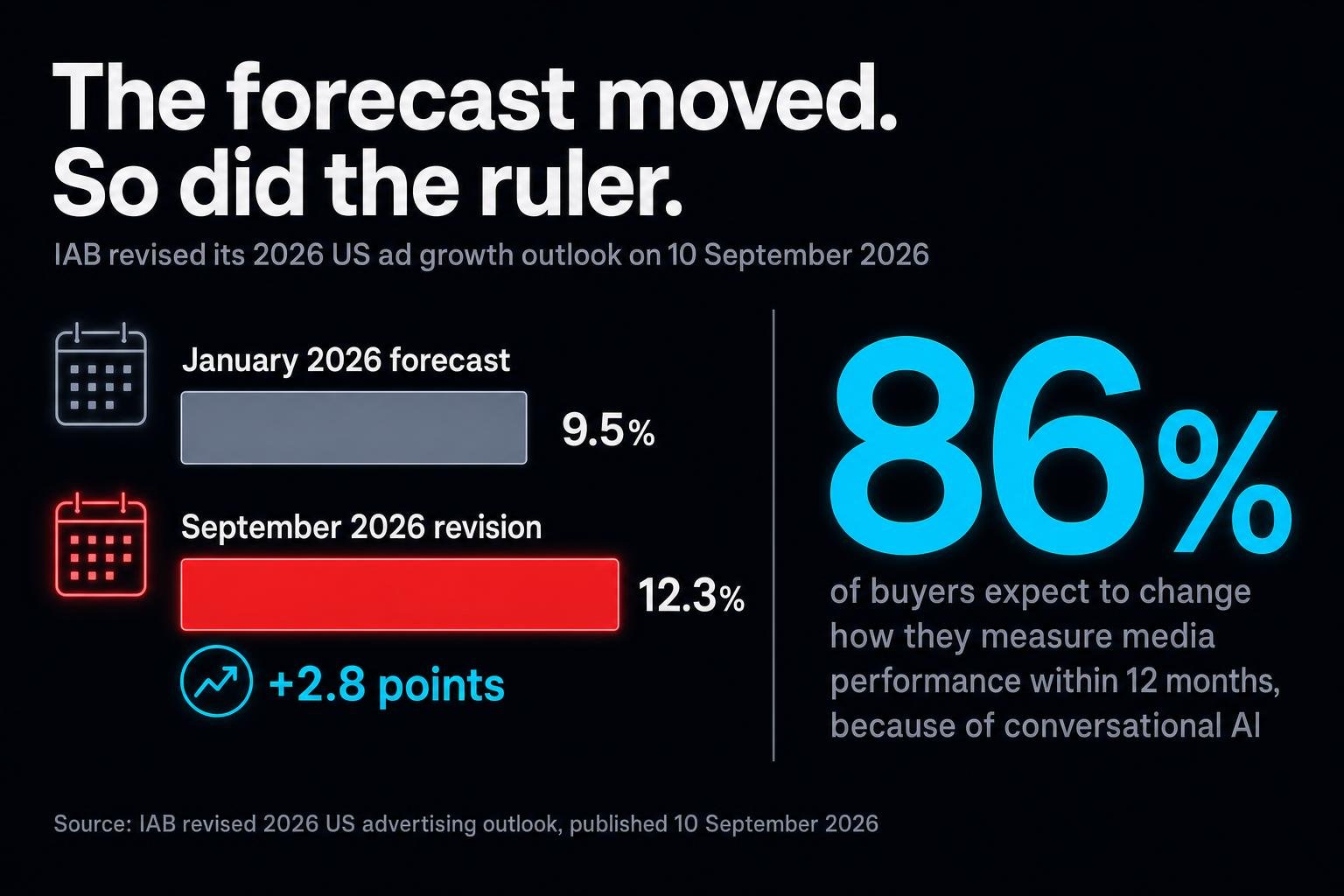
On the same day, the Interactive Advertising Bureau published a revised outlook raising expected US advertising growth for 2026 to 12.3%, up 2.8 points from the 9.5% it forecast in January. Good news, and worth naming plainly: budgets are probably growing, and a good quarter this year is partly the tide, not just the swimming.
But the second finding is the one I cannot stop thinking about. 86% of buyers expect to change how they measure media performance within twelve months, because of conversational AI tools.
Measurement methodology is normally the most inert thing in marketing. Nobody rewrites their attribution model for entertainment. An 86% expectation of change means the incumbent approach has lost authority and the replacement has not been picked yet.
Three stories, one story
Line them up. Meta takes away a control surface, which makes platform-reported data harder to interpret. Amazon opens a conversational channel with no reporting standard at all. And the industry's own trade body says almost everyone expects to rebuild measurement inside a year.
The measurement crisis the IAB is describing is not abstract. It is the direct consequence of the other two.
Here is the part I would bet on. When you lose the ability to control where something runs, the only defensible thing left is being able to prove precisely what it produced, from data you own rather than data the platform hands you. Server-side tracking, first-party sources of truth, and a weekly reconciliation between what the platform claims and what actually landed in your system. That delta is the most useful number in modern advertising and almost nobody produces it.
The steering wheel is going. The odometer is now the whole job.
The honest caveats
- Meta has not published a firm removal date, and the survival of account-level controls is reported by practitioners, not confirmed in a Meta communication I have seen. Verify in Ads Manager.
- The IAB figures come from a trade-press summary of IAB research rather than the publication itself. It is trade-association research on self-reported intent. Treat the direction as real and the magnitude as soft.
- The Amazon and ChatGPT integration is a pilot with a select group of advertisers. Pilots die. This one has unusually good distribution, which is why I think it will not, but that is a read, not a fact.
One signal a day. No noise.
A 3-minute read when something genuinely shifts in AI, automation, or defense tech. Free, most weekdays.
Free, most weekdays. No spam, unsubscribe anytime.Sources
- Social Media Today - Meta removes option to exclude ad placements - https://www.socialmediatoday.com/news/meta-removes-option-to-exclude-ad-placements/828461/
- PPC Land - Meta removes ad placement controls as bid cuts get capped at 90% - https://ppc.land/meta-removes-ad-placement-controls-as-bid-cuts-get-capped-at-90/
- TheOptimizer - Meta ads placement control in 2026: how to actually block placements - https://theoptimizer.io/blog/meta-ads-placement-control-in-2026-how-to-actually-block-placements-its-not-as-simple-anymore
- Amazon Ads - Amazon Ads and ChatGPT advertising integration - https://advertising.amazon.com/library/news/amazon-ads-chat-gpt-advertising-integration
- Search Engine Land - Amazon pilots ChatGPT ads through its DSP - https://searchengineland.com/amazon-pilots-chatgpt-ads-through-its-dsp-488026
- Digiday - Amazon brings its DSP to OpenAI's ChatGPT ads - https://digiday.com/media-buying/amazon-brings-its-dsp-to-openais-chatgpt-ads-extending-its-supply-chasing-streak/
- PPC Land - Amazon Ads gains a ChatGPT ad surface as Delta Vacations tests first - https://ppc.land/amazon-ads-gains-a-chatgpt-ad-surface-as-delta-vacations-tests-first/
- Marketing Dive - Amazon pilots ad services in ChatGPT: what marketers need to know - https://www.marketingdive.com/news/amazon-pilots-ad-services-in-chatgpt-what-marketers-need-to-know/829945/
- Agile Brand Guide - Martech, AI and CX news, 11 September 2026 (IAB outlook) - https://agilebrandguide.com/yesterdays-martech-ai-cx-news-september-11-2026/
Quick answers
What exactly did Meta remove?
The ability to exclude individual ad placements, platforms, devices and operating systems at the ad set level. Advertisers began reporting the control missing around 25 August 2026, with broader communication in the 8 to 11 September window. Meta has not published a firm date for full removal.
Can I still block a placement at all?
Not fully at the ad set level. The replacement is a value rules mechanism that caps bid reductions at 90%, so you can bid down heavily but not exclude. Account-level placement rules under Advertising Settings and then Account Controls are reported to survive and are now the stronger instrument, though that is practitioner reporting rather than a confirmed Meta statement. Check your own account.
Are ads really running inside ChatGPT now?
In a pilot. On 10 September 2026 Amazon Ads and OpenAI opened a pilot letting a select group of US advertisers extend Amazon DSP campaigns into ChatGPT, buyable on CPC and CPM, with OpenAI controlling delivery decisions. Delta Vacations is a named first advertiser. Adform was selected as a technology platform partner for the European rollout, with Volkswagen and Vodafone testing.
Why does the 86% measurement figure matter more than the growth number?
Because measurement methodology almost never changes. If 86% of buyers expect to change how they measure within twelve months because of conversational AI, it means the current approach has lost authority and no replacement has been agreed yet. It is trade-association research on self-reported intent, so treat the direction as real and the exact magnitude as soft.