The Week AI Started Writing Its Own Rules
In a single week, Google proposed a new frontier-AI regulator, the UN seated tech CEOs beside heads of state, and the US Senate wrote down what "human in control" actually means. Here is what it signals.
Most weeks in AI are about capability. A model gets faster, cheaper, or smarter, and everyone argues about the benchmark. This week was different. This week was about the rules, and three very different institutions all moved at once to decide who writes them.
On July 7, Google published a policy framework called AI Governance in America. On July 8, the UN convened the first meeting of its AI for Good Global Commission in Geneva. And in the background, the US Senate Armed Services Committee quietly folded a set of hard requirements for military AI into its draft of next year's defense bill. Taken together, they tell you something the product launches never will: the referees are picking up their whistles.
Google wants to help design the referee
The centerpiece of Google's paper is an idea called FARO, short for a Frontier AI Regulatory Organization. Think of it as an industry-funded, federally overseen body that would set scientific benchmarks for the most powerful models, focusing on the scary edges (cyber and chemical, biological, radiological, and nuclear risk), require incident reporting, and run independent audits.
The clever part is the second track. Google argues that frontier models should be regulated hard, while widely deployed AI applications, the chatbots and tools most of us actually touch, stay under existing law with only targeted updates. Its own priority list for that second track is worth reading twice: child safety, clear disclosures that a chatbot is not sentient, watermarking and provenance standards, and rules for how systems handle self-harm queries.
Here is the analogy I keep coming back to. Imagine the car industry proposing its own crash-test lab, funded by carmakers but answerable to the government, and volunteering the first draft of the seatbelt standard. That is roughly what Google just did, and the timing is the tell. It arrived the day before the White House was widely expected to publish its own framework. When you cannot wait for the rulebook, the next best move is to write it first.
The same week one of the biggest platforms proposed who should referee frontier AI, the Senate quietly wrote down what "human in control" actually means.
The UN put the players on the safety board
A day later in Geneva, the UN's AI for Good Global Commission held its first meeting. What makes it notable is who was in the room. For the first time, a UN body seated leaders from AI companies, including Nvidia, Amazon, Microsoft, Anthropic, and Cohere, right alongside heads of state.
You can read that two ways, and both are true. Optimistically, the people who understand the technology best now have a seat where global norms get shaped. Skeptically, the people with the most to gain are helping draw their own boundaries. Either way, the pattern is the same one Google's paper follows: governance is no longer something done to the industry from the outside. Increasingly, it is being co-authored from the inside.
The Senate wrote the checklist nobody could agree on
The most concrete thing that happened all week got the least attention. The Senate Armed Services Committee approved a regulatory framework for autonomous weapons and military AI inside its draft of the FY2027 National Defense Authorization Act.
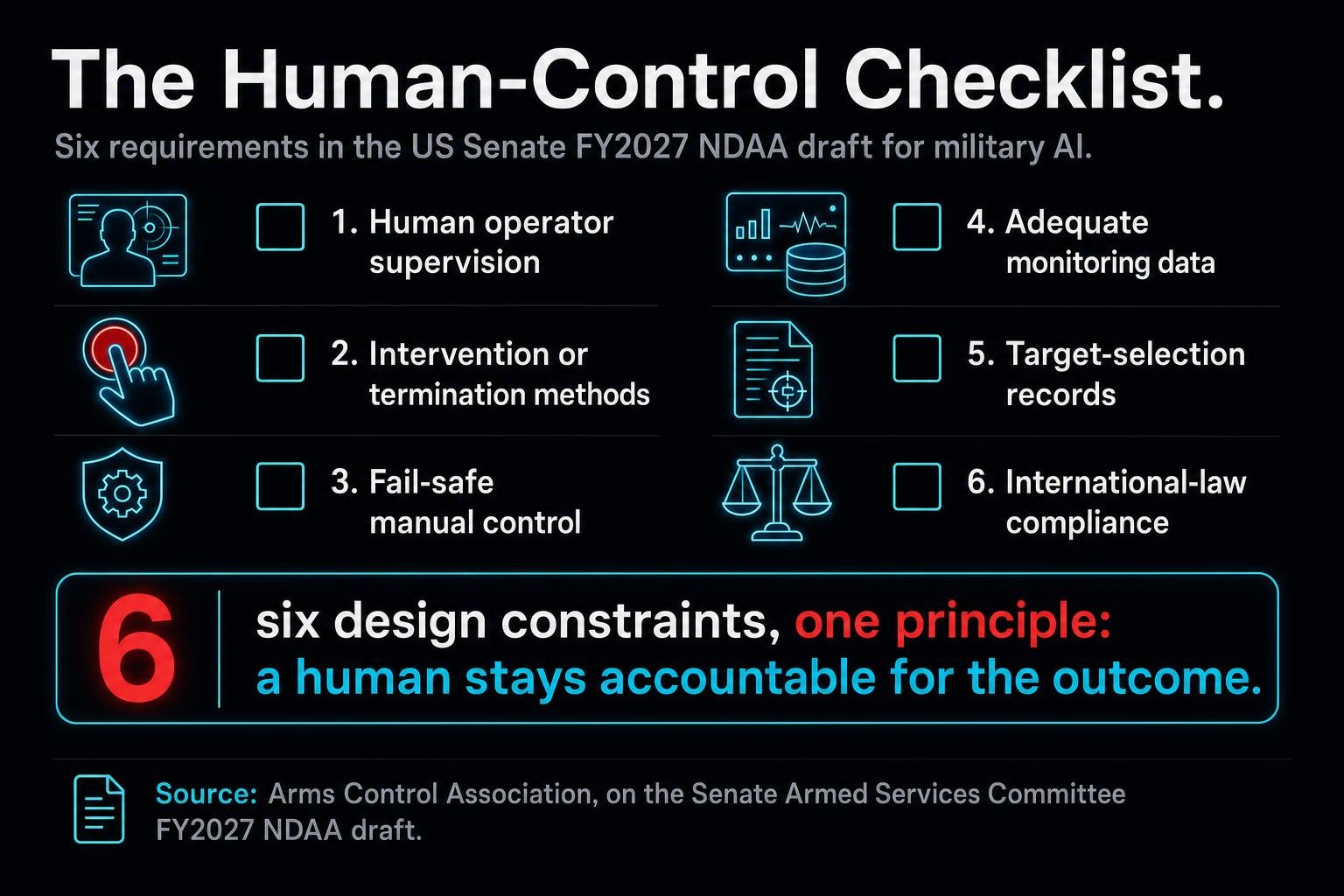
Strip away the acronyms and it is a product spec. Systems must allow supervision by human operators, include methods to intervene or terminate, carry fail-safe mechanisms for manual control, provide adequate monitoring data, keep records of target-selection data and logic, and comply with international law. Six requirements, each one a design constraint. Reporting ties the Senate's motivation directly to unease over a January vendor policy that would have allowed "any lawful use."
Why should you care if you are nowhere near defense? Because those six boxes are a preview of what every high-stakes automation will eventually be asked to tick. Whether an AI is helping select a target or approving a loan, reviewing a medical intake or moving money, the questions converge: Can a human see it? Can a human stop it? Is there a record of why it did what it did? The defense bill is just the first place that checklist got written into statute language.
The through-line
Three moves, three institutions, one direction. A platform proposing a regulator. A global body seating the builders. A legislature turning ethics into a checklist. The connective tissue running through all of them is boring on purpose: disclosure, provenance, auditability, and a human who stays accountable.
That is genuinely good news for anyone building with this technology, because it turns fuzzy values into something you can implement. "Be responsible" is a poster. "Disclose that this is AI, watermark the output, keep a decision log, and give a person a kill switch" is a spec you can build against. The frontier keeps getting faster. This week the guardrails started getting specific, and honestly, that is the part I find exciting.
FAQ
- What is FARO? A Frontier AI Regulatory Organization proposed in Google's July 7 framework: industry-funded and federally overseen, setting scientific benchmarks for frontier risks, requiring incident reporting, and running independent audits.
- What is the two-track idea? Regulate the most powerful frontier models strictly, while keeping widely deployed applications under existing law with targeted updates like disclosure and provenance rules.
- What did the UN commission do? Its AI for Good Global Commission held its first meeting in Geneva on July 8, the first UN body to seat AI company leaders alongside heads of state.
- What are the Senate's six requirements? Human supervision, intervention or termination methods, fail-safe manual control, adequate monitoring data, records of target-selection logic, and compliance with international law.
One signal a day. No noise.
A 3-minute read when something genuinely shifts in AI, automation, or defense tech. Free, most weekdays.
Free, most weekdays. No spam, unsubscribe anytime.Sources
- Forbes - Diving into Google's AI Governance in America framework - https://www.forbes.com/sites/lanceeliot/2026/07/07/diving-headfirst-into-the-google-newly-released-ai-governance-in-america-framework/
- Google - White paper on AI regulation - https://blog.google/company-news/outreach-and-initiatives/public-policy/white-paper-ai-regulation/
- Digital Watch - Google proposes a balanced approach to AI governance - https://dig.watch/updates/google-proposes-a-balanced-approach-to-ai-governance-in-the-us
- unrot.co - Top AI news, UN AI for Good Commission - https://unrot.co/blogs/today-top-10-ai-news-july-6-2026
- Arms Control Association - US Senate panel approves AI autonomous weapons rules - https://www.armscontrol.org/act/2026-07/news/us-senate-panel-approves-ai-autonomous-weapons-rules
- Congressional Research Service - AI and autonomous weapons primer - https://www.congress.gov/crs-product/IF11150
Quick answers
What is FARO?
A Frontier AI Regulatory Organization proposed in Google's July 7 framework: industry-funded and federally overseen, setting scientific benchmarks for frontier risks like cyber and CBRN, requiring incident reporting, and running independent audits.
What is the two-track approach?
Regulate the most powerful frontier models strictly, while keeping widely deployed applications under existing law with targeted updates such as chatbot disclosure, watermarking, and provenance rules.
What did the UN commission do?
The UN AI for Good Global Commission held its first meeting in Geneva on July 8, the first UN body to seat AI company leaders from firms including Nvidia, Amazon, Microsoft, Anthropic, and Cohere alongside heads of state.
What are the Senate's six requirements for military AI?
Human operator supervision, intervention or termination methods, fail-safe manual control, adequate monitoring data, records of target-selection data and logic, and compliance with international law.