Meta Wants Just Your URL and a Budget
Meta is racing toward ad campaigns built entirely by AI from a single product link. Here is what that actually means for anyone who advertises online.

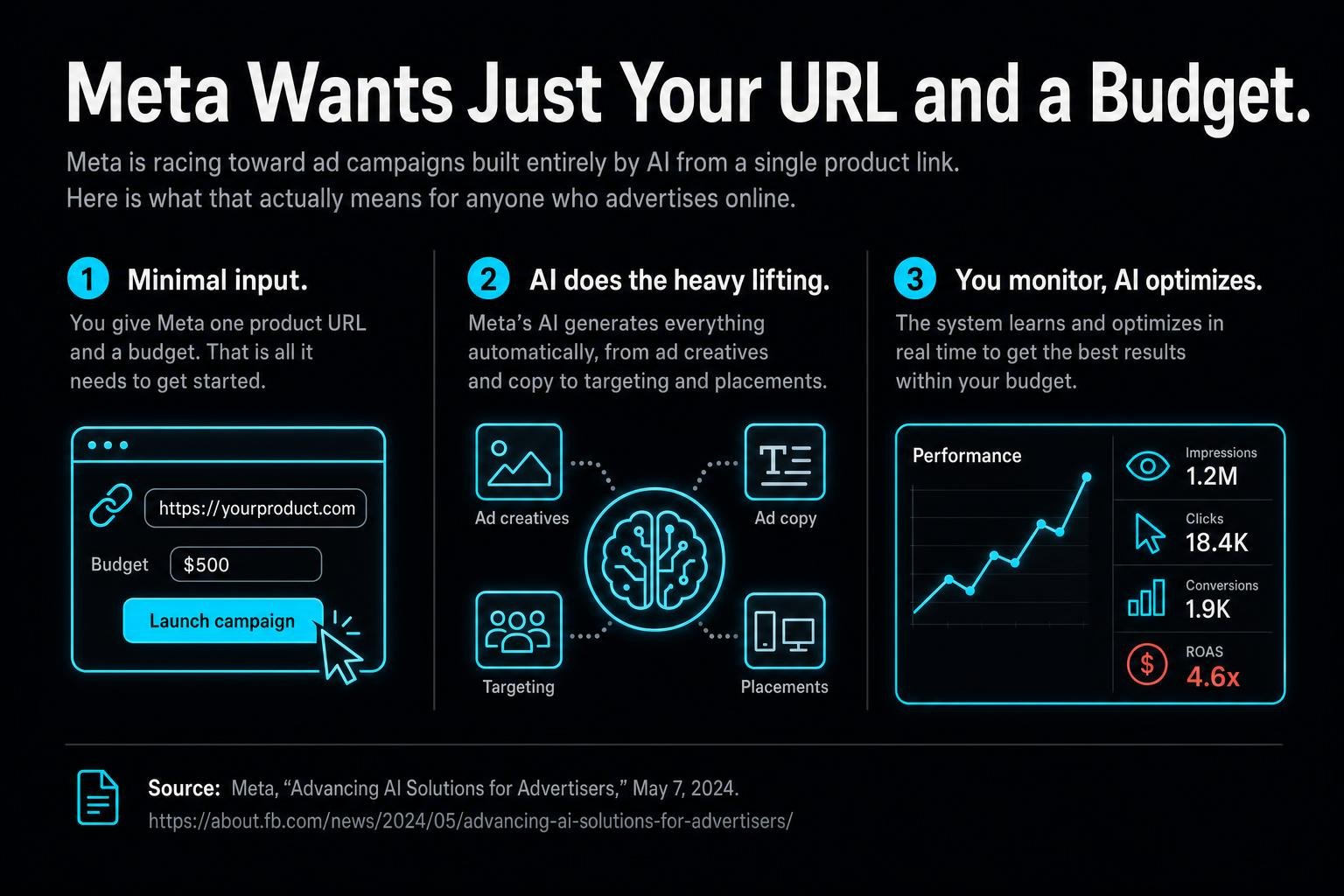
Imagine walking up to a vending machine, dropping in a coin, and instead of a soda you get a finished ad campaign. You feed it one thing, your product page, and it hands back the images, the copy, the audience, and the targeting. That is, more or less, the future Meta is openly building toward: you supply a product URL and a budget, and the AI assembles the entire campaign for you.
This is not a far-off lab demo. It is the stated direction of the company that runs Facebook, Instagram, and Threads, and the adoption numbers behind it are moving fast.
The numbers are the story
Six months ago, about 1 million advertisers were using Meta's generative ad tools. That figure is now more than 4 million. A roughly fourfold jump in half a year is not a quiet rollout. It is a stampede.
And the early performance claims are why people are stampeding. Meta reports that its Advantage+ automation is delivering around 22% higher return on ad spend compared to manually built campaigns. Whether that holds up across every advertiser is a fair question, but it is a number large enough to change behavior. Meanwhile, ads on Threads went worldwide on January 26, opening a brand new surface for the same automated machine to fill.
The endgame is simple and a little startling: hand over a link and a budget, and let the platform do the rest.
Why this matters beyond marketing teams
For a long time, running online ads was a craft. Someone wrote the hooks, cut twelve variations of the creative, picked the audiences, and babysat the budget. A lot of money and a lot of jobs sat on top of that work. Meta is steadily pulling those pieces inside the platform, the way a calculator absorbed the work of doing long division by hand.
Here is the honest read. When a machine can assemble and test ad variations faster and cheaper than a human, the value of assembling them drops toward zero. The skill does not disappear, it moves. It moves to the things the autopilot cannot see: what your actual offer is, why a customer should care, whether your product is even worth advertising, and whether the results you are paying for are real.
Think of it like self-checkout at the grocery store. The machine handles the scanning, but it has no idea whether you put the right items in your cart. The judgment about what belongs there is still yours.
The catch nobody should ignore
Automation that optimizes for a metric will optimize ruthlessly, including in directions you did not intend. If the AI writes your copy and picks your audience, you are trusting a black box with your brand voice and your money. The 22% figure is an average, and averages hide the campaigns that went sideways. The advertisers who win in this world will be the ones who treat the AI as a very fast intern, powerful, tireless, and in constant need of a human checking its work.
There is also a quieter shift in power. When the platform builds the campaign, the platform also decides what "good" looks like. Measurement and independent verification of results become more important, not less, precisely because the thing spending your budget is also the thing grading its own homework.
What to actually do about it
You do not need to fight the tool. You need to feed it well and check it hard.
- Own the offer and the angle. The AI can write a hundred headlines, but it cannot tell you whether your product is priced right or positioned for the wrong customer. That thinking is the durable part.
- Give it good raw material. Clear product pages, honest proof, and sharp positioning are the inputs that decide whether the autopilot has anything good to work with.
- Verify the results yourself. Trust the platform's reporting the way you trust a salesperson quoting their own commission, with interest and a little skepticism.
The vending-machine future is genuinely exciting. It puts capable advertising in reach of small businesses that could never afford a full team. But the lesson of every automation wave is the same. The boring, human judgment at the edges, the strategy, the taste, the willingness to ask "is this number real," becomes the rare and valuable thing. Meta is happy to push the buttons. Deciding which buttons are worth pushing is still on us.
One signal a day. No noise.
A 3-minute read when something genuinely shifts in AI, automation, or defense tech. Free, most weekdays.
Free, most weekdays. No spam, unsubscribe anytime.Sources
- Adtaxi - Meta's AI advertising plans: what to expect in 2026 and how to prepare - https://www.adtaxi.com/blog/metas-ai-advertising-plans-what-to-expect-in-2026-and-how-to-prepare/
- Digital Applied - Meta AI automated ads 2026 marketing guide - https://www.digitalapplied.com/blog/meta-ai-automated-ads-2026-marketing-guide
Quick answers
What is Meta actually building?
Meta is working toward a system where an advertiser supplies only a product URL and a budget, and AI generates the full campaign, including creative, copy, and targeting.
How many advertisers use Meta's AI ad tools?
More than 4 million advertisers now use Meta's generative ad tools, up from about 1 million six months earlier.
Do the AI-built campaigns perform better?
Meta reports its Advantage+ automation delivers roughly 22% higher return on ad spend versus manually built campaigns, though that is an average and results vary.
What should advertisers focus on now?
On the parts automation cannot do: choosing the offer and positioning, supplying strong inputs, and independently verifying that the reported results are real.