Your AI Agent Just Got an Eviction Notice
AWS closed Bedrock Agents, the flagship agent product it launched in 2023, to new customers on July 30. The first generation of agent platforms lasted about two and a half years.

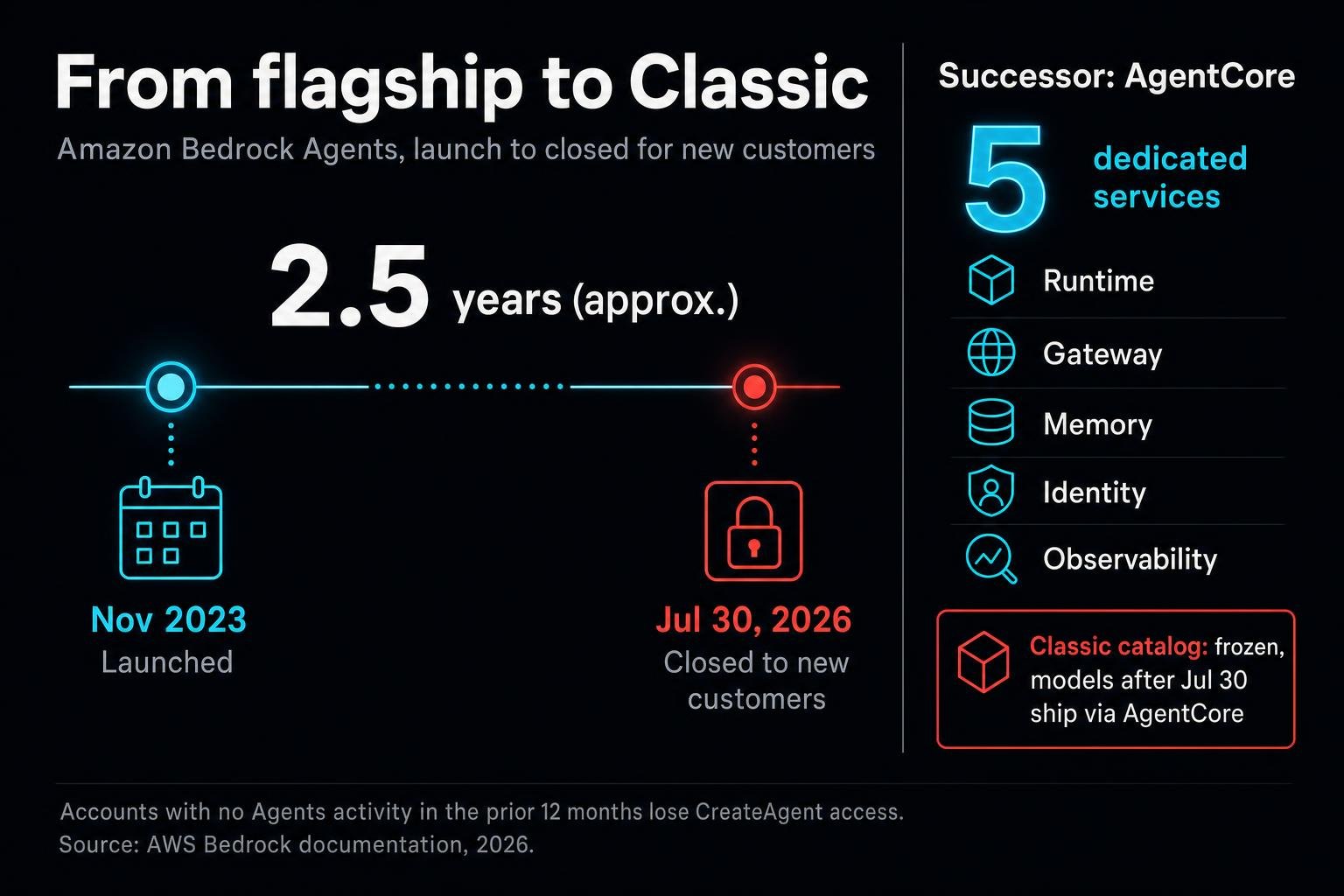
On July 30, 2026, Amazon quietly stopped letting new customers through the door of a product it launched with real fanfare in November 2023. Bedrock Agents, AWS's flagship way to build AI agents, is now officially Bedrock Agents Classic. If your account has not touched it in the previous twelve months, you cannot create a new agent at all. The successor is called AgentCore.
Classic is one of the most polite words in software. It is what a company calls a product when it would like you to leave, without ever saying so.
Two and a half years, launch to eviction
Do the arithmetic and it stings a little. Bedrock Agents went from flagship launch to closed-to-new-customers in roughly two and a half years. That is not a failed experiment being pulled. That is a headline product from the largest cloud provider on earth, aging out of the market it helped create.
If you built production workloads on it, you got about thirty months before the notice arrived. That number is the single most useful thing in this story, because it is the first honest depreciation schedule anyone has for AI agent infrastructure. Not a guess. An actual observed lifespan, published by AWS itself.
Think of it like building your restaurant inside a rented storefront. The food is yours, the recipes are yours, the customers are yours. The walls are not. When the landlord decides the building is going condo, none of your excellence transfers automatically. You move, or you stay in a building nobody is maintaining.
The frozen catalog is the real deadline
Being closed to new customers is survivable if you are already inside. The sharper detail is buried further down: models released after July 30 ship only through AgentCore. Classic's model catalog is frozen.
This is the part people underrate. Nothing breaks. No alarm goes off. Your agents keep answering, keep routing, keep doing the job. They simply stop getting better, permanently, while everything around them accelerates. It is the software equivalent of a phone that still makes calls perfectly well but stopped receiving updates two years ago.
And the pace matters here. Trackers note that the cadence of major model releases has roughly quadrupled since 2023. A frozen catalog in 2019 would have meant missing a couple of upgrades. A frozen catalog now means falling behind on a monthly basis, compounding, forever.
A frozen model catalog is not a shutdown. It is a slow leak. Your agent keeps working exactly as well as it did the day the door closed, and the rest of the world does not.
Which reframes the migration question entirely. Moving off Classic is not optional. It is only deferrable, and every month of deferral has a price you pay in capability rather than in downtime. Those are the most dangerous bills, because nobody sends them to you.
What replaced it tells you what actually lasted
The shape of the successor is the most interesting signal in the whole story. AgentCore is framework agnostic, and it breaks the job into dedicated services: runtime, gateway, memory, identity, and observability.
Compare that to the 2023 idea, which was essentially agents as a feature of the model API. One vendor, one bundle, one place where everything lived. The 2026 idea is agents as infrastructure, with the durable pieces pulled apart and named individually.
Memorize that list, because it is what survived contact with reality. An agent needs somewhere to run. It needs a door to the outside world. It needs to remember things. It needs to be somebody, with credentials that can be scoped and revoked. And it needs to be watchable, because an agent you cannot audit is a liability wearing a helpful face. Notice that the model itself is not on the list. The model is the part that changes every few weeks. The plumbing around it is the part you are actually buying.
Buyers had already worked this out
The funny thing is that the market was ahead of the announcement. Over the past year, the vertical AI agent world settled on a pricing consensus that has almost nothing to do with software licenses: outcome plus consumption, rather than per seat. As one analysis put it, SaaS sells software seats, but vertical agents sell completed work. Buyers stopped asking for fifty CRM licenses and started asking for five thousand tickets handled per month.
Alongside that, small and mid sized buyers are being coached, quite explicitly, on how to protect themselves. Prefer vendors that support MCP or open APIs. Negotiate data portability clauses with exportable formats written into the contract. Keep a backup vendor for anything mission critical.
Read that checklist in January and it sounds like paranoia from someone who has been burned. Read it the week a flagship product turns into Classic and it sounds like the minimum standard of professional care.
So what do you actually do with this
Not panic, and definitely not abstain. The lesson is not that agent platforms are a trap. It is that they have a shelf life, and you now have a real number for it.
- Price the depreciation. Assume roughly two and a half years before any agent platform you pick today faces a generational change. Budget the migration up front rather than discovering it.
- Buy interfaces, not bundles. Open standards and framework agnostic patterns are what let you move. The single vendor agent framework has now demonstrated, publicly, that it is the layer that churns.
- Make the exit cheap before you need it. Exportable data, documented workflows, standard interfaces. If leaving is expensive, you are not a customer, you are a hostage.
- Watch the frozen edges. The thing that quietly stops improving hurts more than the thing that loudly breaks.
There is something almost reassuring about all this. Three years in, the agent industry just experienced its first proper generational turnover, and it went the way generational turnovers always go: the bundle broke apart, the durable primitives got their own names, and the people who kept their options open moved on cheaply. That is not chaos. That is an industry growing up in public, and doing it fast enough that the rest of us get to learn from the first eviction notice instead of our own.
One signal a day. No noise.
A 3-minute read when something genuinely shifts in AI, automation, or defense tech. Free, most weekdays.
Free, most weekdays. No spam, unsubscribe anytime.Sources
- AWS Documentation - Bedrock Agents Classic maintenance mode - https://docs.aws.amazon.com/bedrock/latest/userguide/agents-classic-maintenance-mode.html
- AWS in Plain English - AWS just retired its flagship AI agent product it launched in 2023 - https://aws.plainenglish.io/aws-just-retired-its-flagship-ai-agent-product-it-launched-in-2023-add395ae3fe8
- ServerGurus - AWS Bedrock AgentCore 2026 - https://servergurus.com/blog/aws-bedrock-agentcore-2026
- West Loop Strategy - Amazon Bedrock Agents Classic availability change - https://www.westloop.io/post/amazon-bedrock-agents-classic-availability-change-amazon-bedrock-agents-launched-november-2023-is-now-amazon-bedrock-agents-classic-and-will-no-longer-be-open-to-new-customers-starting-on-july-30-2026-if-you-would-like-to-use-bedrock-agents-classic-sign-up
- DEV Community - Migrating from Bedrock Agents Classic - https://dev.to/aws-builders/my-robot-accountant-got-an-eviction-notice-so-we-moved-migrating-from-bedrock-agents-classic-to-4bjo
- SaaS Mag - Vertical AI agents are eating horizontal SaaS - https://www.saasmag.com/vertical-ai-agents-eating-horizontal-saas/
- SaaS Mag - Why niche vertical SaaS beats horizontal in 2026 - https://www.saasmag.com/vertical-saas-niche-beats-horizontal-2026/
- ACTGSYS - Vertical AI agents and industry specific adoption in 2026 - https://actgsys.com/en/blog/vertical-ai-agents-industry-specific-2026
- Digital Applied - AI model releases tracker, August 2026 - https://www.digitalapplied.com/blog/ai-model-releases-august-2026-tracker
Quick answers
What happened to Amazon Bedrock Agents?
Bedrock Agents, which AWS launched in November 2023, was renamed Bedrock Agents Classic and closed to new customers on July 30, 2026. Accounts with no Agents activity in the prior twelve months lose CreateAgent access. AWS points new builds at AgentCore instead.
Does Bedrock Agents Classic still work if I already use it?
Yes, existing workloads continue to run, but the Classic model catalog is frozen. Models released after July 30, 2026 ship only through AgentCore, so staying on Classic means falling steadily behind on model capability rather than facing an immediate outage.
What is AgentCore?
AgentCore is AWS's framework agnostic successor to Bedrock Agents. Instead of bundling agents into the model API, it splits the job into dedicated services: runtime, gateway, memory, identity, and observability.
What should buyers ask before committing to an agent platform?
The questions the market has converged on are about portability: does the vendor support MCP or open APIs, is there a data portability clause with exportable formats, and is there a viable backup vendor for mission critical workflows. Roughly two and a half years is a reasonable planning horizon before a generational change.