Europe Just Scheduled the Assistant Wars
Binding EU orders give Claude, ChatGPT and Copilot the same deep Android access Gemini has, no later than August 1, 2027, plus a share of Google's search ranking data from January 2027. The most valuable position in consumer AI just became contestable by law.
In 2010, European regulators made Microsoft do something that looked like paperwork and turned out to be seismic: show Windows users a screen asking which browser they wanted. Not a ban. Not a breakup. Just a list. Firefox and Chrome took the decade that followed.
On July 16, 2026, the European Commission did something structurally similar to the AI assistant living on your phone. The full detail of those orders is now public, and it is bigger than the headline suggests.
What the orders actually say
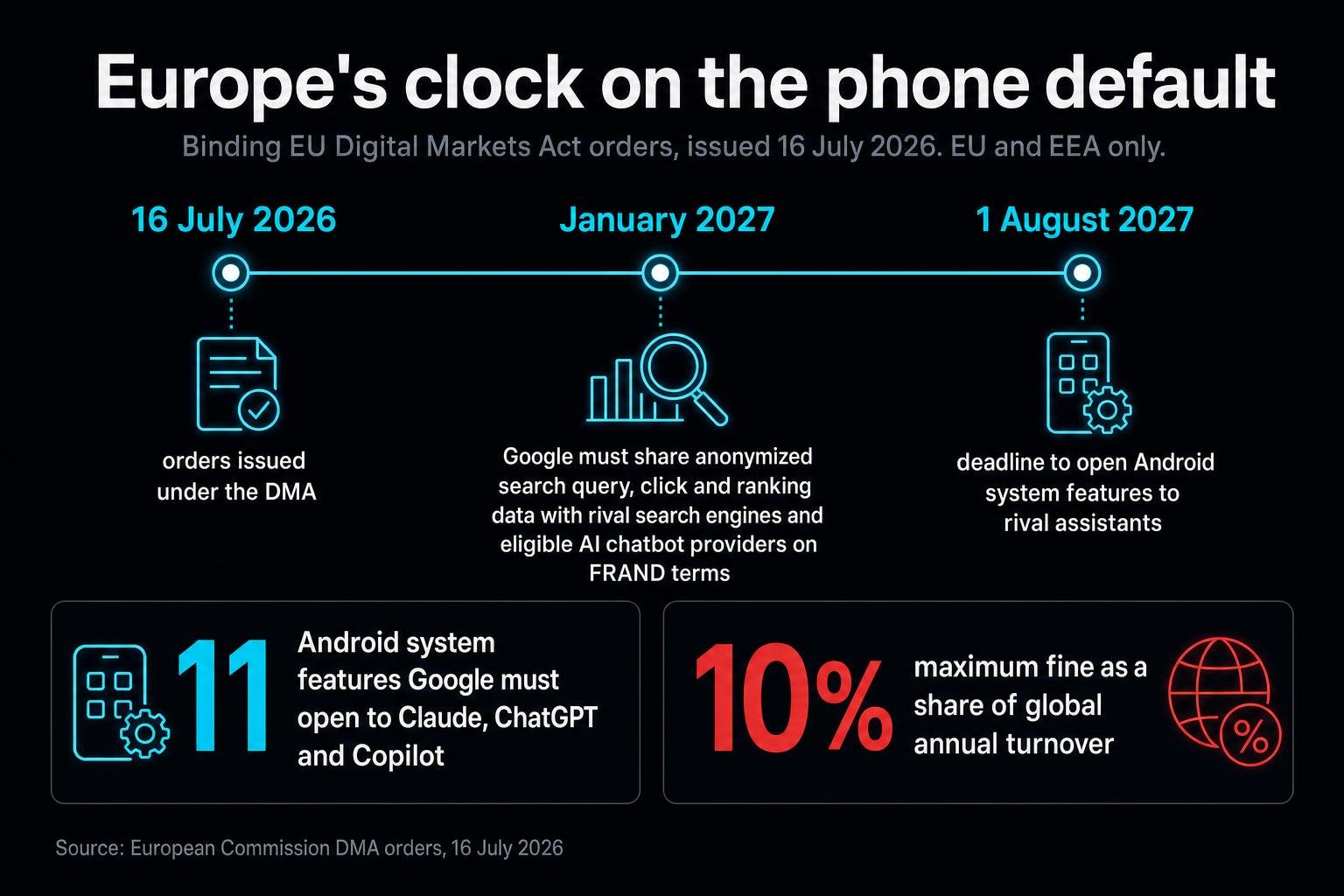
Under binding orders issued through the Digital Markets Act, Google must open 11 Android system features to rival AI assistants. The list includes voice invocation (the "Hey ChatGPT" trigger), on-device app context, autonomous app control, and access to on-device machine learning models. The rivals are named in the reporting: Claude, ChatGPT, and Copilot. The deadline is Android 18, and no later than August 1, 2027. The penalty for non compliance runs up to 10% of global turnover.
A parallel order lands earlier and is getting far less attention. From January 2027, Google must share anonymized search query, click and ranking data with rival search engines and eligible AI chatbot providers, priced on FRAND terms (fair, reasonable and non discriminatory).
This applies in the EU and EEA only. Google is appealing, and the orders stay binding while the appeal runs.
Why "voice invocation" is the whole ballgame
Every item on that list of 11 sounds like plumbing. It is not plumbing. It is the difference between an app and an assistant.
Picture a hotel. The concierge behind the desk can book your table, call your car, and walk into the back rooms where the real work happens. Every other helpful person in that building has to wait in the lobby until you cross the floor and ask. On Android today, Gemini is the concierge and everyone else is in the lobby.
Voice invocation means a rival can be summoned without you opening anything. On-device context means it can see what you are actually looking at. Autonomous app control means it can act on your behalf instead of telling you what to tap. Those three together are what turns a chat window into something that runs your day. Handing them to three competitors is not a cosmetic remedy.
Nobody chose the AI assistant on their phone. It arrived with the phone. In Europe, that is about to become a decision, and decisions are markets.
The data half is the sleeper
The January 2027 order may end up mattering more than the August 2027 one. Search query, click and ranking data is not a pile of documents. It is the accumulated record of which answers people actually wanted, gathered at a scale nobody has been able to buy their way into.
Once eligible AI chatbot providers can license that signal on fair terms, the moat around grounded answers gets shallower for everyone. A well funded team no longer has to spend a decade learning what a good result looks like. If you have wondered why AI answer quality clusters so tightly around a couple of providers, this is the input that explains a lot of it, and it stops being exclusive on a published date.
Apple's protest, and the two track phone
The counter-move is already visible: Apple is withholding its new Siri AI from EU devices in protest. That is the outcome the browser ballot era did not have to reckon with. Instead of more choice, parts of Europe may simply get less product.
So the likely near future is two tracks. US users get assistant features EU users cannot have. EU users get an assistant layer that is open in ways the US version is not. Anyone shipping consumer AI is now building for two continents with different rules about what a phone is allowed to let software do.
Why this matters even if you never touch Android
Three things travel well beyond this specific fight.
- Regulation became a distribution channel. For years the assumption was that the default assistant slot would be won with money or with a better model. In the EU it will be assigned partly by law. That is a genuinely new path to the most valuable real estate in consumer software.
- Being findable in one assistant stops being a strategy. If the assistant a customer talks to could be any of four, and if several of them are grounded in comparable search data, then presence has to be measured across all of them rather than optimized for whichever one is currently fashionable.
- You get real dates. January 2027 and August 1, 2027 are hard, public deadlines in an industry that mostly runs on rumor. That is rare and worth putting on a calendar.
What is still unknown is the part that decided the browser fight: design. A choice screen's placement order, wording, and default position moved enormous market share last time. The remedy exists on paper. Whether it moves anything depends on a screen nobody has seen yet.
The browser ballot looked like a footnote in 2010. Ten years later it had quietly redrawn who controlled the front door to the internet. This time the front door talks back.
One signal a day. No noise.
A 3-minute read when something genuinely shifts in AI, automation, or defense tech. Free, most weekdays.
Free, most weekdays. No spam, unsubscribe anytime.Sources
- European Commission - press release on the DMA orders - https://ec.europa.eu/commission/presscorner/detail/en/ip_26_1634
- TNW - Google, the EU, Android and Gemini's rivals - https://thenextweb.com/news/google-eu-android-gemini-rivals-dma
- AIToolsRecap - EU DMA: Google must open Android to Claude, ChatGPT and Copilot - https://aitoolsrecap.com/Blog/eu-dma-google-android-claude-chatgpt-ai-assistants-2026
- Memeburn - EU forces Apple and Google to open AI assistants - https://memeburn.com/eu-forces-apple-google-open-ai-assistants/
Quick answers
What did the EU actually order Google to do?
Two things. First, open 11 Android system features to rival AI assistants including Claude, ChatGPT and Copilot, covering voice invocation, on-device app context, autonomous app control and on-device machine learning models. Second, share anonymized search query, click and ranking data with rival search engines and eligible AI chatbot providers under FRAND pricing.
When do the deadlines hit?
The search data sharing obligation starts in January 2027. The Android assistant access must ship with Android 18 and no later than August 1, 2027. The orders themselves were issued July 16, 2026.
Does this apply outside the EU?
No. The orders cover the EU and EEA only. That is already creating a split experience: Apple is withholding its new Siri AI from EU devices in protest, so European and American users may end up with meaningfully different assistant layers on the same hardware.
What happens if Google does not comply?
Fines of up to 10% of global turnover. Google is appealing, but the orders remain binding while the appeal proceeds.