The Default Setting Is Now 'Let AI Do It'
Meta and OpenAI will start editing ads by default this month, and Google now summarises almost every buying-stage search. The switch is flipped for you. The consequences are yours.

Picture handing your car keys to a valet. You come back and the car has a new paint job, the seats have been reupholstered, and the sat-nav now takes you somewhere you did not choose. The valet hands you a note: any damage from these improvements is your responsibility. You never asked for any of it. You just parked.
That is roughly the deal advertisers are being offered this month, and it is the clearest example yet of a bigger shift. The platforms we market on are switching AI features on by default, and the responsibility for what those features do is quietly moving to the person who paid.
Meta: "solely responsible" from 30 October
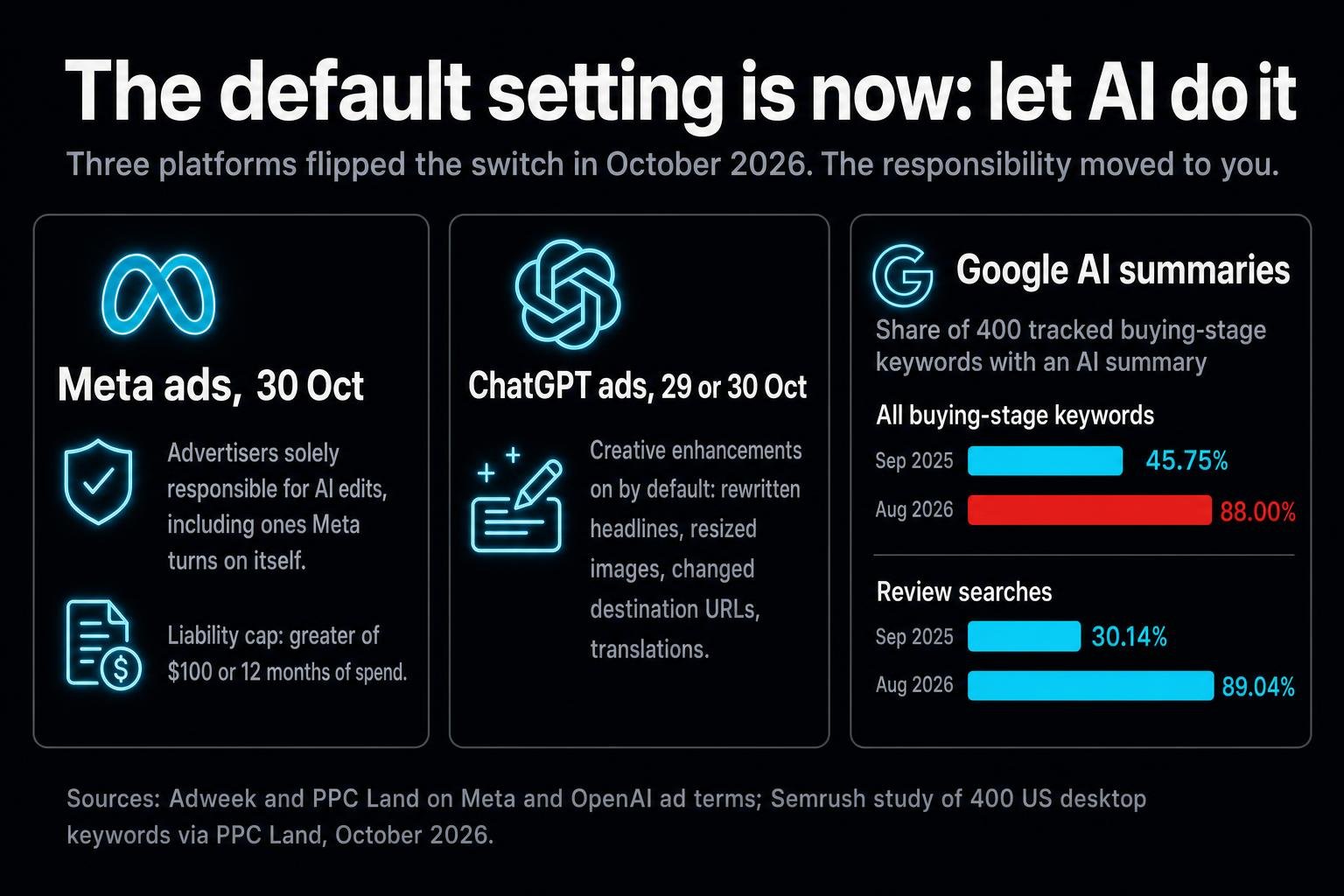
According to Adweek's reading of Meta's revised Commercial Terms, summarised by PPC Land, a new "AI Features" section takes effect on 30 October 2026. Under it, advertisers are "solely responsible" for whatever Meta's AI creates or changes in their ads. That includes features Meta switches on by itself. The previous wording only applied when the advertiser chose to use an AI tool.
There is no button to click. Acceptance is by continued use. If your account is still running ads on 31 October, you have agreed.
This is not theoretical. Agencies have reported live edits they never requested: sitelinks added, copy translated, AI images and carousels built from a brand's own photos. One agency, Exverus, pulled live ads to strip the changes out. Bookshop.org turned off every Meta AI ad feature it could find. The options sit in hidden or collapsed menus, and they apply unless every single one is unchecked.
Meta's own exposure, meanwhile, stays where it was. Its liability cap is still the greater of $100 or twelve months of your spend. And the terms already treat an agency placing ads as acting on the advertiser's behalf, so there is no gap for a middleman to stand in.
One caveat worth stating plainly: the full text of the AI Features section has not been published, and PPC Land could not retrieve Meta's preview to check it. Treat the quoted phrases as Adweek's account, not the contract itself.
OpenAI: the same move, a day earlier
If this were only Meta, you could call it a Meta problem. It is not. PPC Land reports that OpenAI will turn on "creative enhancements" by default for self-serve ChatGPT ads on 29 or 30 October. Its email and its help page disagree on which day. The enhancements include rewritten headlines, resized images, changed destination URLs and translations.
Read that list again. A changed destination URL means the system can decide where your click lands. A translation means your words will appear in a language you may not be able to check. The ad you approved and the ad that runs are now two different objects, and the one you are accountable for is the one you have not seen.
Nobody asked you. You just parked.
Google: your page is now an ingredient
The third default is subtler, because nobody edits your content. Google just stops sending people to it. Semrush tracked 400 US desktop keywords in banking, software and ecommerce from September 2025 to August 2026, and counted how often Google's AI summary appeared above the results. Across all 400 keywords the figure went from 45.75% to 88.00%. By search volume, PPC Land puts it at 97%.
The buying-stage modifiers moved hardest. "Reviews" searches went from 30.14% to 89.04%. "Best X for Y" went from 42.72% to 96.12%. "Price" and "cost" queries went from 43.59% to 82.05%. "Alternatives" went from 48.44% to 82.81%. Ecommerce as a category rose from 32.62% to 85.11%.
The study has real limits. It is desktop only, US only, has no click data, and each cell holds only about 20 to 30 keywords. Semrush also sells the tracking it recommends. But the direction is hard to argue with, and the Mailchimp versus Klaviyo example in the study shows the mechanism. Klaviyo's own comparison page argued for Klaviyo. Zapier's page, cited in the same summary, argued for Mailchimp. The buyer saw both arguments without opening either page.
Your comparison page, your review page, your pricing page: these used to be destinations. They are now ingredients in someone else's answer. The thing that matters is whether you are cited, not where you rank.
Why this is one story, not three
Think about the thermostat in a rented flat. The landlord sets it. You can change it, if you know where the panel is, and if you remember to check it after every visit from maintenance. The temperature is technically your choice. In practice it is whatever was left on last.
Default settings are the most powerful product decision a platform makes, because most people never touch them. Meta, OpenAI and Google have each decided that the default is now "let the AI do it." That is a reasonable product bet. What is new is the second half: the responsibility for the outcome is being written into the contract on the side of the person who did not flip the switch.
For most brands that is an annoyance. For anyone in a regulated category, health, finance, anything where a rewritten headline or a machine translation can imply a claim you never made, it is a compliance exposure with no audit trail. Nobody keeps a record of which AI variant ran.
What to do before 30 October
- Open the collapsed menus. In every Meta ad account you run, list which AI creative features are on, and switch off anything you did not explicitly approve. Do the same for ChatGPT ads before the 29th.
- Write it down, with a date. Screenshots of the settings on the day you checked them are the only proof you will have of what you authorised.
- Check where you are cited. Search your own "vs", "best" and "review" terms and look at who the AI summary quotes. If it is not you, that is the gap to close.
- Repeat weekly. Defaults are not set once. They are set every time the platform ships an update.
None of this is dramatic work. It is the digital equivalent of walking round the car before you drive it off the valet lot. The difference is that, from this month, the note in the glovebox says the dents are yours.
One signal a day. No noise.
A 3-minute read when something genuinely shifts in AI, automation, or defense tech. Free, most weekdays.
Free, most weekdays. No spam, unsubscribe anytime.Sources
- PPC Land - Meta makes advertisers solely responsible for its AI ad edits from Oct 30 - https://ppc.land/meta-makes-advertisers-solely-responsible-for-its-ai-ad-edits-from-oct-30/
- Adweek - Advertisers pull Meta ads that had unwanted AI glow-ups - https://www.adweek.com/media/advertisers-pull-meta-ads-that-had-unwanted-ai-glow-ups/
- PPC Land - OpenAI to rewrite ChatGPT ads by default as advertisers get days to opt out - https://ppc.land/openai-to-rewrite-chatgpt-ads-by-default-as-advertisers-get-days-to-opt-out/
- PPC Land - Google AI Overviews now hit 88% of tracked commercial keywords, Semrush finds - https://ppc.land/google-ai-overviews-now-hit-88-of-tracked-commercial-keywords-semrush-finds/
Quick answers
What changes in Meta's ad terms on 30 October 2026?
According to Adweek's reading, summarised by PPC Land, a new AI Features section makes advertisers solely responsible for anything Meta's AI creates or changes in their ads, including features Meta switches on by itself. Acceptance is by continued use, so any account still running ads on 31 October has agreed. The full text has not yet been published.
Is OpenAI doing the same thing with ChatGPT ads?
Yes. PPC Land reports that OpenAI will turn on creative enhancements by default for self-serve ChatGPT ads on 29 or 30 October 2026. These include rewritten headlines, resized images, changed destination URLs and translations. Advertisers have a few days to opt out.
How often does Google now show an AI summary on buying-stage searches?
In Semrush's study of 400 US desktop keywords in banking, software and ecommerce, the share showing an AI summary rose from 45.75% in September 2025 to 88.00% in August 2026. Review searches rose from 30.14% to 89.04%, and 'best X for Y' searches reached 96.12%. The study is desktop only, US only, and has no click data.
What should advertisers do before the deadlines?
Open the collapsed AI settings in every Meta and ChatGPT ad account, switch off anything not explicitly approved, keep a dated record of the settings, and check which sources Google's AI summaries cite for your own comparison and review terms. Repeat the check weekly, because defaults change with every platform update.