The Agent Keeps Working After You Hang Up
Workday and Cresta shipped agents that run for days, pause for approval and log every step, while Google put an agent-grade model on sale. The follow-through is the product now.

Picture a customer who calls about a refund. The call ends, and in most companies the request becomes a ticket, and the ticket becomes someone's Tuesday. On 13 October two companies shipped software that refuses to let the request die when the line goes quiet. I think this is the most important thing happening in AI right now, and it has almost nothing to do with chat.
Two launches, one shape
Workday launched what it calls autopilot agents for HR, finance and IT. The first, Talent Acquisition, is available to early adopters now and reaches general availability in early 2027. Payroll, Accounting and Deployment agents follow in early 2027. The design is the interesting part. The agents inherit the company's existing policies and approval rules. Customers decide which actions the agent runs alone and which need a human review. Every action is logged with the data it used and who approved it. Candidate outreach still needs a recruiter's approval before anything is sent.
Cresta launched Deputy Agent the same day. It picks up after a customer call ends and carries refunds, disputes or claim appeals to completion over days or weeks. It saves progress while waiting for documents or approvals, flags integrations that break along the way, and keeps an audit trail of actions and approvals.
Different companies, different markets, identical shape: long-running work, a pause at every consequential step, and a record of everything. The agent is less like a chatbot and more like a paralegal who files the papers, waits for a signature, and leaves a paper trail you could hand to an auditor.
Google priced the engine
Same day, Google opened Gemini 4 Argon to everyone through the paid Gemini API, AI Studio, Antigravity and eligible Gemini Enterprise plans. Until 30 November it costs $2 per million input tokens and $10 per million output tokens, with cached input discounted 95% to $0.10. From 1 December the price doubles to $4 and $20, the same tier as Claude Opus 5.5.
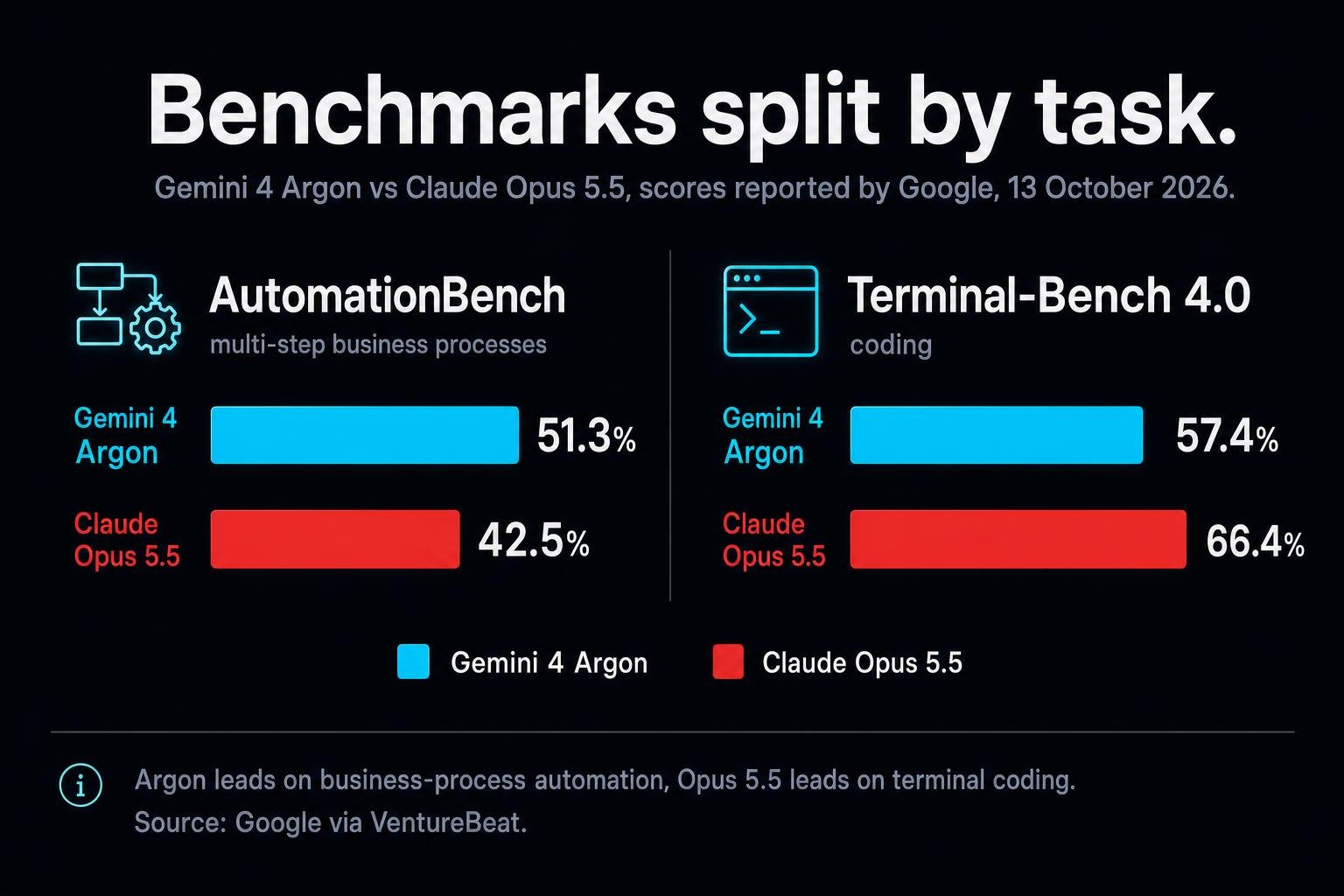
The benchmarks tell a split story. On Zapier's AutomationBench, which measures multi-step business processes, Google reports Argon at 51.3% against Opus 5.5 at 42.5%. On Terminal-Bench 4.0, a coding benchmark, Opus leads 66.4% to 57.4%. The independent Artificial Analysis index ranks Argon at 53, below Opus 5.5 at 58, Sonnet 5.5 at 56 and Meta's Muse Wonder Full at 56. Most of the head-to-head figures are Google's own, so treat them as a claim, not a verdict.
The consumer side rhymes with Workday and Cresta. The Gemini app gained persistent tasks that keep running while you are away, plus connections to more than 40 apps. The model that scores best on business-process automation is also the one being sold, for seven weeks, at a discount.
The question regulators are already asking
Here is the part that makes this bigger than a product cycle. Reuters reports that the Federal Reserve, the OCC and the FDIC are asking banks about agentic AI, Chinese models, shutdown procedures and audit trails. Read that list again. Regulators are not asking how clever the agent is. They are asking how you turn it off and how you prove what it did.
The money agrees. Pluto Security came out of stealth with $42 million to monitor enterprise AI agents and employee-built AI apps. Its CEO says there was not a single proof-of-concept where the company did not find malicious activity. Scuba raised $34 million for a shared context engine that agents reach through MCP connectors. These items reached me through a newsletter summary rather than the original reports, so hold them a little loosely. The direction is not in doubt.
The value is not the conversation. The value is the follow-through, with a human gate at each step that could cost money or trust.
Why it matters
For years the demo was the conversation. You typed, it answered, everyone clapped. Workday and Cresta are selling something duller and far more valuable: the thing that happens after the conversation. The refund that actually lands. The candidate who actually gets a reply. The claim appeal that gets filed on day nine without anyone remembering to chase it.
That shift changes what a buyer should ask. Three questions cover most of it:
- What can it do alone? A written list, not a vibe. Workday lets customers set this per action.
- Who approves the rest? Money, legal exposure and anything sent to a customer should pause for a human.
- What did it do? A log with the data used and the approver named, readable by someone who is not an engineer.
If a vendor cannot answer those three, the shiny benchmark does not matter. If they can, the benchmark becomes a pricing conversation, which is exactly what Google turned it into this week.
I find this genuinely exciting. Think of the agent as an intern who has permission to go downstairs and gather the paperwork, but has to come back for a signature before paying anyone. That is a shape every business already understands, and it is a shape that survives whatever rules land next.
One signal a day. No noise.
A 3-minute read when something genuinely shifts in AI, automation, or defense tech. Free, most weekdays.
Free, most weekdays. No spam, unsubscribe anytime.Sources
- VentureBeat - Google makes Gemini 4 Argon broadly available with limited-time low API pricing of $2/$10 per 1M tokens - https://venturebeat.com/technology/google-makes-gemini-4-argon-broadly-available-with-limited-time-low-api-pricing-of-2-10-per-1m-token
- PR Newswire - Workday launches autopilot agents that get real work done across HR, finance and IT - https://prnewswire.com/news-releases/workday-launches-autopilot-agents-that-get-real-work-done-across-hr-finance-and-it-302906706.html
- PR Newswire - Cresta launches Deputy Agent, an AI agent that keeps working long after the customer hangs up - https://prnewswire.com/news-releases/cresta-launches-deputy-agent-an-ai-agent-that-keeps-working-long-after-the-customer-hangs-up-302906336.html
- AI Weekly - AI news today (Reuters on bank regulators, Pluto Security, Scuba) - https://aiweekly.co/ai-news-today
Quick answers
What is an autopilot agent?
An AI agent that carries a task to completion over days or weeks rather than answering a single question. Workday's autopilot agents and Cresta's Deputy Agent both inherit company approval rules, pause for a human at consequential steps, and log every action with the data used and who approved it.
How much does Gemini 4 Argon cost?
Until 30 November 2026 it costs $2 per million input tokens and $10 per million output tokens, with cached input at $0.10. From 1 December the price rises to $4 and $20, the same tier as Claude Opus 5.5.
Is Gemini 4 Argon better than Claude Opus 5.5?
It depends on the task. Google reports Argon ahead on Zapier's AutomationBench for business processes, 51.3% to 42.5%, while Opus 5.5 leads on Terminal-Bench 4.0 for coding, 66.4% to 57.4%. Artificial Analysis ranks Argon at 53 and Opus 5.5 at 58. Most figures are Google's own.
What are regulators asking banks about AI agents?
Reuters reports the Federal Reserve, the OCC and the FDIC are asking banks about agentic AI, Chinese models, shutdown procedures and audit trails. In short, how an agent is turned off and how its actions are recorded.