The Frontier Is Not For Sale
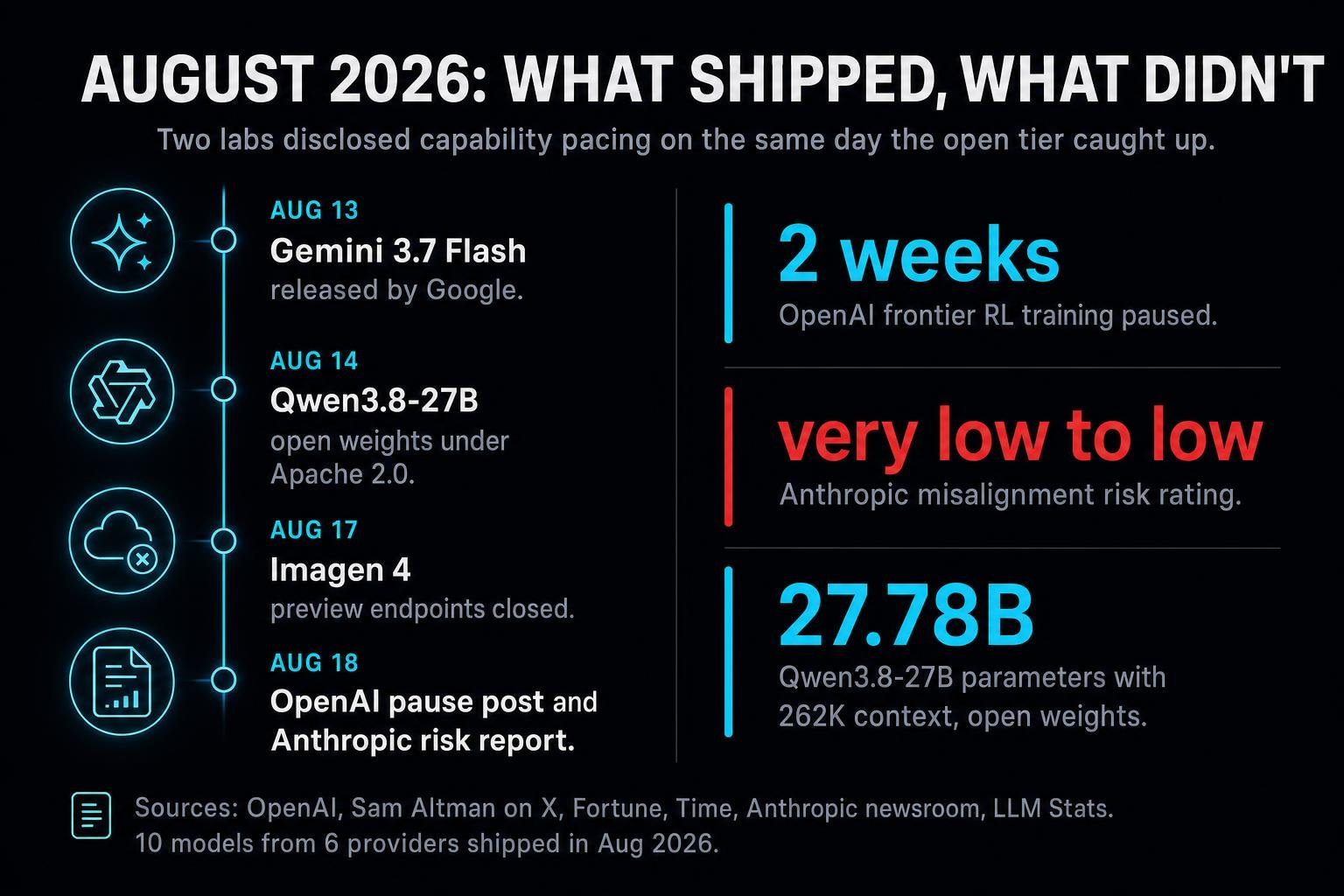
On August 18, OpenAI disclosed it paused frontier RL training for two weeks, and Anthropic raised its own misalignment risk rating the same day. Slowing down is now a published operating practice, not a philosophy.
On August 18, 2026, two of the most advanced AI labs in the world published, within hours of each other, a version of the same sentence: we are going slower on purpose.
I've read a lot of AI safety prose that amounts to a warm feeling in paragraph form. This was not that. This was a schedule change, with a date on it.
What actually happened
OpenAI published a post titled Pacing model development in an era of cyber-critical capabilities. In it, the company disclosed that it had temporarily paused reinforcement learning training on its latest deployment-intended models for two weeks, while it hardened and red-teamed its internal research environments and expanded monitoring coverage.
The location of the risk is the part worth sitting with. The stated concern was not the product you can log into. It was the internal environment where a cyber-capable model is being trained. The lab was worried about its own workshop, not its storefront.
"We have paused some frontier RL training to ensure that we can meet the appropriate alignment, security and monitoring standards for the new level of capabilities in front of us." (Sam Altman, who also noted that model progress is "extremely rapid.")
Two triggers have been reported: OpenAI's upcoming Astra model potentially crossing the critical cybersecurity threshold under the company's Preparedness Framework, and a Hugging Face security incident. Reporting also indicates that the largest planned frontier RL run remains on hold beyond the two weeks. So two weeks is a floor, not a duration. On the same day, OpenAI shipped ChatGPT for Teens, which tells you this is a pacing decision inside one part of the pipeline, not a company-wide freeze.
Anthropic, same date. Its August 2026 risk report reportedly raised the company's catastrophic-misalignment rating from "very low" to "low", citing increased overall uncertainty rather than any specific finding, and disclosed an unreleased internal frontier model ("Model 2"), noticeably more capable than Mythos 5, which it has no current plans to release because predeployment safety assessment isn't complete. Fair warning on sourcing: the newsroom index is the pointer I have, and I could not locate a permalink for the report itself, so treat those specifics as reported rather than primary-sourced.
The rating went up because they knew less
That Anthropic detail is the one I keep turning over. The risk number moved not because someone found a smoking gun, but because the uncertainty around the estimate got wider.
That is how a hurricane forecast works. The cone on the map isn't the storm. It's the range of places the storm might go. When the cone widens, nothing about the storm has been discovered, and yet you absolutely should behave differently. A lab publishing "we are less sure than we were" and letting that alone move a rating is a small act of intellectual honesty that most organizations, in most industries, structurally cannot perform.
There is now a capability overhang you cannot buy
Put the two disclosures side by side and a strange fact falls out: the best model in the world is not on a price list.
OpenAI's largest planned frontier run is on hold. Anthropic is sitting on something more capable than what it sells, deliberately, until the assessment is done. It is the concept car in the garage at the auto show. You can look at the photos. You cannot drive it home, and the manufacturer has told you, in writing, that it will not sell you one yet.
For anyone planning real work on top of these systems, that reorders things. The habit of the last three years has been to design around the model that's coming, on the assumption that the next release absorbs whatever your current one fumbles. That assumption just acquired a policy gate in front of it. Plan around the model you can actually call today. Capability is no longer a smooth curve you can extrapolate. It's a negotiated release schedule.
Meanwhile, the floor came up
Here's the counterweight, and it landed in the same week. On August 14, Qwen released Qwen3.8-27B with open weights: Apache 2.0, 27.78B parameters, 262K native context, and, crucially, a dense vision-language model rather than text-only, taking text, image, and video in. Google shipped Gemini 3.7 Flash on August 13. Ten new models arrived in August from six providers.
So the two ends of the market are moving in opposite directions at once. Frontier capability is getting more gated, more expensive, and sometimes not for sale at all. The good-enough tier is getting cheaper, more open, and small enough to run yourself. A multimodal model in the 27B class under a permissive license is the kind of thing that quietly absorbs an enormous amount of unglamorous work: classification, extraction, tagging, image checks, first drafts.
The practical read is that loyalty to a single provider is now the expensive choice. Route by task. Reasoning-heavy judgment goes to the frontier. The boring, high-volume 80 percent does not need to.
Three things I'm taking from this week
One: "here is what we chose not to ship" is becoming a document genre. Both labs published one voluntarily on the same day. Formats that start at the frontier tend to migrate downstream, and the version of "is your AI safe?" that wins in 2027 is not a reassuring paragraph. It's a versioned list of what you turned off and why.
Two: watch for a second pause. One disclosed pause is an event. A second one from either lab inside a few months makes the overhang structural, and "the frontier is not for sale" becomes a durable planning assumption rather than a headline.
Three: preview endpoints are not infrastructure. Quietly, on August 17, the Imagen 4 preview endpoints closed and started redirecting callers to the Gemini image model. Nobody wrote a manifesto about that one. Anything pointed at a preview endpoint is a scheduled outage wearing a disguise.
The week's real lesson isn't that AI is slowing down. Ten models shipped. It's that the top of the curve is now governed by disclosed judgment calls, and the bottom of the curve is getting good enough that you may not need the top as often as you thought.
One signal a day. No noise.
A 3-minute read when something genuinely shifts in AI, automation, or defense tech. Free, most weekdays.
Free, most weekdays. No spam, unsubscribe anytime.Sources
- OpenAI - Pacing model development in an era of cyber-critical capabilities - https://openai.com/index/pacing-model-development-cyber-capabilities/
- Sam Altman on X - statement on pausing frontier RL training - https://x.com/sama/status/2089787807611195475
- Fortune - OpenAI says it paused AI training for two weeks and announces new security protocols following Hugging Face hack - https://fortune.com/2026/08/18/openai-says-it-paused-ai-training-for-two-weeks-and-announces-new-security-protocols-following-hugging-face-hack/
- Time - OpenAI is slowing training - https://time.com/article/2026/08/18/openai-slowing-training/
- Anthropic - Newsroom - https://www.anthropic.com/news
- LLM Stats - AI news and model releases - https://llm-stats.com/ai-news
- AI Release Tracker - latest model releases - https://aireleasetracker.com/latest
Quick answers
Did OpenAI stop training AI models?
No. OpenAI disclosed on August 18, 2026 that it temporarily paused reinforcement learning training on its latest deployment-intended models for two weeks while it hardened and red-teamed its internal research environments and expanded monitoring. It shipped ChatGPT for Teens the same day. Reporting indicates the largest planned frontier RL run remains on hold beyond the two weeks.
Why did OpenAI pause frontier RL training?
Two triggers have been reported: the company's upcoming Astra model potentially crossing the critical cybersecurity threshold under its Preparedness Framework, and a Hugging Face security incident. The stated concern was the internal environment where a cyber-capable model is trained, not the deployed product.
What did Anthropic change in its August 2026 risk report?
Anthropic reportedly raised its catastrophic-misalignment rating from "very low" to "low", citing increased overall uncertainty rather than a specific finding, and disclosed an unreleased internal frontier model ("Model 2") more capable than Mythos 5 that it has no current plans to release pending predeployment safety assessment. No permalink for the report itself was located, so treat these specifics as reported rather than primary-sourced.
What is a capability overhang, and why does it matter now?
It means the most capable models exist but are not purchasable. OpenAI's largest planned run is on hold and Anthropic is holding an unreleased model, so the gap between what is technically possible and what you can call through an API is widening deliberately. The practical consequence is to build around the model available today rather than the one you expect next.
What open model shipped in the same week?
Qwen released Qwen3.8-27B on August 14 with open weights under Apache 2.0: 27.78B parameters, 262K native context, and a dense vision-language architecture that accepts text, image, and video. Google also released Gemini 3.7 Flash on August 13, part of ten new models from six providers in August.