Your Storefront Now Has An API You Didn't Build
On August 5, every Shopify Liquid storefront quietly became callable by AI agents with no setup required. The same shift is showing up in protocol specs and in $100M defense prizes, and it points at one conclusion: the interface is the product now.

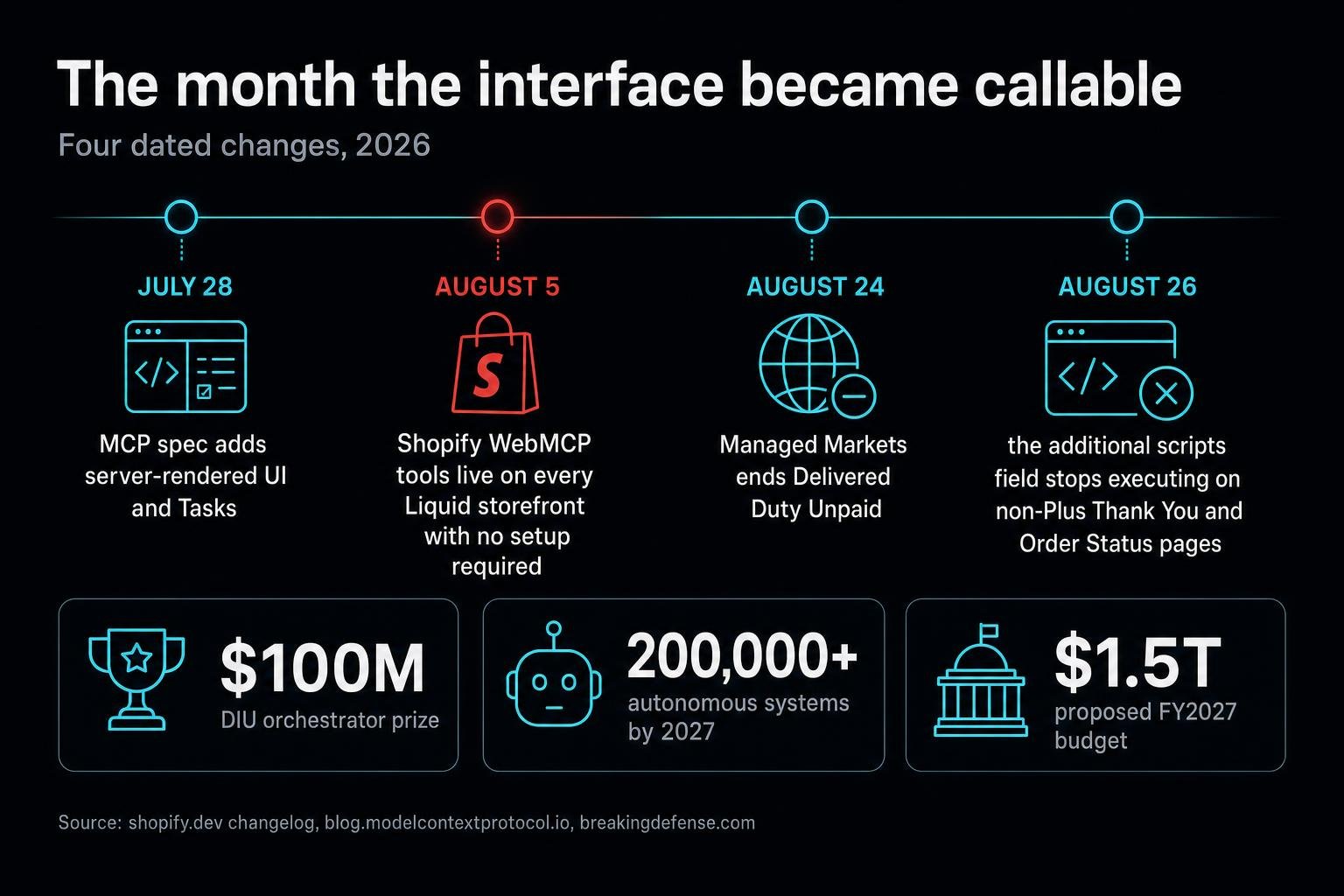
Something happened on August 5 that most store owners still don't know about. Shopify shipped WebMCP tools for online stores, live on every Liquid storefront, with no setup required. An AI agent running in the shopper's browser can now search the catalog, edit the cart, and open checkout as first-class registered tools, rather than by scraping the page and faking mouse clicks.
Nobody had to opt in. Nobody had to negotiate a partnership or rebuild a checkout. It is already on.
A service counter you didn't know you installed
For thirty years, a website was a shop window. Machines that wanted something from it had to press their face to the glass and guess: read the pixels, find the button, hope the layout didn't change overnight. That's what web scraping is, and it has always been brittle and slightly undignified.
WebMCP, a proposed web standard that lets a page register callable tools with the browser itself, replaces the window with a service counter and a bell. The agent walks up, rings, and says "three of these, size medium, checkout." No guessing at pixels. A defined request, a defined response.
Two much less exciting Shopify dates land in the same week, and they're worth separating out because they're easy to conflate with the big one. On August 24, Managed Markets ends Delivered Duty Unpaid, so affected markets switch to duties collected at checkout. On August 26, non-Plus stores must have upgraded their Thank You and Order Status pages, and after that date the additional scripts field stops executing permanently on those pages.
Those two are chores. WebMCP is a category change. But do the chores, because the August 26 one fails silently: any pixel or tracking snippet still living in that field just stops running, nobody gets an email about it, and the damage shows up weeks later as conversion data that no longer reconciles and ad platforms optimizing against a broken signal. Silent failures are the expensive kind precisely because there's nothing to notice.
The machine reads fields, not adjectives
Here's the part I find genuinely thrilling, and slightly ominous.
When an agent calls a storefront tool, it doesn't read your headline. It doesn't see the beautiful comparison graphic your designer built. It reads the values in the fields Shopify's default tool definitions expose: product titles, variant names, tags, metafields, collection structure. Whatever is in there right now is your agent-facing surface, uncurated, as of two weeks ago.
So imagine three products that a human shopper can easily tell apart, because the difference is explained in an image on the product page. To the agent, they are three near-identical rows. It cannot recommend one over another, because the thing that distinguishes them was never written down anywhere it can reach. Meanwhile a competitor whose variant names actually encode the buying decision, the duration, the dose, the format, gets picked.
This is technical SEO in 2012 all over again: the skill is reading what the machine sees instead of what the human sees. The work is unglamorous, invisible to visitors, and decisive.
Integrations that render their own front end
The same pattern showed up a week earlier in a much drier document. The Model Context Protocol spec dated 2026-07-28 is its largest revision since launch, and most of the coverage focused on the stateless core and SDK migration. Two extensions matter more.
MCP Apps lets servers return server-rendered UI, not just text or JSON. Tasks adds a formal pattern for long-running work that outlives a single request.
Until now, an MCP server was plumbing: it handed data to a model, and the model narrated it back in prose. With server-rendered UI, a server can return an actual interface. A table. A form. An approval button. A chart. Which means the integration and the front end stop being two separate things you build, host, and maintain. They become one artifact.
The operational details make that economically sane rather than merely clever. Stateless requests carry their own context, so a remote server runs behind plain round-robin load balancing and routes on an Mcp-Method header. Clients cache the tool list per a server-declared time-to-live. Auth aligns with OAuth and OIDC. All four Tier-1 SDKs support it, TypeScript, Python, Go and C#, with Rust in beta.
The sleeper item is the least glamorous line in the whole spec: there is now a formal deprecation policy. Protocols without one punish everybody who shows up early. This one just stopped doing that, which is the actual signal that MCP is safe to build a business on.
The Pentagon put a price on the same idea
Now the part that convinced me this is a pattern and not a coincidence.
The Defense Innovation Unit is running a $100M prize challenge for an "Autonomous Vehicle Orchestrator": an AI mediator between human and machine that converts plain-English instructions into detailed machine-readable commands, so a single servicemember can direct a group of unmanned vehicles by text or voice. SpaceX is among the entrants.
Strip the camouflage off that problem statement and it reads: natural language in, structured machine commands out, with a human confirming intent before anything executes. That is the architecture of every serious agent product, and the Department of Defense just attached nine figures to solving it well enough to trust.
The difficulty isn't the language model. Parsing "move the three closest units to the ridge and hold" is not hard in 2026. The difficulty is everything around it: how the system restates its interpretation before acting, how it asks which ridge instead of guessing, how it bounds what it is willing to do, and how it records what a human authorized versus what actually happened.
The procurement side tells the same story. The U.S. Army selected Swarmbotics AI in February 2026 to develop autonomous ground vehicle swarms for breaching and maneuver using hundreds of small robots. That's swarm software, not swarm hardware. Anduril won the next-gen command and control common data layer baseline. And the 2026 read on capital in swarm robotics is that funding rewards coordination and orchestration, decentralized algorithms that scale from dozens of agents to thousands, over the machines themselves.
The buyer is paying for the layer that coordinates the things, not the things.
Scale is what forces it. DoD is pursuing over 200,000 autonomous systems by 2027, against a proposed $1.5 trillion FY2027 budget. One operator per vehicle is arithmetically impossible at that number. The ratio has to invert, which makes orchestration the binding constraint on the entire program. Hardware is a manufacturing problem with known suppliers. Coordinating 200,000 heterogeneous systems safely, with human accountability intact, is unsolved software.
One shift, three domains
A storefront becoming callable. An integration that renders its own interface. A $100M bounty on translating human intent into machine action. These look unrelated until you notice they're all the same move: the interface stops being something a person looks at and becomes something a system calls, and value migrates to whoever structures things for the caller.
If you own a website, the practical version is small and boring and worth doing this month. Make sure the information a buyer needs lives in fields, not in pictures of fields. Check whether anything load-bearing is sitting in a script field that's about to stop running. Then open your own site the way a machine would, and see whether it can actually tell your products apart.
And if you build software, the more interesting news is where the margin went. It went to the seam between what a human meant and what a machine did. Everything on either side of that seam is becoming substitutable.
One signal a day. No noise.
A 3-minute read when something genuinely shifts in AI, automation, or defense tech. Free, most weekdays.
Free, most weekdays. No spam, unsubscribe anytime.Sources
- Shopify - Developer changelog - https://shopify.dev/changelog
- Fudge.ai - Shopify updates, August 2026 - https://www.fudge.ai/blog/shopify-updates-august-2026/
- Model Context Protocol - 2026-07-28 specification - https://blog.modelcontextprotocol.io/posts/2026-07-28/
- Cloudflare - MCP v2 - https://blog.cloudflare.com/mcp-v2/
- Breaking Defense - DIU offers $100M in prizes for a voice-controlled drone swarm orchestrator - https://breakingdefense.com/2026/01/diu-offers-100m-in-prizes-for-voice-controlled-ai-enabled-drone-swarm-orchestrator/
- AI CERTs - SpaceX joins DoD drone swarm orchestrator contest - https://www.aicerts.ai/news/spacex-joins-dod-drone-swarms-orchestrator-contest/
- Superscout - Swarm robotics sector - https://superscout.co/sector/swarm-robotics
- Govly - DoD autonomous systems signal - https://app.govly.com/public/signals/85347
- Breaking Defense - Army picks Anduril to lead next-gen C2 common data layer baseline - https://breakingdefense.com/2026/06/army-picks-anduril-to-lead-next-gen-c2-common-data-layer-baseline/
Quick answers
What is WebMCP?
WebMCP is a proposed web standard that lets a page register callable tools directly with the browser, so an AI agent can invoke defined actions instead of scraping the page and simulating clicks. Shopify shipped WebMCP tools for online stores, live on every Liquid storefront with no setup required, covering catalog search, cart edits, and opening checkout.
Do I need to enable anything on my Shopify store?
No. The tools went live on every Liquid storefront with no setup required. That's exactly why it's worth attention: your agent-facing surface is currently whatever Shopify's default tool definitions expose, which means product titles, variant names, tags, metafields and collection structure, with no curation.
What happens on August 26, 2026?
Non-Plus Shopify stores must have upgraded their Thank You and Order Status pages by then. After that date, the additional scripts field stops executing permanently on those pages, so any tracking snippet or pixel still living there simply stops running, with no error and no notification.
What changed in the July 2026 MCP spec?
The 2026-07-28 spec is the largest revision since launch. Alongside a stateless core, it adds MCP Apps, which let servers return server-rendered UI rather than only text or JSON, and Tasks, a formal pattern for long-running work that outlives a single request. It also aligns auth with OAuth and OIDC and introduces a formal deprecation policy.