The $0.15 Agent
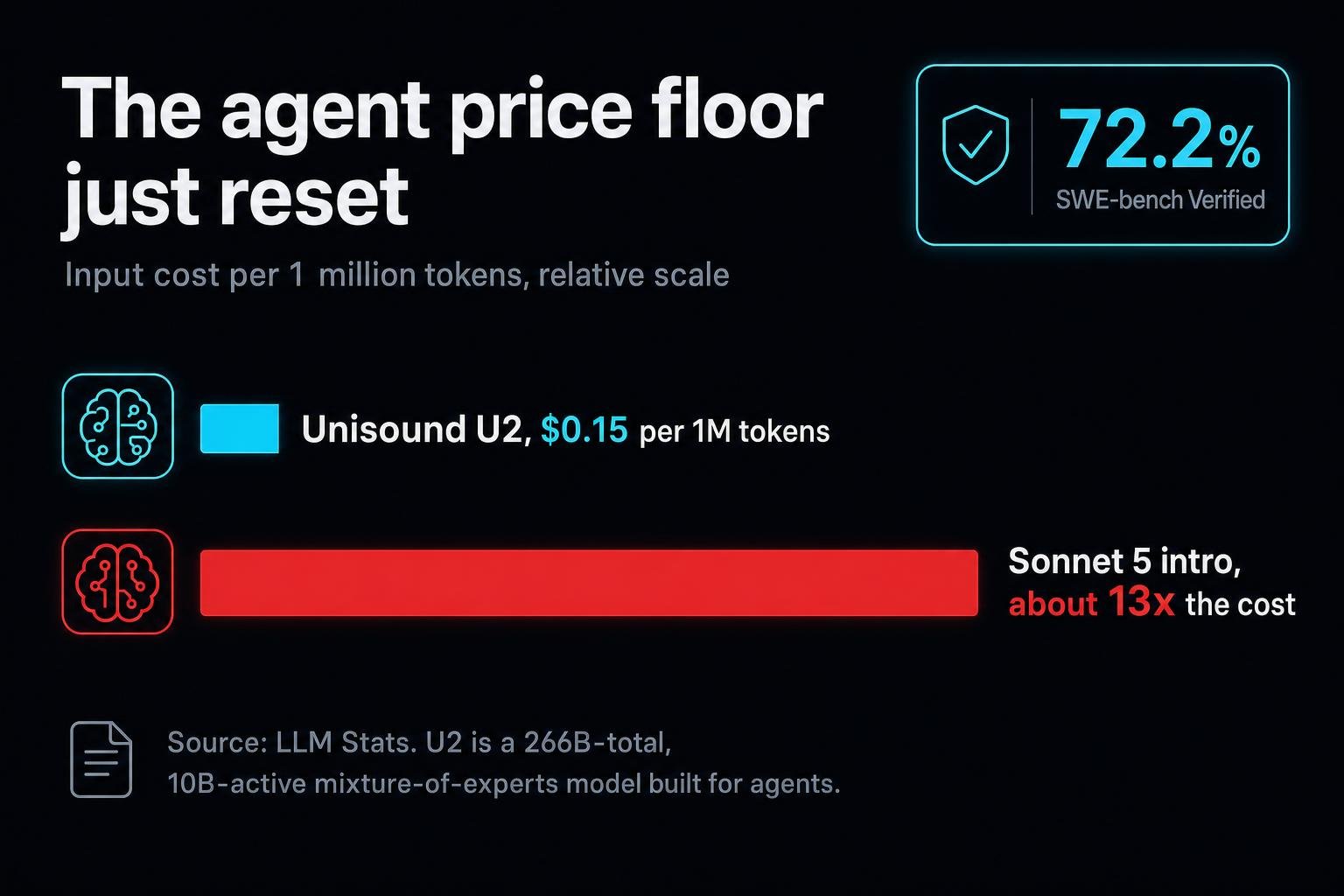
A 10-billion-active-parameter model just posted 72.2% on SWE-bench Verified at fifteen cents per million tokens. The floor for 'good enough' AI agents is collapsing toward pennies.

Every so often a technology stops being exciting and starts being cheap, and that second thing is the one that actually changes the world. Solar panels did it. Bandwidth did it. This quarter, AI agents quietly did it too.
Two numbers tell the story. A model called Unisound U2 posted an independently verified 72.2% on SWE-bench Verified, a hard benchmark that measures whether an AI can actually fix real bugs in real software repositories. And it did that at a price of $0.15 per million input tokens and $0.30 per million output tokens, which is roughly one-thirteenth of the introductory price of a top-tier frontier model like Sonnet 5.
If you have never thought about token pricing, here is the plain-language version: the cost of having a competent AI do a full loop of real work just fell off a cliff.
Why a 'sparse' model is the trick
U2 is what engineers call a mixture-of-experts model. Its total size is 266 billion parameters, but for any given request it only wakes up about 10 billion of them. Think of it like a hospital with hundreds of specialists on staff where your case only pulls in the three doctors you actually need, instead of marching the entire building past your bed. You get expert-level answers while paying for a fraction of the compute.
The important part is that it was built specifically for agents, meaning the repetitive, multi-step, tool-calling grind that autonomous software does all day. That focus is why a model this cheap can still score in the 70s on a benchmark that humbles many larger, pricier systems.
The plumbing got boring, and that is a compliment
The price drop did not happen in isolation. The same quarter saw the frameworks that developers use to build agents grow up in public. Pydantic AI V2 and LlamaIndex Workflows 1.0 both shipped stable releases within 48 hours of each other, and Anthropic added hierarchical subagent spawning to its Claude Agent SDK, so one agent can now spin up and coordinate a small team of specialist agents beneath it.
Stable version numbers are not glamorous. But they are the tell that a category has crossed from experiment to infrastructure. When your plumbing stops surprising you, you can finally stop staring at the pipes and start thinking about the house.
Two floors moved at once. The framework layer became boring and reliable, and the price of a capable agent collapsed toward pennies. That combination is what turns a demo into a product.
What actually changes when agents get cheap
When the marginal cost of a task approaches zero, the math of what is worth automating flips. Work that was borderline at two or three dollars per million tokens becomes trivially affordable at fifteen cents. That opens the door to things you would never bother doing at frontier prices:
- Swarms instead of single shots. Instead of asking one expensive model once, you can run dozens of cheap agents in parallel and cross-check their answers, which often beats a single lonely genius.
- High-volume, low-stakes work. Classifying, tagging, enriching, and triaging huge piles of data becomes a rounding error rather than a line item.
- Longer loops. An agent that has to try, fail, and retry a dozen times to solve a problem is painful at premium prices and totally fine at commodity ones.
The strategic read is simple. If the frameworks are stable and the models are cheap, then the thing that separates a good AI product from a bad one is no longer which model you picked or which library you used. It is the design of the workflow: what you ask the agents to do, how you check their work, and where you keep a human in the loop for the decisions that matter.
The catch worth watching
Cheap benchmark scores and cheap real-world reliability are not the same thing. A price that looks great in a launch post can change under heavy load, and where a model is physically hosted matters a lot for anyone handling sensitive data. The honest question over the next few months is whether this pricing holds when real traffic hits it, and whether more vendors follow. If two or three more players ship capable agent models under fifty cents per million tokens by autumn, a permanent 'cheap tier' becomes a fixture of every serious AI stack, sitting underneath the expensive models you save for judgment calls.
Either way, the direction is set. The interesting question in AI is shifting away from 'can it do this' and toward 'how little does it cost to have it do this a million times.' That second question is the one that reshapes industries.
One signal a day. No noise.
A 3-minute read when something genuinely shifts in AI, automation, or defense tech. Free, most weekdays.
Free, most weekdays. No spam, unsubscribe anytime.Sources
- LLM Stats - LLM updates - https://llm-stats.com/llm-updates
- Agentic.ai - News - https://agentic.ai/news
Quick answers
What is SWE-bench Verified?
It is a benchmark that tests whether an AI can fix real bugs in real software repositories, so a high score signals genuine, hands-on coding ability rather than trivia recall. Unisound U2 posted an independently verified 72.2%.
Why is $0.15 per million tokens a big deal?
It is roughly one-thirteenth of the introductory price of a top-tier frontier model. At that cost, high-volume and multi-step agent work that was marginal at a few dollars per million tokens becomes trivially affordable.
What is a mixture-of-experts model?
It is a model with a large total size that only activates a small slice for any given request. U2 totals 266 billion parameters but wakes only about 10 billion per request, giving expert-level output at a fraction of the compute cost.
Does cheap pricing mean it is reliable?
Not automatically. Launch pricing can shift under heavy load, and hosting location matters for sensitive data. The open question is whether this pricing holds at scale and whether other vendors follow with sub-fifty-cent agent models.